 Whalesbook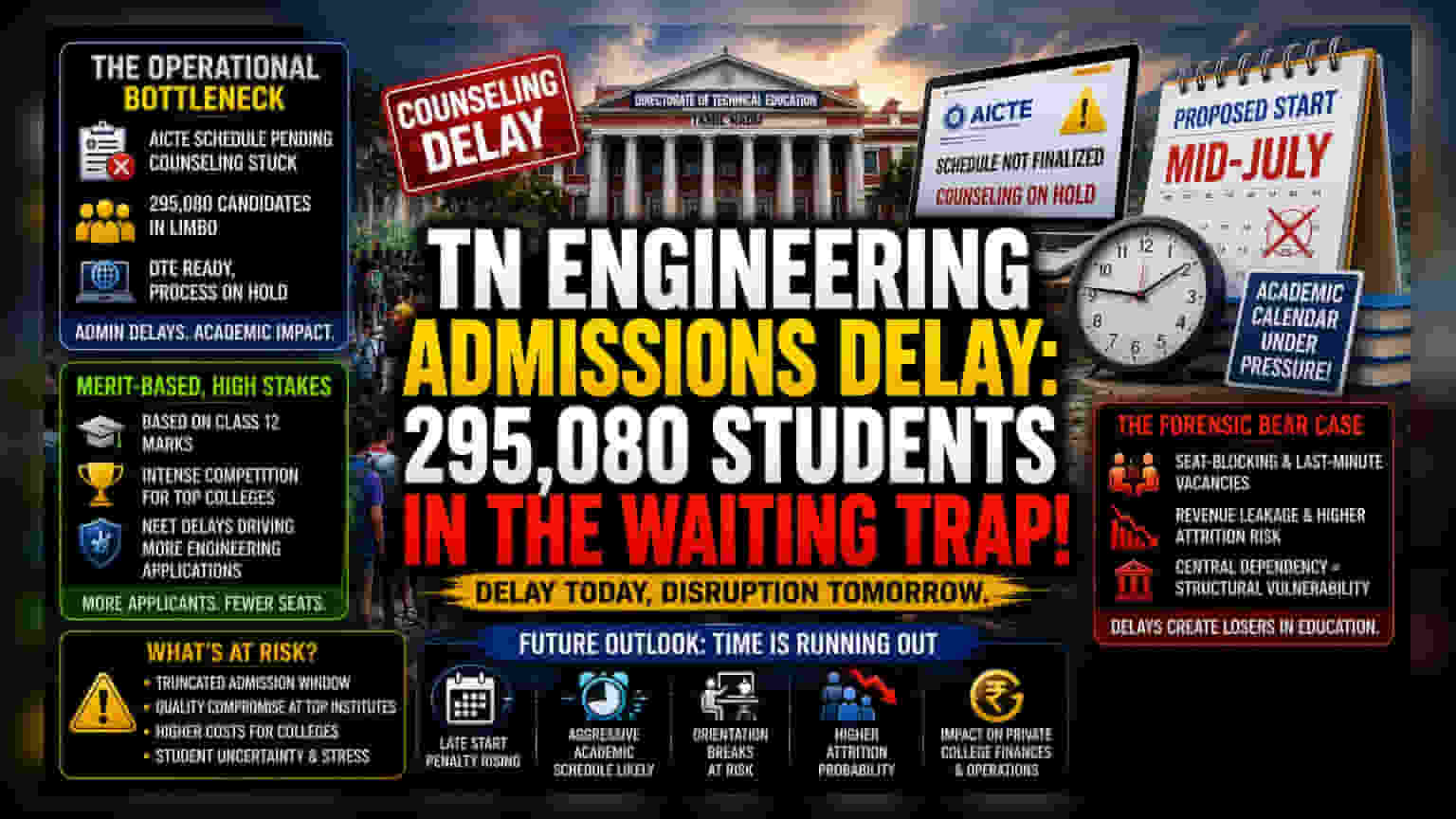


The Operational Bottleneck
Administrative friction between regional education authorities and central regulatory bodies has created a critical impasse for the state’s technical education sector. While the Directorate of Technical Education remains prepared to initiate the online counseling process, the absence of a finalized schedule from the All India Council for Technical Education has effectively frozen the placement of roughly 295,080 registered candidates. This administrative inertia threatens to erode the efficiency of the state’s centralized admission system, which typically relies on a strictly regimented, mark-based selection cycle.
Market Dynamics and Capacity Constraints
Unlike professional education systems in other regions that utilize standardized national entrance testing for engineering, Tamil Nadu relies on a merit-based system weighted heavily by Class 12 board performance. The current volume of applications suggests an intensifying competition for seats at top-tier autonomous institutions. When admission windows compress, premium colleges often experience a decline in student quality as the scramble for placements favors rapid enrollment over deliberate selection. Furthermore, the correlation between NEET-related delays and increased engineering interest points to a defensive academic strategy by students, who are diversifying their options to hedge against the volatility of national medical entrance timelines. Private engineering conglomerates and university groups are likely to face increased operational costs as they manage a truncated onboarding process for incoming freshmen.
The Forensic Bear Case: Structural Risks
From a risk perspective, this delay exposes significant vulnerabilities in the state’s educational infrastructure. Prolonged admission cycles often lead to a 'seat-blocking' phenomenon, where students provisionally hold spots at multiple private institutions, only to vacate them at the last moment. This creates artificial demand metrics that can lead to inefficient faculty hiring and capital allocation for private college operators. Historically, institutions that fail to convert their waitlists efficiently during delayed cycles face significant revenue leakage in their first-year intake. Moreover, the reliance on a single regulatory approval point suggests a lack of autonomy in the state’s technical education governance, making the entire sector susceptible to central-level bureaucratic externalities that ignore local institutional requirements.
Future Outlook and Academic Continuity
If the counseling process does not commence by the proposed mid-July target, the academic calendar will face extreme pressure to maintain credit-hour requirements for the upcoming year. Educational analysts anticipate that institutions may be forced to eliminate customary orientation breaks and shift to an aggressive mid-semester schedule to catch up. For stakeholders involved in the financing and management of private technical universities, the immediate outlook remains cautious, as the probability of a late-start penalty—characterized by higher student attrition and logistical fatigue—is rising.