

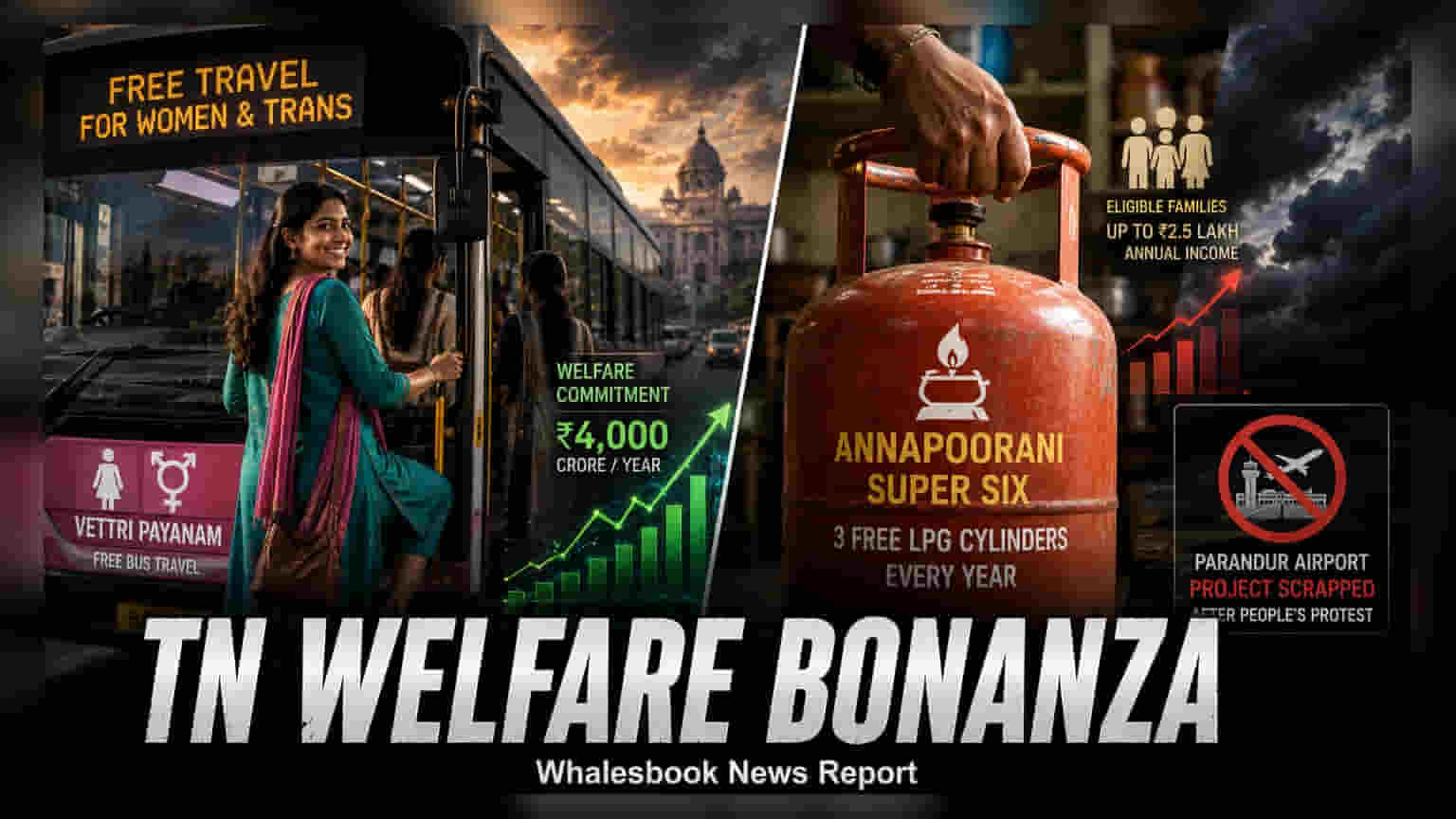
Tamil Nadu Chief Minister C. Joseph Vijay has announced free LPG cylinders for low-income households and expanded free bus travel, costing approximately ₹4,000 crore annually. While these measures aim to support families, the state’s high debt levels raise questions about fiscal sustainability. Additionally, the government has officially cancelled the proposed Parandur greenfield airport project following local opposition.
Tamil Nadu Chief Minister C. Joseph Vijay has unveiled a series of major policy decisions, introducing new welfare schemes while simultaneously cancelling a high-profile infrastructure project. The announcements include the 'Annapoorani Super Six' initiative, which will provide three free cooking gas cylinders annually to eligible families earning up to ₹2.5 lakh, and the 'Vettri Payanam' scheme, which significantly widens the scope of free bus travel for women and transgender persons to include deluxe, express, and mofussil services.
These welfare expansions, expected to be implemented starting from late 2026 and early 2027, reflect the government's focus on social support. However, these decisions carry a notable financial implication. The government estimates an annual budgetary outlay of approximately ₹4,000 crore to sustain the LPG subsidy alone. Financial observers note that this adds further pressure to the state's exchequer, which is already managing a significant debt burden. Balancing these social expenditures with the need to maintain fiscal discipline remains a primary challenge for the state administration.
In a separate move, the government has officially decided to scrap the proposed Parandur greenfield airport project. The decision follows prolonged opposition from local farmers and residents who raised concerns over the acquisition of agricultural land. While the cancellation responds to community demands, it also leaves the Chennai region without a clear path forward for planned aviation infrastructure, forcing the government to explore alternative sites to meet future capacity needs.
For the state’s financial outlook, the coming quarters will be critical. Investors and analysts are expected to track how the government manages the fiscal deficit amidst these new spending commitments. The success of these schemes will depend not only on their implementation via the Direct Benefit Transfer (DBT) mechanism but also on the state's ability to generate sufficient revenue to fund them without compromising on essential capital spending.