

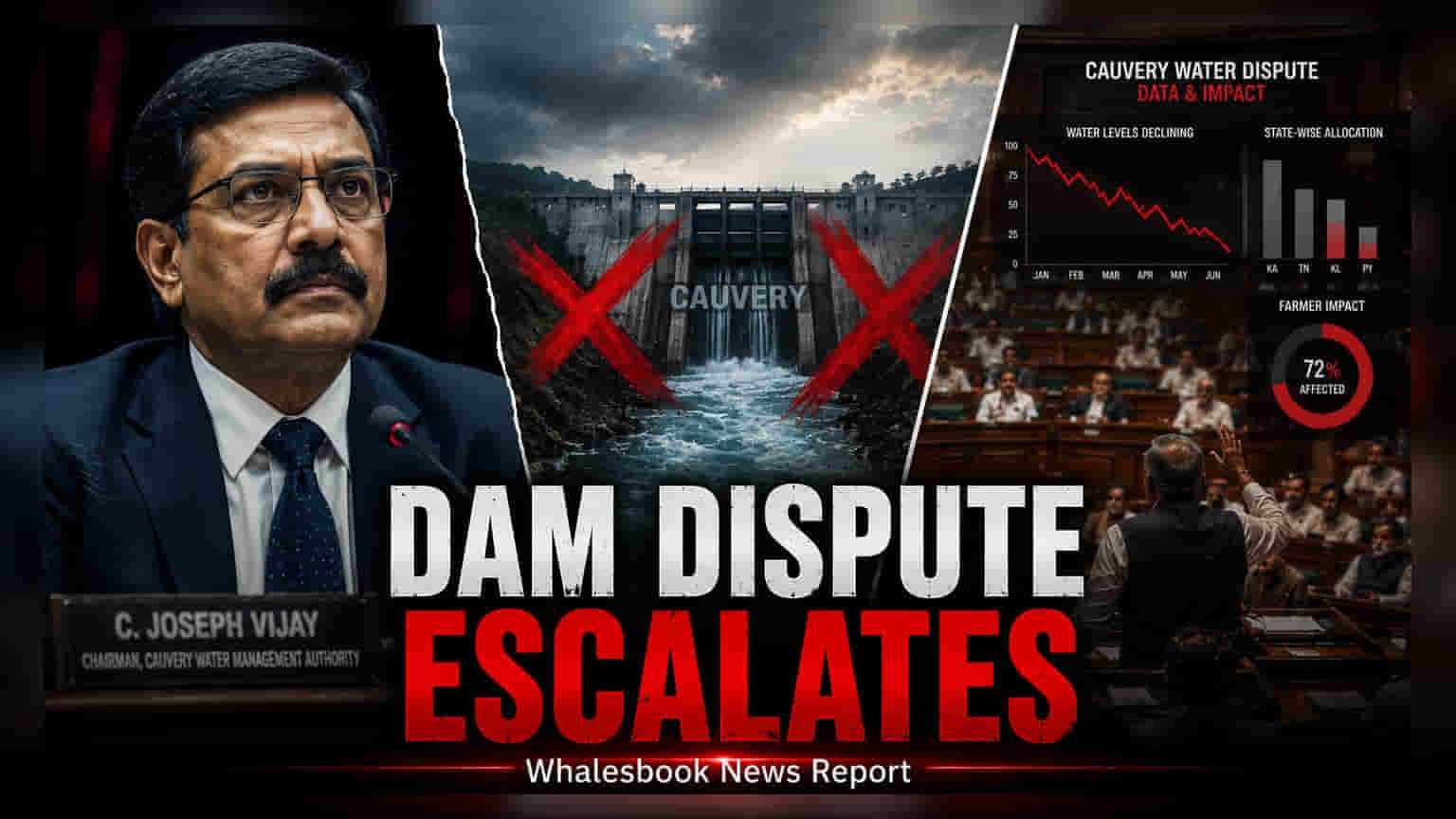
Tamil Nadu Chief Minister C. Joseph Vijay has urged the Centre to withdraw its recent Rajya Sabha statement regarding the Mekedatu dam. He demands that any project approvals must strictly follow the Cauvery Water Disputes Tribunal award and Supreme Court rulings to protect the water rights of downstream states.
Detailed Coverage
Tamil Nadu Chief Minister C. Joseph Vijay has formally expressed strong disagreement with the Union government’s recent position concerning the proposed Mekedatu dam project in Karnataka. In a communication addressed to Prime Minister Narendra Modi, Vijay criticized the government’s recent reply in the Rajya Sabha, labeling it as disappointing and requesting its immediate withdrawal.
The core of the conflict centers on the regulatory and legal requirements for water-sharing projects involving inter-state rivers. Vijay argued that the statement provided by the Minister of State for Jal Shakti in the Rajya Sabha incorrectly suggested that there is no explicit requirement for a lower riparian state, such as Tamil Nadu, to provide consent for structures built across the Cauvery. The Chief Minister maintained that this interpretation overlooks established legal precedents and Supreme Court directives that govern inter-state river water management.
Legal Precedents and Regulatory Hurdles
To support his position, Vijay cited specific legal instances, including the Supreme Court’s ruling in the Alamatti dam case, which required prior consent from lower riparian states. Furthermore, he highlighted Clause XVIII of the Cauvery Water Disputes Tribunal award, which was later affirmed by the Supreme Court. This clause mandates that states may regulate water flow within their territories only if such actions do not conflict with the Tribunal's final order.
From a project development perspective, the Mekedatu dam proposal has faced significant regulatory scrutiny. The Central Water Commission previously returned the Detailed Project Report submitted by Karnataka in 2019, specifically requiring revisions to ensure compliance with the Tribunal’s water-sharing award. This history underscores that regulatory and legal clearance for such large-scale infrastructure projects remains a complex and lengthy process involving multiple environmental and inter-state stakeholders.
Impact on Regional Governance and Irrigation
For investors and stakeholders observing the southern Indian infrastructure and agricultural sectors, the Mekedatu project represents a significant point of policy uncertainty. The Cauvery River remains the primary source of water for agricultural and industrial activity across large parts of Tamil Nadu and Karnataka. Any shift in water flow or regulated release patterns can have direct implications for irrigation capacity and, by extension, the economic stability of the regions dependent on the river.
The political climate remains tense as debates continue over whether diplomatic dialogue between state leaders can resolve the long-standing water-sharing disagreements. For now, the primary monitorable for this issue is whether the Union government adjusts its stated position in parliament or if further legal challenges are initiated in the Supreme Court to clarify the necessity of downstream state consent for the project.