

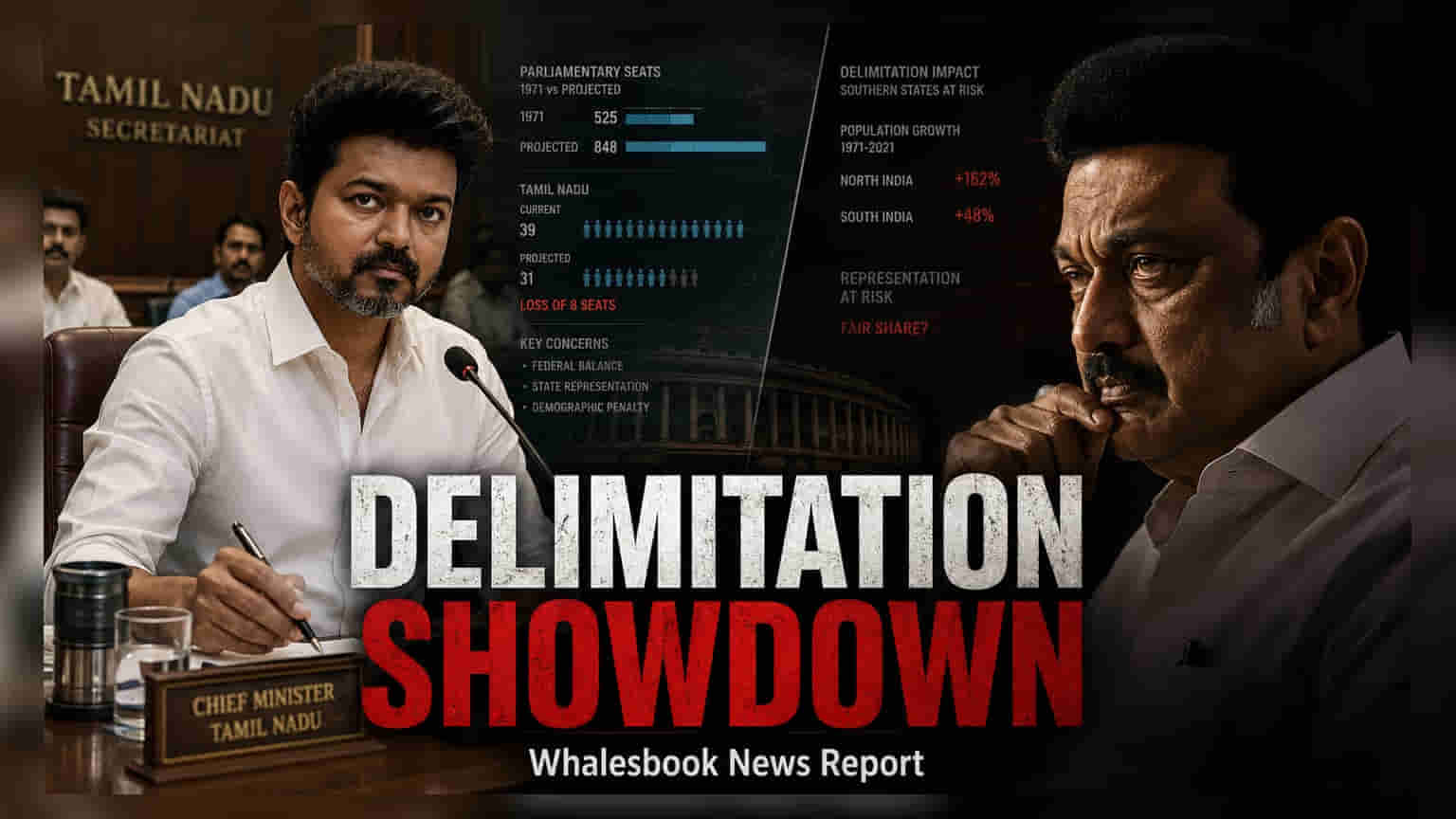
Tamil Nadu Chief Minister C. Joseph Vijay held a meeting with MPs on August 8, 2026, to discuss the central government's delimitation proposal. Major opposition parties, including the DMK, AIADMK, and DMDK, boycotted the event, demanding immediate focus on the Mekedatu dam issue. This political divide highlights ongoing tensions regarding state representation and administrative cooperation.
On August 8, 2026, Tamil Nadu Chief Minister C. Joseph Vijay convened a meeting with the state's Members of Parliament at Kalaivanar Arangam in Chennai. The discussion centered on the Union government's proposed delimitation exercise, which involves redrawing parliamentary constituencies. The Chief Minister aimed to form a unified state response to protect Tamil Nadu’s representation in Parliament.
However, the meeting faced significant opposition, as key parties including the Dravida Munnetra Kazhagam (DMK), All India Anna Dravida Munnetra Kazhagam (AIADMK), and Desiya Murpokku Dravida Kazhagam (DMDK) boycotted the proceedings. The opposition parties argued that the state government should have prioritized the Mekedatu dam issue—a long-standing water dispute with the neighboring state of Karnataka—over the delimitation discussion.
While the meeting continued with representatives from the Congress, VCK, CPI, CPI(M), and IUML, the absence of major opposition parties marks a deepening political rift. Delimitation is a sensitive topic for many southern states, where concerns persist that effective population control measures should not lead to a reduction in their political weight in national decision-making.
From a macro perspective, political stability and consensus-building are essential for a state’s administrative efficiency and its ability to engage effectively with the Union government. When major political factions in a state are divided on critical administrative and federal issues, it can create challenges for long-term policy execution and inter-state negotiations. For observers and stakeholders in the region, such political friction is a reminder of the complex federal challenges that can impact administrative priorities.
The state government’s ability to navigate these tensions while balancing immediate infrastructure and resource disputes will be the key factor to watch. Future developments will depend on how the administration addresses the Mekedatu water dispute and whether it can build a broader political consensus on the delimitation issue as the federal process moves forward.