 Whalesbook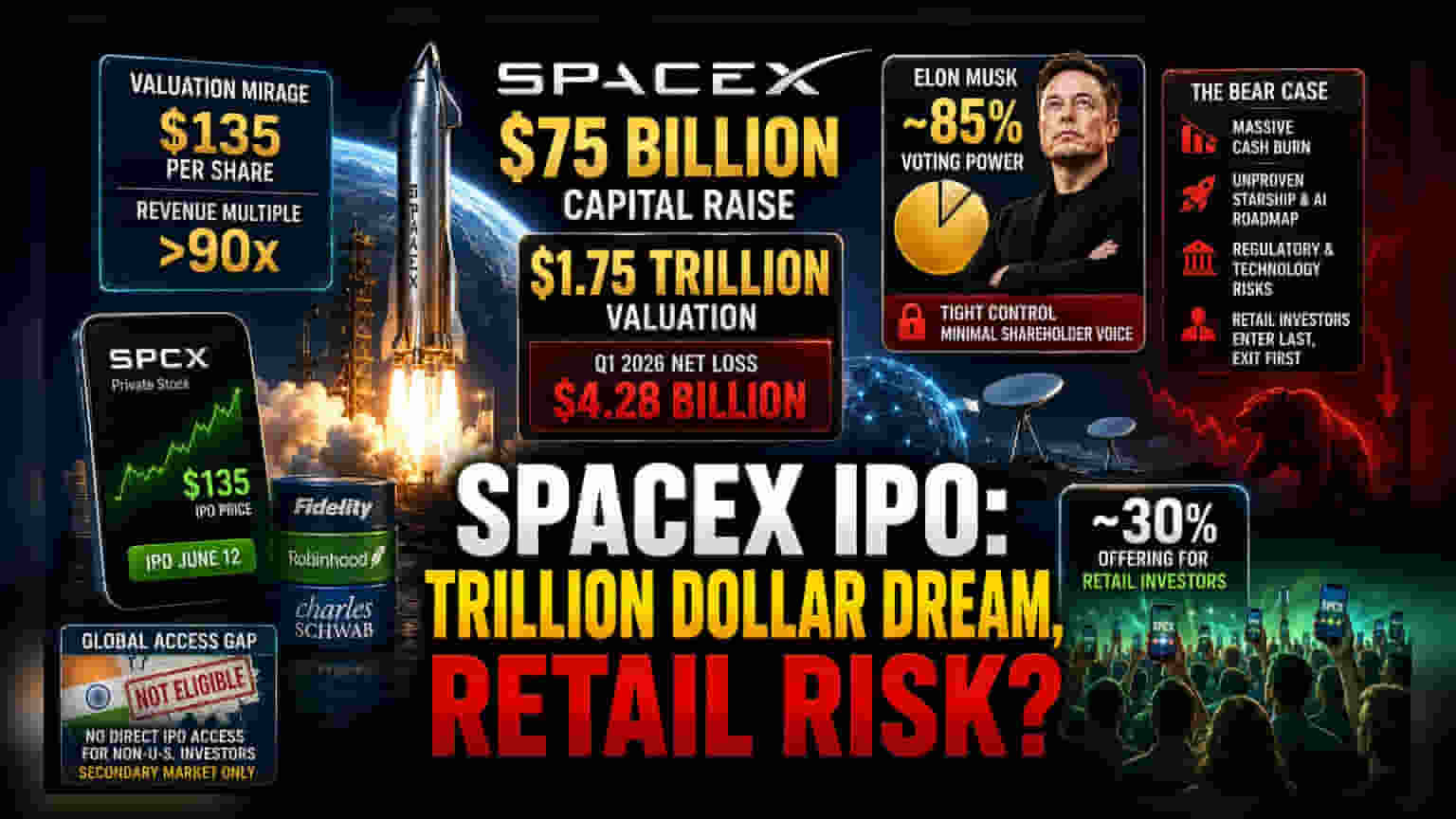


The Valuation Mirage
SpaceX’s upcoming $75 billion capital raise represents more than just a massive liquidity event; it is a fundamental test of market appetite for capital-intensive, loss-making growth. Pricing at $135 per share, the company arrives at a $1.75 trillion valuation—a figure that places it in direct competition with the largest global tech incumbents. Despite this gargantuan market cap, the company posted a $4.28 billion net loss in the first quarter of 2026 alone, driven by heavy expenditure in its newly consolidated AI division. This valuation implies a revenue multiple exceeding 90x, a premium that assumes flawless execution across Starlink, launch services, and orbital AI infrastructure.
The Retail Experiment
Unlike traditional Wall Street debuts where retail investors are relegated to picking up scraps post-listing, SpaceX has reserved approximately 30% of its offering for individual participants. This structural shift, facilitated by platforms like Fidelity, Robinhood, and Charles Schwab, aims to democratize access. However, this level of retail allocation is often viewed by institutional analysts as a potential indicator of tepid demand from major funds. For the average investor, the euphoria surrounding the ticker SPCX masks the reality that they are participating in an offering where the vast majority of equity remains tightly controlled by Elon Musk, who retains roughly 85% of voting power.
The Forensic Bear Case
Investors must look past the Starlink growth narrative to the structural risks inherent in the prospectus. The integration of xAI into the core SpaceX entity has introduced significant accounting complexity and a massive quarterly cash burn. Critics point out that the company’s valuation is decoupled from near-term profitability, relying heavily on the success of Starship and unproven orbital data center models. Furthermore, the governance structure provides shareholders with virtually no voice in strategic pivots. If the aggressive rollout of its AI and satellite roadmap faces regulatory hurdles or technological setbacks, the stock’s premium could evaporate quickly, leaving retail buyers—who are often the last to enter and first to panic-sell—holding the bag.
The Global Accessibility Gap
For investors outside the U.S., particularly in India, the exclusion from the IPO allocation process is a mechanical certainty. The U.S. book-building mechanism lacks a direct equivalent to India's ASBA process, effectively locking out direct participation at the $135 offering price. International investors are limited to secondary market purchases via LRS-enabled platforms after the June 12 listing. By the time these channels are active, the initial retail supply-demand imbalance may have already pushed the market price well above the IPO floor, limiting the potential for early-stage alpha.