

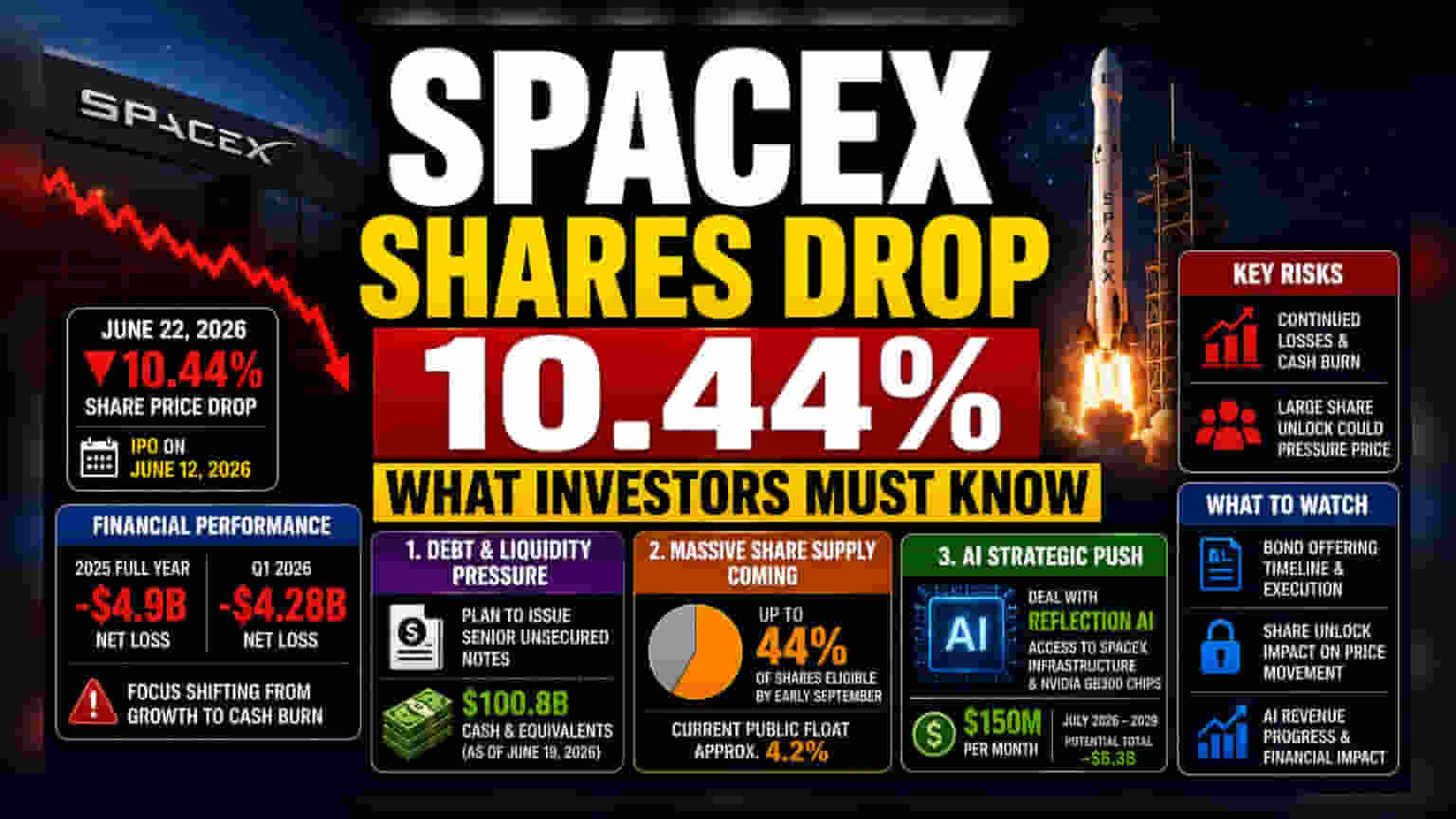
SpaceX shares fell over 10% on Monday as investors re-evaluated the company's valuation following heavy losses in 2025 and the first quarter of 2026. The market is also reacting to plans for a new debt offering and the potential for a large release of insider shares, which may increase the supply of stock available for trading.
What Happened
SpaceX shares saw a sharp decline of 10.44% by the close of trading on Monday, June 22, 2026. This drop adds to the selloff pressure following the company's initial public offering (IPO) on June 12, which had initially drawn significant interest. Investors are currently recalibrating their expectations for the space technology firm as concerns regarding profitability and upcoming changes to the stock's supply take center stage.
Financial Performance and Investor Sentiment
Much of the early excitement surrounding the company was linked to the track record of its leadership and the potential of its technology. However, recent financial data has tempered some of that enthusiasm. The company reported a net loss of $4.9 billion for the full year 2025, followed by another loss of $4.28 billion in the first quarter of 2026. This consistent unprofitability has led investors to closely scrutinize the company's valuation, moving the focus from growth potential to the current speed of cash burn.
The Liquidity and Share Supply Risk
Beyond the financial losses, two specific factors are creating pressure on the stock price. First, the company announced a plan to issue senior unsecured notes. While SpaceX reported having $100.8 billion in cash and equivalents as of June 19, the decision to raise debt suggests a move to manage cash needs and existing borrowings.
Second, the market is monitoring a significant event related to share availability. Reports indicate that up to 44% of SpaceX shares could become eligible for trading by early September. This is a substantial jump from the current public float of approximately 4.2%. When a large number of shares held by insiders become available to trade, it can create supply pressure, as the sudden increase in the number of shares can sometimes lead to lower prices if demand does not match the new supply.
Strategic Pivot: The AI Venture
Amidst these stock market challenges, the company continues to push forward with its artificial intelligence business. It has secured a deal with the startup Reflection AI. Under this agreement, Reflection AI will gain access to SpaceX's infrastructure and advanced Nvidia GB300 chips. The deal is valued at $150 million per month from July 2026 through 2029, with a potential total value of around $6.3 billion. This move represents a strategic effort to diversify revenue streams outside of its core space operations.
What Investors Should Track
Investors will likely watch several key updates in the coming months. The most immediate is the timeline and execution of the bond offering. Additionally, the market will monitor how the company handles the upcoming share unlock phase, as the increase in tradable shares can significantly influence price movement. Finally, tracking the progress of the AI-related revenue streams will be important to see if they can help improve the company's overall financial health and offset the losses seen in its space operations.