 Whalesbook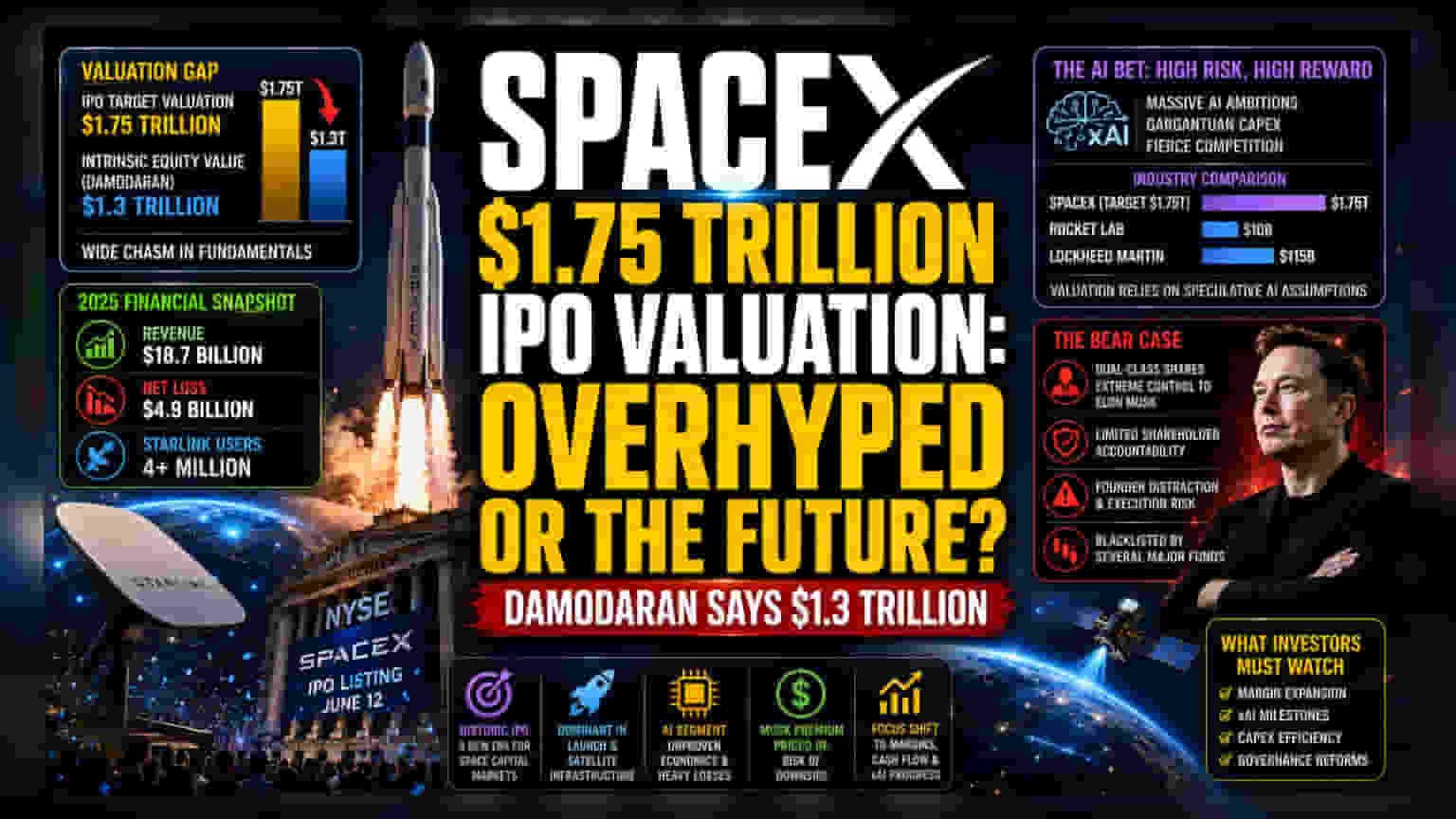


The Valuation Gap
The market debut of SpaceX marks a historic moment for capital markets, yet the wide chasm between the company’s $1.75 trillion target valuation and independent fundamental assessments remains a critical focal point. Financial analysis from valuation authority Aswath Damodaran reinforces the skepticism felt by institutional observers, pegging the firm's intrinsic equity value closer to $1.3 trillion. This discrepancy is largely rooted in the company's aggressive expansion into artificial intelligence, where heavy capital expenditures and fierce competition challenge the narrative-driven premiums currently applied by prospective investors.
Analytical Deep Dive: The AI Pivot
SpaceX has rapidly transitioned from a focused aerospace entity into an integrated AI and satellite infrastructure provider. While the 2025 revenue of $18.7 billion demonstrates strong execution in Starlink connectivity, the enterprise is increasingly dependent on the xAI business unit. Unlike the launch and satellite segments, which benefit from established cost advantages and growing recurring revenues, the AI arm requires gargantuan reinvestment. Damodaran’s assessment specifically critiques the total addressable market assumptions cited in the IPO prospectus, which he characterizes as speculative. When benchmarking against emerging rivals like Rocket Lab, which maintains a more specialized focus, or legacy defense contractors, the valuation premium assigned to SpaceX relies heavily on the assumption that it can maintain its first-mover status while simultaneously scaling a loss-making AI division.
The Forensic Bear Case
Beyond the valuation metrics, the primary deterrent for many institutional allocators lies in the firm's governance structure. The dual-class share arrangement, which grants CEO Elon Musk effective control through super-voting shares, creates a concentration of power that some pension funds and governance experts have labeled extreme. This setup effectively shields management from typical shareholder accountability, including the ability to influence board composition or challenge strategic pivots. Furthermore, the firm's recent financial performance reveals a $4.9 billion net loss for 2025, a figure that mandates a rapid trajectory toward operational efficiency. The risk of distraction, given the founder’s multi-firm responsibilities, and the inherent volatility of launch and infrastructure projects, present a classic high-risk, high-reward profile that has already triggered blacklisting by several major investment funds.
Future Outlook and Sector Context
Looking ahead, the market reaction to the June 12 listing will hinge on whether speculative retail demand can overcome the caution voiced by seasoned valuation experts. While the sheer scale of the IPO and the firm's market-making potential in space and connectivity are undeniable, the focus will soon shift from the initial excitement to quarterly margin expansion and the tangible economic viability of the xAI segment. Analyst consensus suggests that while long-term growth prospects are high, the current entry price likely incorporates a significant "Musk premium" that may face downward pressure if the company fails to deliver consistent progress against its aggressive AI development milestones.