 Whalesbook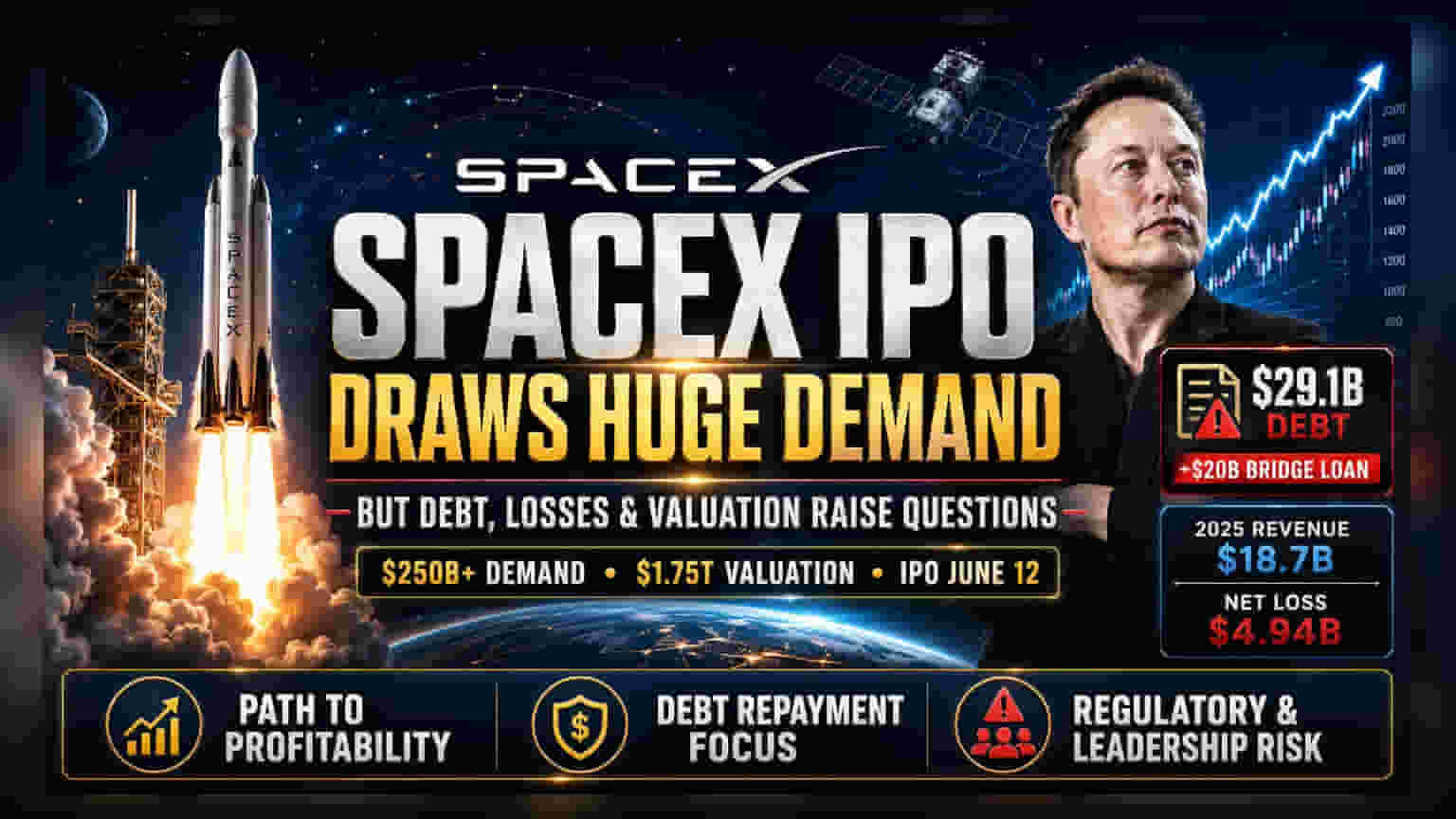


SpaceX is set to launch its IPO on June 12 with a massive $1.75 trillion valuation. While demand is high, the company faces financial challenges, including a $4.94 billion net loss in 2025 and $29.1 billion in total debt. A major concern for investors is that a large portion of the money raised will go toward paying off a $20 billion bridge loan rather than fueling growth. Investors are also watching risks related to Elon Musk’s time management and potential regulatory hurdles.
What Happened
SpaceX, the aerospace company led by Elon Musk, is preparing for its initial public offering (IPO) scheduled for June 12. The market interest is substantial, with demand reportedly crossing the $250 billion mark. However, this excitement is balanced against an ambitious valuation of $1.75 trillion and a complex financial picture that investors are now evaluating closely.
The Financial Reality Check
While SpaceX continues to report high revenue—hitting $18.7 billion in the 2025 fiscal year—the company is not yet profitable. It posted a net loss of $4.94 billion for the year, which is a sharp change from the profit of $791 million seen the previous year. For investors, the main question is the path to profitability. The company operates in a high-risk sector, and notably, it does not carry insurance for its launch vehicles or satellites, meaning it bears the full financial risk of any mission failure.
The Debt And Repayment Question
One of the most important factors for potential shareholders is the company’s debt structure. SpaceX and its units carry a total debt burden of $29.1 billion. A critical part of this is a $20 billion bridge loan taken out in March 2026. A significant portion of the capital raised from this IPO is contractually required to be used to pay off this debt within six months. This means that instead of using all the new funds for research, development, or expanding infrastructure, a large chunk will go directly to lenders. Investors may want to monitor how this debt repayment affects the company's financial flexibility after the IPO.
Leadership And Regulatory Risks
Elon Musk plays a central role in the company, holding absolute voting control. However, he also manages several other high-profile businesses, including Tesla, Neuralink, and The Boring Company. This has raised concerns about whether his attention is too divided to oversee such a capital-intensive business effectively. Furthermore, the company faces external regulatory risks. For example, recent reports have highlighted how legal issues involving Musk's other entities, such as X (formerly Twitter), have led to situations like the freezing of Starlink's assets in Brazil. Such regulatory entanglements can create uncertainty for shareholders.
Strategic Challenges In AI And Energy
SpaceX is pursuing an ambitious orbital AI computing program. Its success depends on the theory that space-based solar energy will be cheaper than electricity generated on Earth. If technology improves to make terrestrial power cheaper or more efficient, the economic logic behind these space-based data centers could be challenged. Additionally, there is uncertainty regarding how quickly the market will adopt and pay for these complex space-based AI models.
What Investors Should Track
Looking ahead, investors may focus on three key areas. First, the timeline for reducing the company's debt load is crucial to see how much cash flow will remain for actual business expansion. Second, the company’s ability to move from losses to consistent profits will be a primary measure of success. Third, ongoing updates regarding regulatory compliance and Musk’s management bandwidth will likely remain important talking points for the market. Investors will also look for clarity on how the company plans to manage its high-cost, high-risk operational model without insurance for its major assets.