 Whalesbook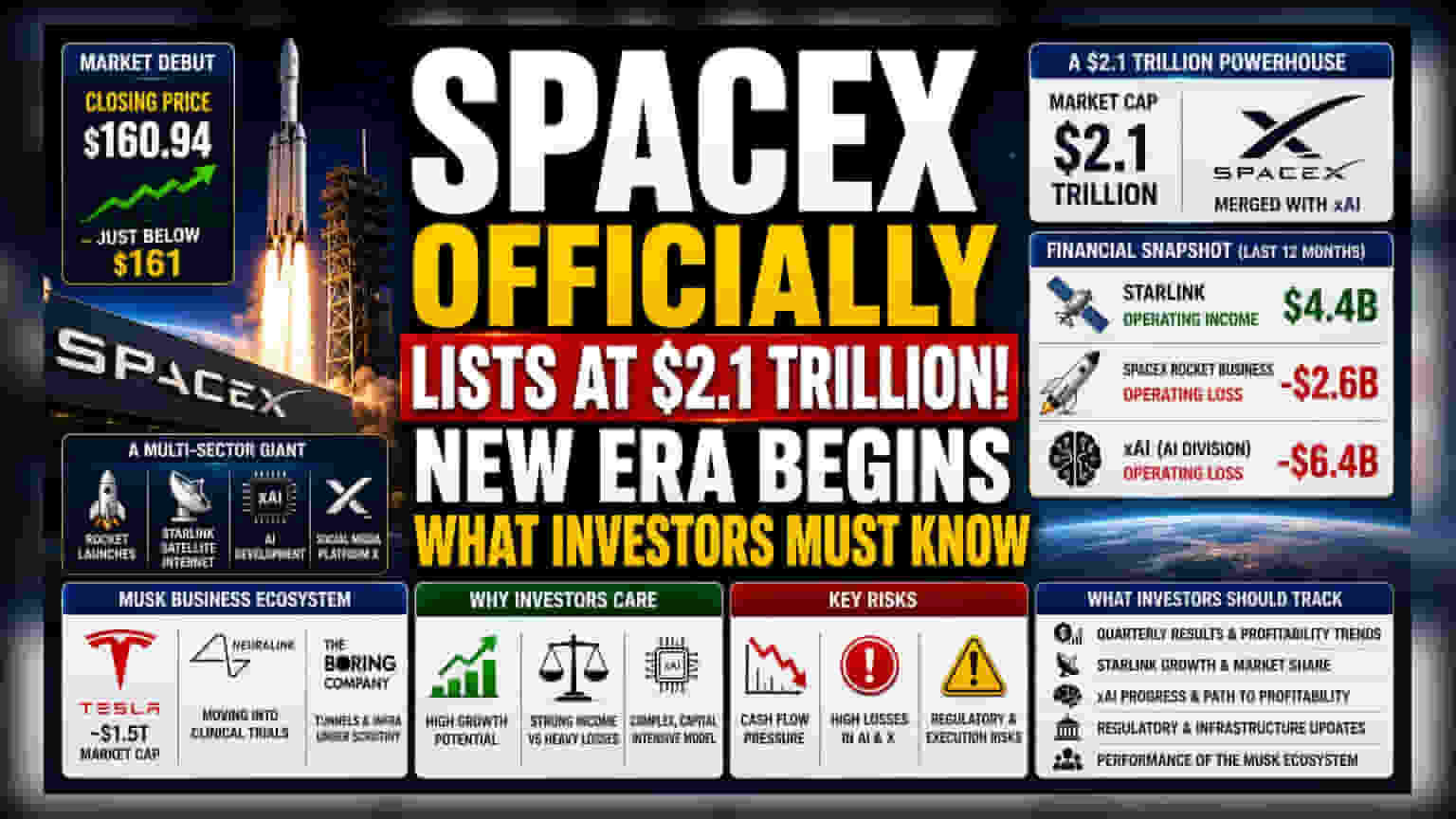


SpaceX has debuted on the public market with a $2.1 trillion valuation, making it a historic listing. Investors are now weighing the profitability of its Starlink service against significant operational losses in its AI and social media divisions.
What Happened
SpaceX officially began public trading on Friday, with its shares closing just below $161. This debut marks one of the most significant events in market history, resulting in a total market value of $2.1 trillion for the aerospace and technology company. The listing follows the company's recent merger with xAI, the artificial intelligence firm founded by Elon Musk. With this move, SpaceX has become a massive, multi-sector entity that combines rocket manufacturing, satellite internet services, and AI development under one corporate umbrella.
Why This Matters For Investors
The $2.1 trillion valuation places SpaceX among the most valuable companies globally. For investors, the most important takeaway is the mixed financial picture within this newly public giant. While the company's rocket business remains its core, its satellite internet arm, Starlink, has emerged as a major financial highlight, generating $4.4 billion in operating income over the past year. However, this success is balanced against operational losses in other areas, including a $2.6 billion loss reported by the core rocket business and a $6.4 billion loss within the xAI division last year. Investors are looking at a company that is not just a rocket maker, but a conglomerate with high-growth potential in tech and deep-value spending in emerging fields.
How Investors May Read This
The primary question for shareholders is how these different business segments will perform together. The market value suggests high expectations for future growth, particularly from Starlink. However, the heavy losses in the AI and social media units (the latter being the platform X) create a complex financial structure. Unlike companies that focus on a single, predictable revenue stream, SpaceX now carries the risks and costs associated with aggressive AI research and social media operations. Investors may compare this to other major tech giants, but with the added complexity of the aerospace and satellite infrastructure requirements.
The Bigger Business Context
SpaceX is part of a larger ecosystem of businesses controlled by Elon Musk. This includes Tesla, the electric vehicle manufacturer, which currently holds a market value around $1.5 trillion. Despite the scale of these companies, they are not immune to market pressures. Tesla has recently faced increased competition and a decline in sales, which has been linked to concerns regarding the CEO's political activities. Other ventures like Neuralink and The Boring Company add further diversity to the portfolio. While Neuralink is moving into clinical trials, The Boring Company has faced scrutiny regarding safety and environmental standards in its tunnel projects. This interconnected web of businesses means that developments in one area can potentially influence investor sentiment across the entire group.
What Could Go Wrong
There are clear risks that shareholders may track closely. First, the company's reliance on high-cost, high-tech ventures creates a need for consistent capital. If AI or satellite operations do not meet profit expectations, the company may face cash flow pressure. Second, the heavy losses in the AI and social media segments act as a drag on overall profitability. Third, the company’s diverse operations, from tunneling to brain-computer interfaces, carry unique regulatory and execution risks. For example, projects like The Boring Company's infrastructure plans have encountered previous safety concerns that could lead to delays or increased costs if regulators intervene.
What Investors Should Track
Moving forward, the key monitorables will be the profitability trend of the combined entities. Investors may watch for quarterly results that show how Starlink's income is offsetting the losses in the AI and social media divisions. The ability of the management to execute its ambitious roadmap for space travel while managing the cash drain from its other tech ventures will be critical. Additionally, any updates on regulatory hurdles for infrastructure projects or market share changes in the satellite internet sector will be important indicators of the company's health. The stability of the broader Musk-led business ecosystem, including Tesla's performance, may also continue to play a role in how the market values this new public titan.