 Whalesbook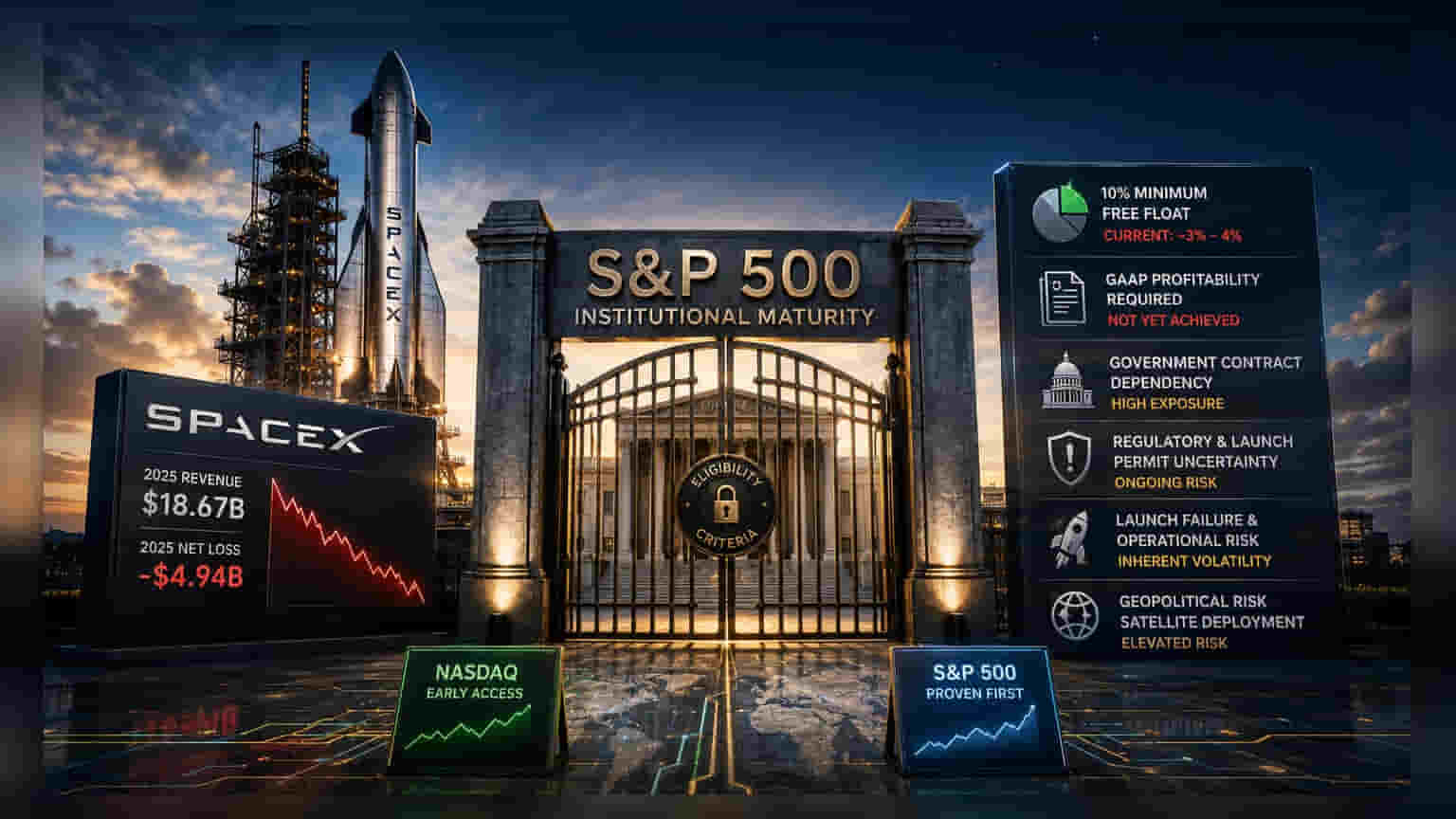


The Index Gatekeeper Effect
The decision by S&P Dow Jones Indices to adhere strictly to its eligibility criteria serves as a forceful reminder that the S&P 500 remains an index of institutional maturity rather than speculative growth. By refusing to accelerate the entry of SpaceX, index administrators have signaled that the massive liquidity pool tied to the S&P 500—totaling over $20 trillion—will remain insulated from the volatility typically associated with high-profile aerospace IPOs. This stance essentially forces SpaceX to prove its financial viability on the open market for at least four fiscal quarters before it can even be considered for inclusion, deferring any potential index-driven demand until at least mid-2027.
The Profitability Disconnect
SpaceX currently operates in a structural paradigm that conflicts with the S&P 500’s mandate for GAAP-verified profitability. While the firm’s $18.67 billion revenue print for 2025 demonstrates massive top-line expansion, the $4.94 billion net loss highlights the heavy capital expenditure required for projects like Starship and the continued build-out of the Starlink constellation. When contrasted with peers in the aerospace and defense sector, such as Lockheed Martin or Northrop Grumman, which prioritize consistent dividends and earnings per share, SpaceX represents a classic high-burn tech narrative. The market is currently pricing SpaceX based on future orbital dominance, whereas the S&P 500 eligibility committee remains tethered to bottom-line performance.
The Forensic Bear Case
The insistence on a 10% free-float requirement represents a significant hurdle that could impact long-term stock liquidity. With current expectations placing the float closer to 3% or 4%, SpaceX risks maintaining a concentrated ownership structure that could lead to erratic price action during periods of market stress. Furthermore, the reliance on government contracts and the regulatory uncertainty surrounding launch permits add layers of operational risk that standard index funds are not designed to absorb. Unlike traditional industrial titans, SpaceX faces unique exogenous risks including launch failure protocols and geopolitical constraints on satellite deployment. If management continues to prioritize growth at the expense of fiscal discipline, they may find themselves in a liquidity trap where a low free float discourages institutional participation even after they satisfy the temporal requirements for index entry.
Future Outlook
While the Nasdaq and FTSE Russell have adopted more lenient inclusion policies, the S&P 500’s refusal to pivot suggests that the benchmark intends to maintain its status as a bastion of 'proven' capital. Investors should expect the firm’s debut to be characterized by high retail enthusiasm initially, potentially disconnected from the valuation metrics that would typically define a blue-chip company. The divergence in rules between exchange-traded indexes and broad market benchmarks will likely create a bifurcation in institutional sentiment, where early-stage capital chases the SpaceX story on the Nasdaq, while the broader, conservative passive market waits for the financials to stabilize.