

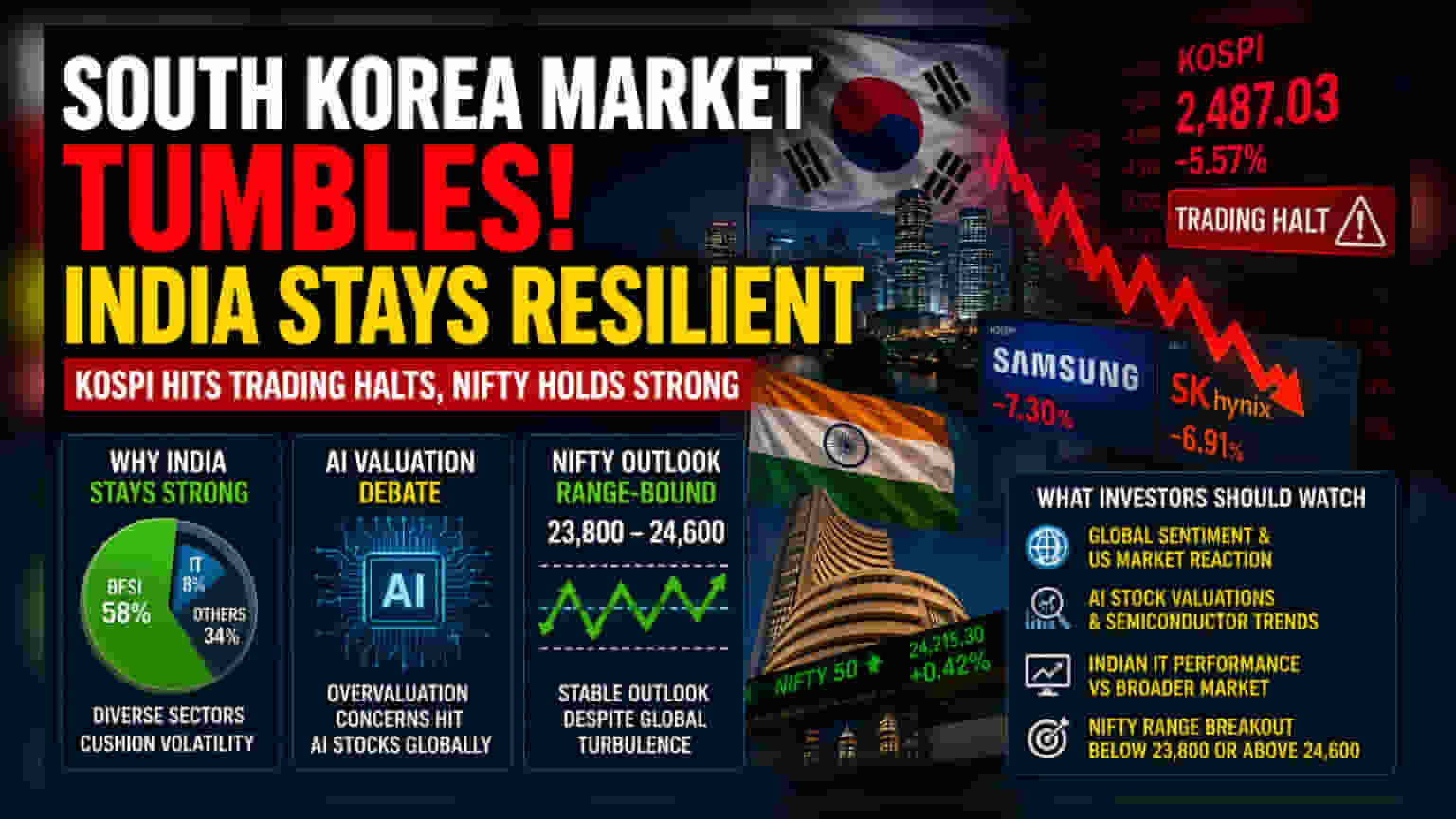
The South Korean KOSPI index saw a sharp decline and trading halts on Friday due to a tech stock sell-off. Market experts believe Indian markets will likely remain stable because the Indian Nifty index has a lower reliance on the technology sector compared to the Korean market. Analysts expect the Nifty to stay within the 23,800 to 24,600 range.
What Happened
The South Korean stock market experienced a significant drop on Friday, which triggered trading halts in the KOSPI index. The decline was largely driven by a sharp fall in major technology stocks. Investors globally are observing this volatility to see if it will affect other markets. However, financial analysts in India suggest that the spillover effect on Indian equities will be limited. The Nifty is currently expected to maintain a stable, range-bound movement between 23,800 and 24,600.
Why India Is Structurally Different
A key reason for this expected resilience is the difference in how the Indian and South Korean stock indices are built. The KOSPI index is heavily influenced by large technology companies such as Samsung Electronics and SK Hynix, both of which saw significant price drops. When these giants fall, the entire index is pulled down.
In contrast, the Indian IT sector makes up a smaller portion of the Nifty 50 index, roughly 8%. The Indian market also draws significant strength from the banking, financial services, and insurance (BFSI) sectors. This diversification acts as a cushion, protecting the Indian benchmark from the type of concentrated volatility seen in the South Korean market.
The AI Valuation Debate
Experts point out that the sell-off in South Korea is partly a correction after a long rally, particularly driven by concerns over high valuations in AI-linked stocks. There are ongoing questions globally about whether the rapid growth in AI infrastructure spending is sustainable. Since many tech giants have recently raised prices, investors are now reassessing the future demand for semiconductor and AI-related hardware.
For Indian IT firms, the situation is different. Most of these companies are still in the earlier stages of integrating AI infrastructure into their business models. Consequently, the immediate impact of the global reassessment of AI-linked semiconductor stocks is expected to be transient rather than a long-term problem for Indian IT firms.
How Investors May Read This
Market volatility in foreign indices often creates anxiety, but it is important to distinguish between market-specific events and global trends. The current situation in South Korea is highly specific to its tech-heavy index composition. For Indian investors, this highlights the value of having a diversified portfolio that does not rely solely on one sector. While short-term fluctuations are normal, the current structure of the Indian market appears to offer a degree of protection against the specific tech-led volatility seen abroad.
What To Monitor Next
The primary monitorables for investors will be the broader global sentiment and how the US markets react to the ongoing AI valuation debate. Locally, investors may watch for any shift in the performance of the Indian IT sector relative to the rest of the market. While the Nifty is expected to remain range-bound, any significant deviation from this expected trading band will be a key signal to watch.