

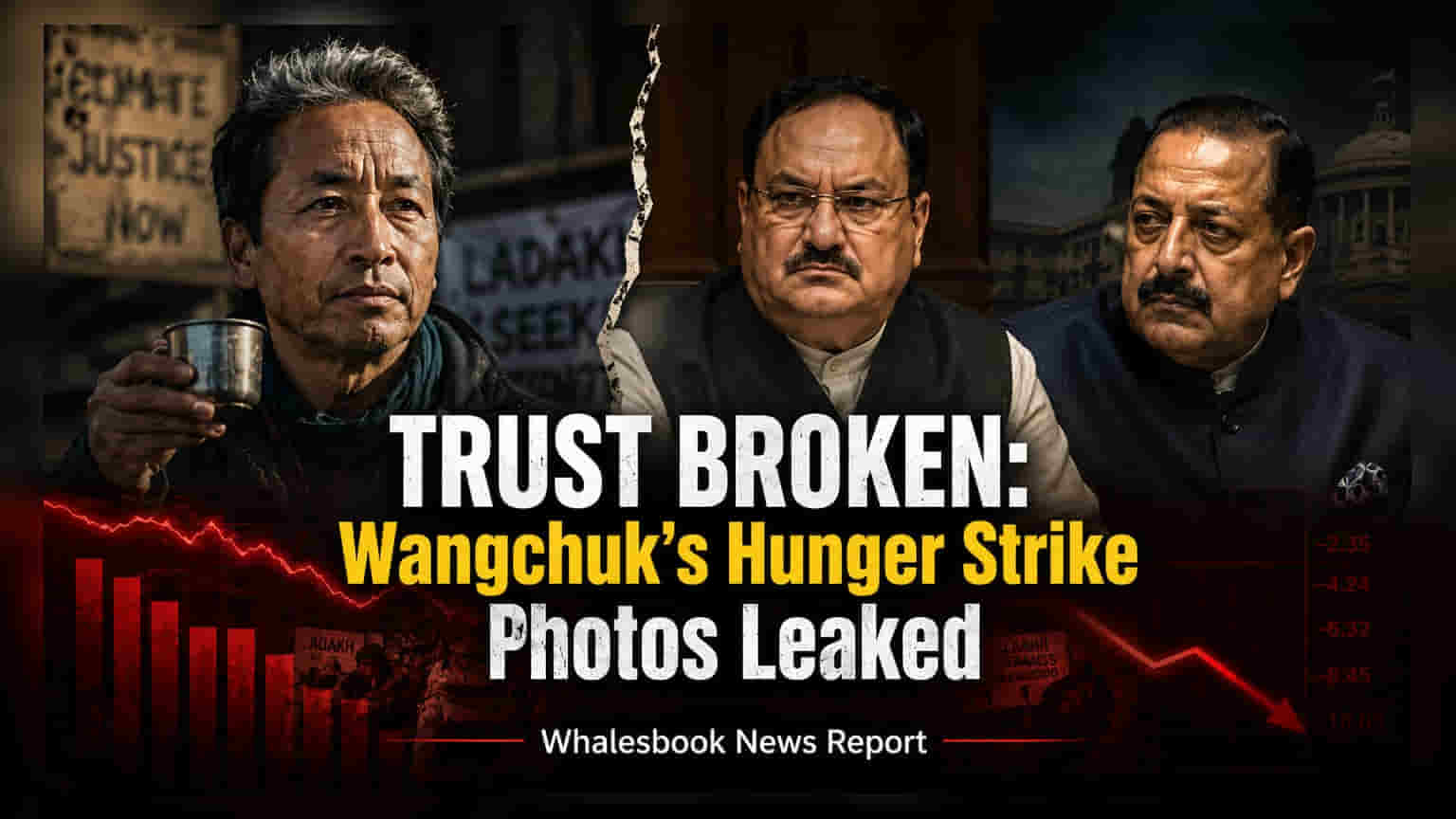
Activist Sonam Wangchuk has alleged that Union Ministers JP Nadda and Jitendra Singh violated an agreement to coordinate the release of photographs marking the end of his 26-day hunger strike. While the incident has drawn public attention, this social and political development does not involve listed companies or have a direct impact on Indian financial markets.
Activist Sonam Wangchuk has publicly expressed disillusionment, accusing Union Ministers JP Nadda and Jitendra Singh of violating an understanding regarding the release of photographs that documented the conclusion of his 26-day hunger strike. The fast, which ended on July 24, 2026, was held to highlight demands related to education system reforms and the recent NEET-UG examination irregularities.
According to the activist, there was a specific agreement in place with the ministers and intelligence officials present at the site. Wangchuk claimed that he had requested a collaborative announcement that would feature opposition and student leaders alongside the government representatives. He stated that the intention behind this condition was to ensure the end of the protest was viewed as a joint effort for the cause, rather than a political event for any single party. He alleged that this trust was broken when images of him ending the fast were released prematurely, excluding the other groups he had intended to include.
Wangchuk noted that while juice or soup is traditionally offered to end a protest fast in Ladakh, he wanted the visual record of the event to reflect a united front. He characterized the premature circulation of the photos on television channels as a violation of the understanding he reached with the ministers upon their arrival.
From an investor perspective, this development is a matter of social and political discourse and does not hold any direct relevance to the performance of companies listed on the National Stock Exchange (NSE) or the Bombay Stock Exchange (BSE). The movement and its aftermath are centered on policy advocacy, public administration, and political relations, which are distinct from the operational, financial, and regulatory factors that typically drive stock market movements. There is no evidence suggesting this incident will impact corporate earnings, sectoral indices, or overall market stability.
For those tracking the broader situation, the focus remains on whether the government will fulfill the written assurances provided to the activist during the conclusion of his strike. Future updates on this matter will likely emerge through public statements from the activist and government authorities as the implementation of those reforms progresses.