

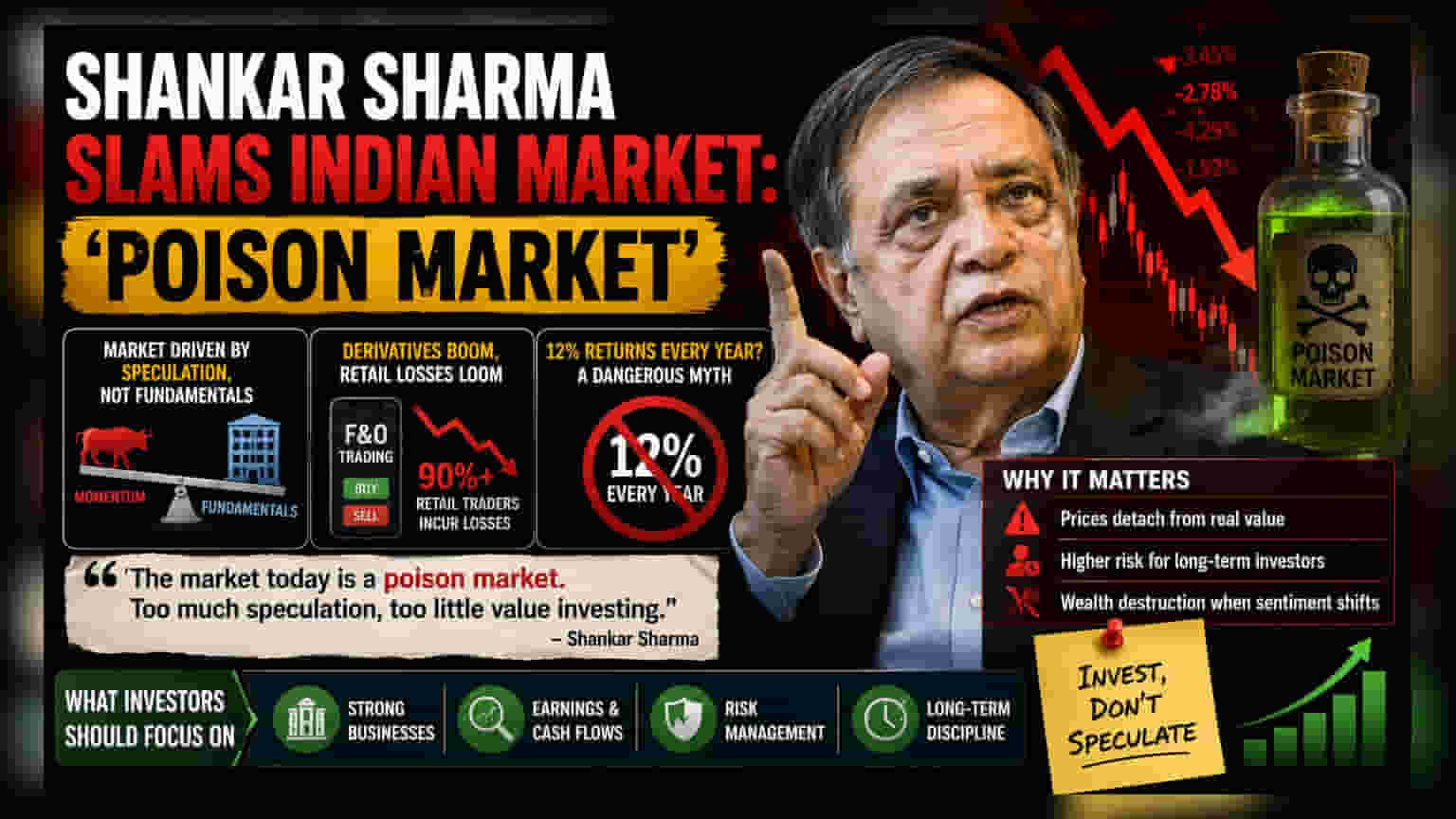
Veteran investor Shankar Sharma has described the Indian stock market as a 'poison market,' arguing that excessive speculation has overshadowed fundamental business growth. This critique highlights ongoing concerns about high derivatives trading volumes and unsustainable return expectations among retail participants. The remarks serve as a cautionary note for investors relying on market momentum rather than company performance.
What Happened
Veteran investor Shankar Sharma has voiced strong criticism of the current state of the Indian stock market, referring to it as a 'poison market.' In recent comments, he suggested that the market has become overly focused on short-term speculation rather than the long-term value of the underlying businesses. Sharma, who has tracked Indian equities for over four decades, noted that the current environment is increasingly driven by momentum rather than company fundamentals.
The Shift Toward Speculation
The central point of Sharma’s critique is the rise of speculative trading, particularly within the derivatives segment. While retail participation in the Indian markets has grown significantly over the last few years, a large portion of this activity is concentrated in Futures and Options (F&O) trading. The market regulator, the Securities and Exchange Board of India (SEBI), has frequently flagged that a vast majority of individual traders in the derivatives segment incur financial losses. Sharma’s comments echo these concerns, suggesting that the ease of access provided by modern trading apps and social media trends has encouraged a 'get-rich-quick' mindset, which he believes is detrimental to the broader market health.
Challenging Return Expectations
Beyond market structure, Sharma also addressed common beliefs regarding wealth creation. He specifically pushed back against the expectation that mutual funds or stock market investments will consistently deliver a fixed 12% annual return. He emphasized that equity investing is inherently subject to market cycles, valuations, and company-specific performance. According to Sharma, assuming steady returns is a misconception that ignores the risks of market volatility and the impact of entry pricing on long-term wealth.
Why This Matters For Retail Investors
For the average retail investor, this critique serves as a reminder to distinguish between trading and investing. Trading is often driven by price movements and technical indicators, while investing relies on the ability of a company to grow its revenue, profit, and cash flow over time. When the market is driven by speculation, prices of stocks can detach from their actual financial value. This makes it difficult for long-term investors to find companies at fair prices and increases the risk of loss when market sentiment inevitably shifts.
What Investors Should Track Next
Investors may want to track how regulatory bodies like SEBI continue to manage the growth of the derivatives segment. Increased rules on trading or higher margin requirements could cool down speculative activity. Additionally, the focus remains on whether companies can continue to deliver strong earnings growth to justify current market valuations. As market conditions evolve, the key for retail participants remains a focus on financial discipline, company balance sheets, and long-term time horizons rather than chasing short-term market trends.