

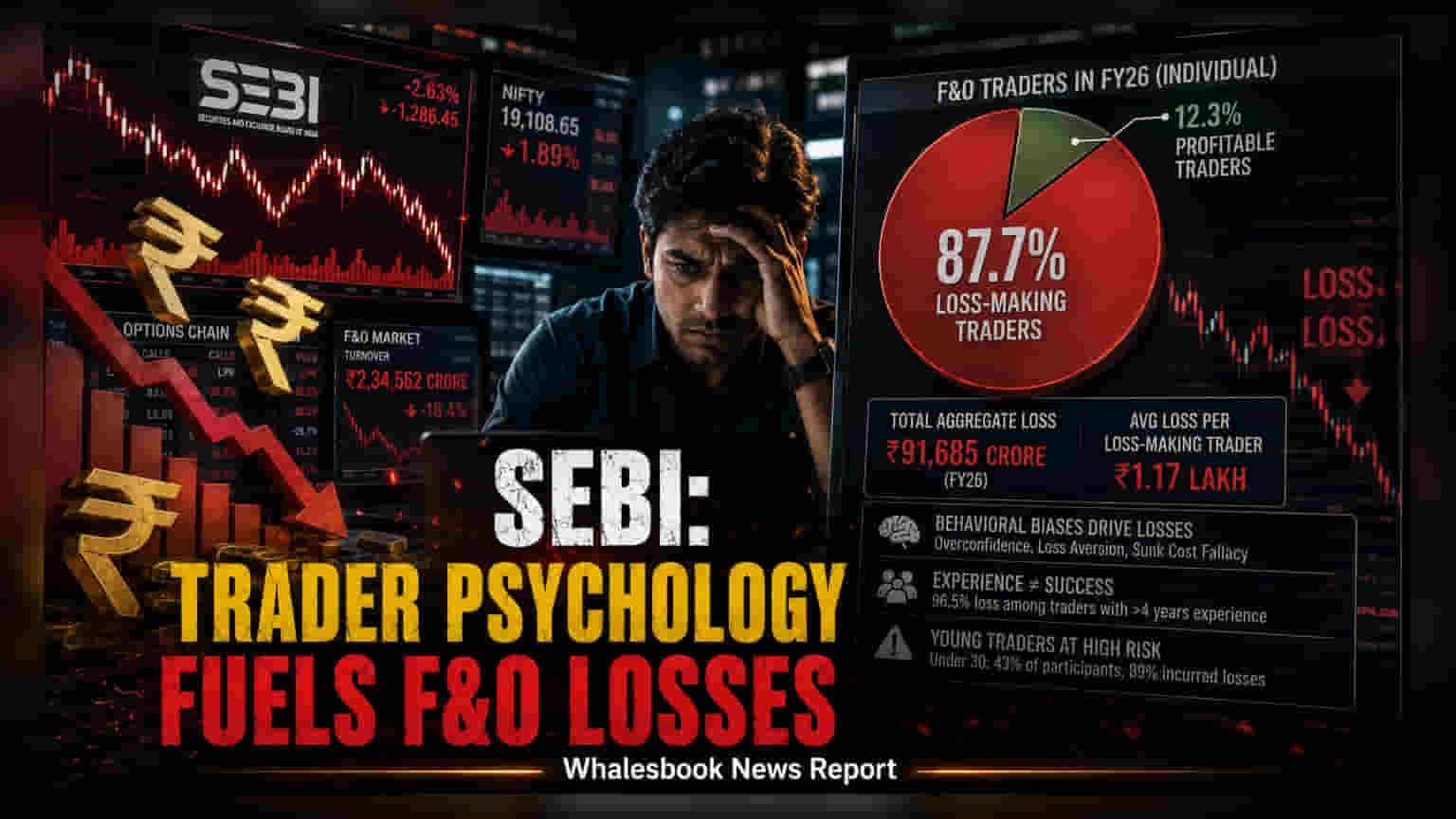
SEBI’s latest study reveals that 87.7% of individual traders in the equity derivatives segment faced net losses in FY26, totaling ₹91,685 crore. The regulator highlights that behavioral biases, rather than market risk alone, are the primary drivers of these financial outcomes, urging traders to reconsider their approach to derivatives.
The Securities and Exchange Board of India (SEBI) has released comprehensive data analyzing trading patterns in the equity derivatives segment for the fiscal year 2026. The findings paint a challenging picture for individual retail participants, revealing that 87.7% of individual traders incurred net losses during the year. While the total aggregate loss for retail traders fell to ₹91,685 crore from ₹1.12 lakh crore in the previous year, the high percentage of loss-making accounts remains a significant concern for the market regulator.
The Psychology Behind Losses
The study suggests that financial losses in derivatives are not merely a result of market volatility, but are heavily influenced by behavioral biases. A key finding is the preference for 'lottery-like' options. Many traders treat low-cost options as lottery tickets, consistently choosing high-risk, low-probability trades. This behavior is compounded by overconfidence and the tendency to attribute gains to personal skill while blaming market conditions for losses.
Furthermore, the data challenges the belief that experience leads to better performance. In fact, the report indicates that the longer a trader stays in the market, the higher the likelihood of sustained losses. Among traders with one year of experience, 91% incurred losses. This figure rose to 96.5% for those who had been active for over four years. This trend suggests that instead of learning and improving, many traders are doubling down on losing positions, a behavior often fueled by the 'sunk cost fallacy'—the refusal to stop trading because of past investment.
High Intensity and Concentration Risk
The research also points to a disparity between retail participants and professional players. While individual traders struggle to generate consistent returns, proprietary trading desks and foreign portfolio investors (FPIs) continue to capture the majority of gross profits in the F&O segment.
For many retail participants, derivatives trading is not just a side activity but a core financial strategy. The average loss per loss-making trader climbed to approximately ₹1.17 lakh in FY26. Younger traders, particularly those under the age of 30, accounted for a significant portion—43%—of the total participants, with nearly 89% of this group recording net losses. This high trading intensity and turnover relative to available capital are strongly associated with poorer financial outcomes.
Regulatory Focus and Future Steps
To address these structural issues, SEBI is looking beyond standard risk warnings. The regulator is proposing behavioral nudges to help traders manage their risks better. These include implementing mandatory, clear profit and loss statements at the time of login, conducting appropriateness tests for new entrants, and introducing self-set loss limits. The goal is to shift the perception of derivatives trading from an open-ended, lottery-style activity to a disciplined, budgeted expense. Investors and traders may monitor future exchange circulars for the implementation of these measures, as they are likely to change how derivatives accounts are managed and monitored.