

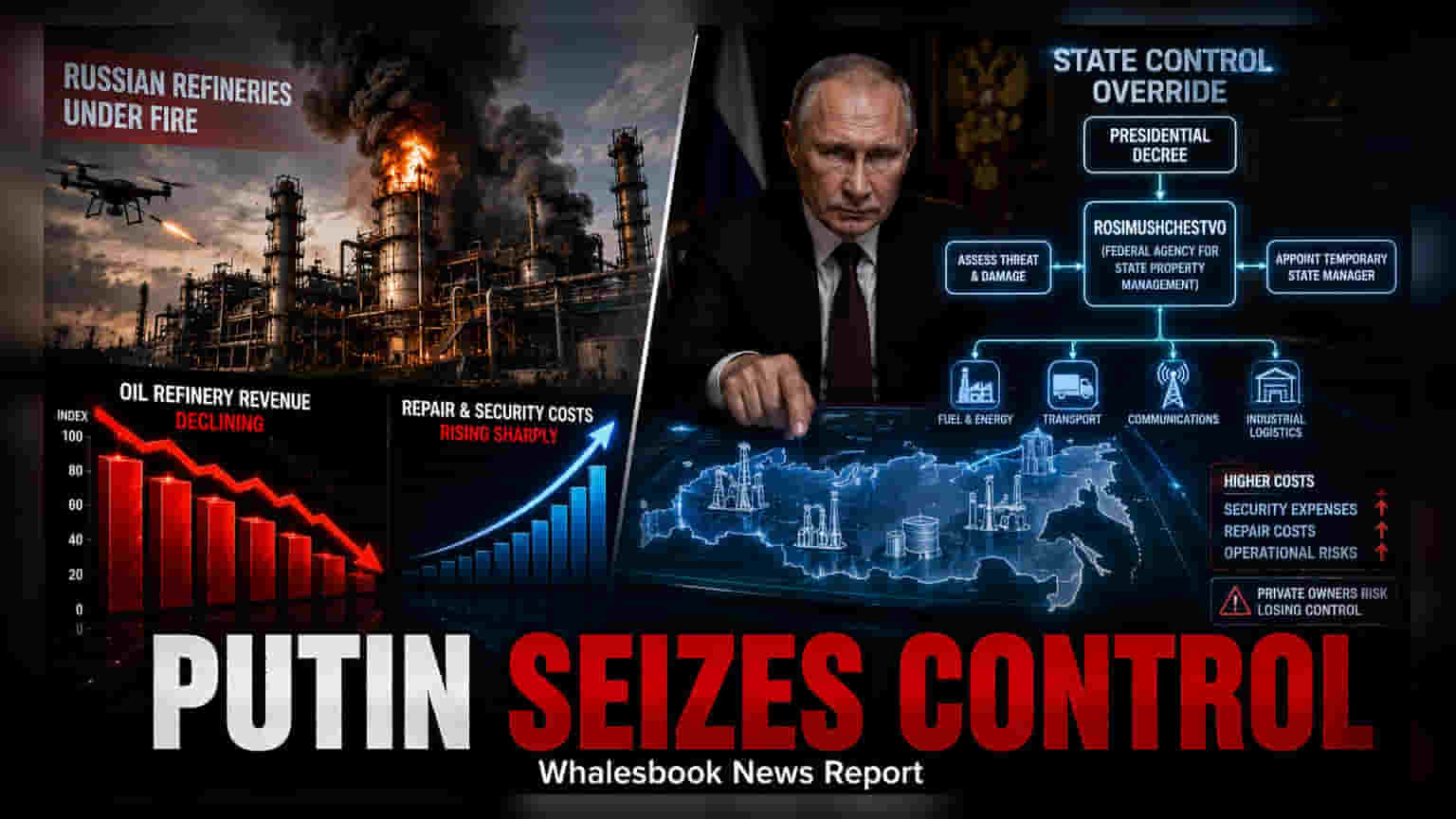
President Vladimir Putin has signed a decree enabling the government to take temporary control of critical infrastructure if private owners fail to secure or repair facilities after drone attacks. This measure introduces significant operational risks for companies in energy, transport, and industrial sectors.
Russian President Vladimir Putin signed a decree on August 24, 2026, that grants the government the authority to temporarily take over critical infrastructure if private owners are unable to protect or repair their facilities following external attacks. This policy is designed to ensure the continuity of essential services, including fuel, energy, transport, communications, and industrial logistics.
Under this measure, the Federal Agency for State Property Management, known as Rosimushchestvo, or another government-designated entity, can step in to act as a temporary manager. The decree extends beyond just running the site; it allows the state to assume control over physical assets, financial holdings, securities, and ownership rights. While the government has described this as a targeted tool rather than a mass nationalization program, it creates a mechanism for the state to replace existing management if performance or security standards are not met.
The policy is a direct response to the escalating frequency of drone strikes targeting Russian refineries, storage facilities, and transport hubs. By enforcing this rule, the government is shifting the burden of security and maintenance onto private owners. Companies operating in high-risk regions now face a dual challenge: they must either absorb the high costs of enhanced security systems and rapid repair teams, or risk losing operational control to government-appointed administrators.
For investors and businesses, the decree adds a layer of operational uncertainty. Because the rule does not specify a clear time limit for these temporary takeovers, it remains unclear how long the state might hold control over a seized asset once intervention occurs. This ambiguity may impact long-term planning and capital spending for firms heavily invested in vulnerable areas.
Investors tracking the Russian industrial and energy sectors should monitor management disclosures and updates regarding site security. Any announcement regarding a change in management or the appointment of state representatives to a company board could indicate that the government has deemed the entity’s security or repair capabilities insufficient. As the conflict continues to affect physical infrastructure, the ability of private companies to maintain operations without state intervention will be a critical measure of their business resilience.