

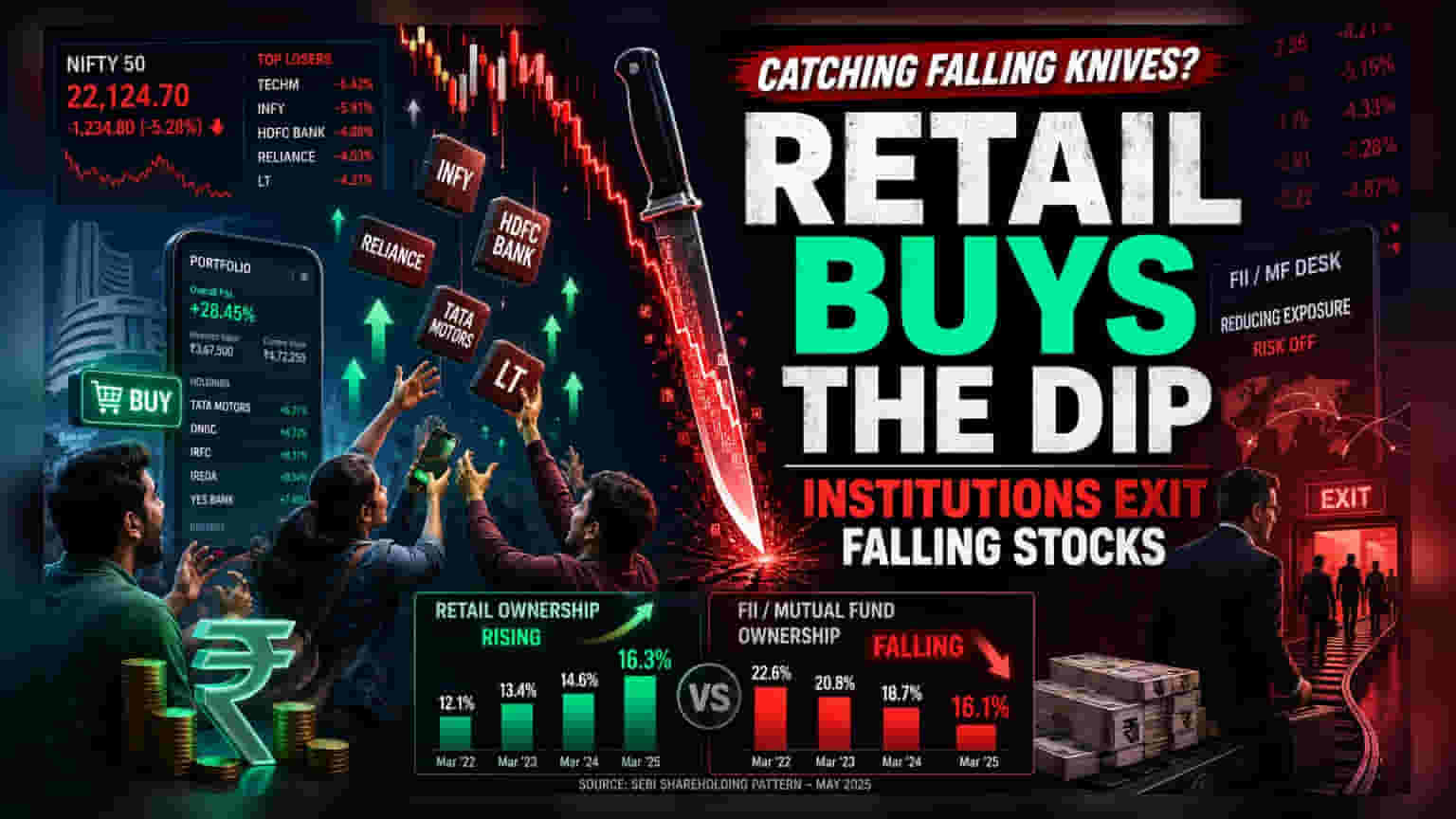
Data shows retail investors are aggressively buying stocks that have crashed since the September 2024 market peak. This strategy, often called "catching falling knives," contrasts sharply with institutional investors who are reducing their stakes. Investors risk buying into value traps when they base decisions only on falling prices rather than business fundamentals.
What Happened
Since the Indian stock market hit its peak in September 2024, a significant correction has taken place across many sectors. While the broader market sentiment has been cautious, an analysis of 1,993 NSE-listed companies reveals a distinct trend: individual retail investors are aggressively increasing their stakes in stocks that have seen the sharpest price declines. This behavior is the exact opposite of institutional investors, including Foreign Institutional Investors (FIIs) and mutual funds, who have largely been reducing their exposure to these same underperforming stocks.
The 'Falling Knife' Strategy Explained
This trend is frequently described in market parlance as "catching falling knives." It occurs when an investor buys shares of a company whose price is rapidly dropping, in the hope that it will soon reach a bottom and rebound. The data suggests a direct correlation: as the percentage of price decline deepens, the frequency of individual investors increasing their holdings rises. In companies that have corrected by over 60% since the September 2024 peak, retail ownership increased in over 83% of observed cases. This pattern is particularly visible in stocks like Ola Electric and Go Fashion, which have seen significant retail accumulation despite sharp price corrections.
Why Institutions Are Moving Away
Institutional investors, who typically rely on detailed research and long-term valuation models, have taken a different path. In companies where prices have dropped more than 60%, FIIs and mutual funds have largely been net sellers. For example, in companies like Allcargo Logistics and Sterling & Wilson Renewable Energy, institutional ownership has decreased significantly even as individual stakes climbed. This divergence suggests that professional investors may see fundamental issues—such as deteriorating margins, debt pressure, or weakening demand—that are driving the price drop, rather than viewing the decline as a simple buying opportunity.
The Valuation Trap
One of the most critical risks for retail investors is ignoring the difference between a "cheap stock" and a "value trap." A stock that has fallen 50% is not automatically inexpensive. If the company’s earnings, profit, or cash flow have fallen by 70% in the same period, the stock has actually become more expensive in terms of valuation (P/E ratio). The data shows that retail investors have continued to increase holdings in high P/E companies like Epack Durable, Entero Healthcare, and Easy Trip Planners, even as these stocks underwent price corrections. If the underlying business quality is declining, buying the dip does not guarantee a recovery.
What Investors Should Track Next
For those looking to invest, it is important to separate a temporary price correction from a long-term decline in business health. Investors may consider looking beyond the stock price chart and focusing on:
- Business Fundamentals: Is the revenue and profit trend sustainable, or is the company facing structural growth issues?
- Debt and Cash Flow: Is the company managing its debt, or is the price drop a reflection of financial stress?
- Institutional Activity: While retail investors don't have to copy institutions, a persistent exit by mutual funds and FIIs often signals deep-seated concerns regarding governance or execution.
- Valuation Metrics: Check whether the stock's valuation is justified by its future growth prospects, not just by how far it has fallen from its peak.