

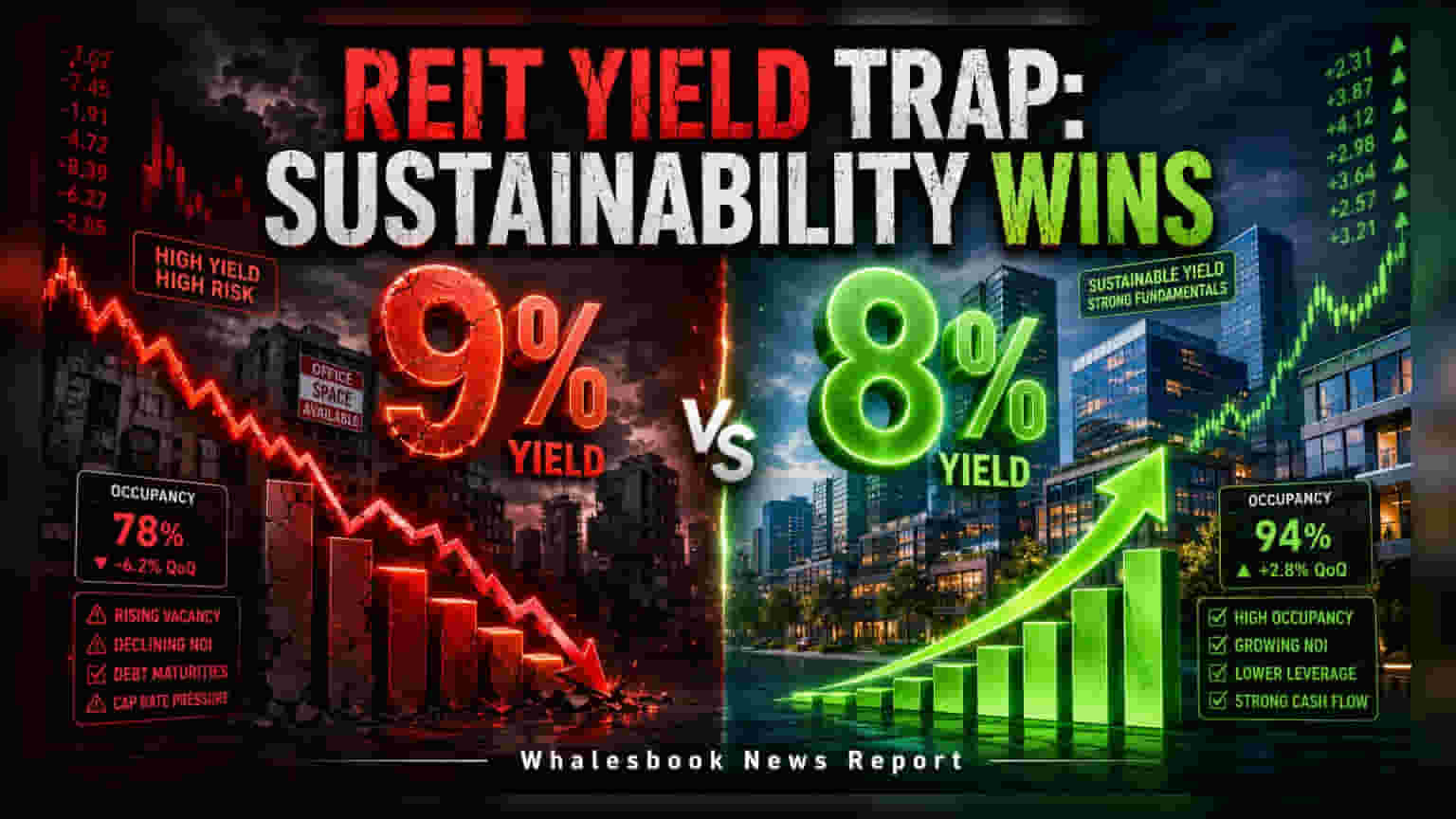
Investors often chase high REIT yields, but these can mask financial stress or low asset quality. Understanding metrics like occupancy and debt levels is more important than the payout figure alone when assessing long-term stability.
Real Estate Investment Trusts (REITs) are often favored by income-seeking investors for their regular cash distributions. However, looking at the distribution yield—the annual dividend divided by the share price—can be misleading. A very high yield is not always a sign of a great investment; sometimes, it is the market warning you that something is wrong.
The Mechanics of the Yield Trap
There is an inverse relationship between a REIT's share price and its yield. When investor confidence in a REIT drops, the share price often falls. As the share price declines, the math behind the yield creates a higher percentage figure. This is known as a 'yield trap.'
If a REIT's yield suddenly spikes, it is often not because the company has become more profitable or generous, but because the market is pricing in risks. These risks could include concerns about declining tenant occupancy, the inability to refinance debt, or doubts about the company's long-term business strategy. Investors who buy solely based on this headline number may find themselves holding an asset where the capital value is dropping faster than the dividends they receive.
Key Metrics for Assessing Stability
To build a sustainable income stream, investors should look past the yield and focus on the health of the underlying property portfolio.
Occupancy rates are a primary indicator of quality. If a REIT has high, stable occupancy, it means the properties are in demand and generating predictable rental income. A declining occupancy rate, on the other hand, suggests that the REIT may struggle to maintain its distribution levels in the future.
Another critical factor is the Loan-to-Value (LTV) ratio. This measures how much debt the REIT has compared to the total value of its assets. While some borrowing is normal in real estate, excessive leverage can become a major problem if interest rates rise or if the REIT needs to refinance debt in a difficult market. A lower LTV ratio generally offers a cushion, providing the company with more financial flexibility during economic downturns.
Why Tenant Mix and Sponsor Quality Matter
The stability of a REIT's income also depends on who is paying the rent. A REIT that relies on a single large tenant is far riskier than one with a diversified pool of tenants across different sectors. If that one big tenant moves out, the REIT faces a sudden, sharp drop in revenue.
Furthermore, the quality of the sponsor or management team is vital. Experienced sponsors typically have better access to high-quality properties and stronger governance standards. They are also better equipped to navigate market cycles, whether they are buying new assets or managing existing ones.
Moving Beyond Fixed-Income Expectations
It is important to remember that REITs are equity-linked instruments, not fixed-income alternatives like bank deposits or bonds. Their value fluctuates based on market sentiment, interest rates, and property performance.
Investors looking for long-term returns should prioritize REITs with proven track records of consistent distributions, high-quality asset portfolios, and prudent financial management. A lower, but reliable and growing payout, is often a better foundation for wealth creation than a high, volatile yield that carries significant underlying risk.