 Whalesbook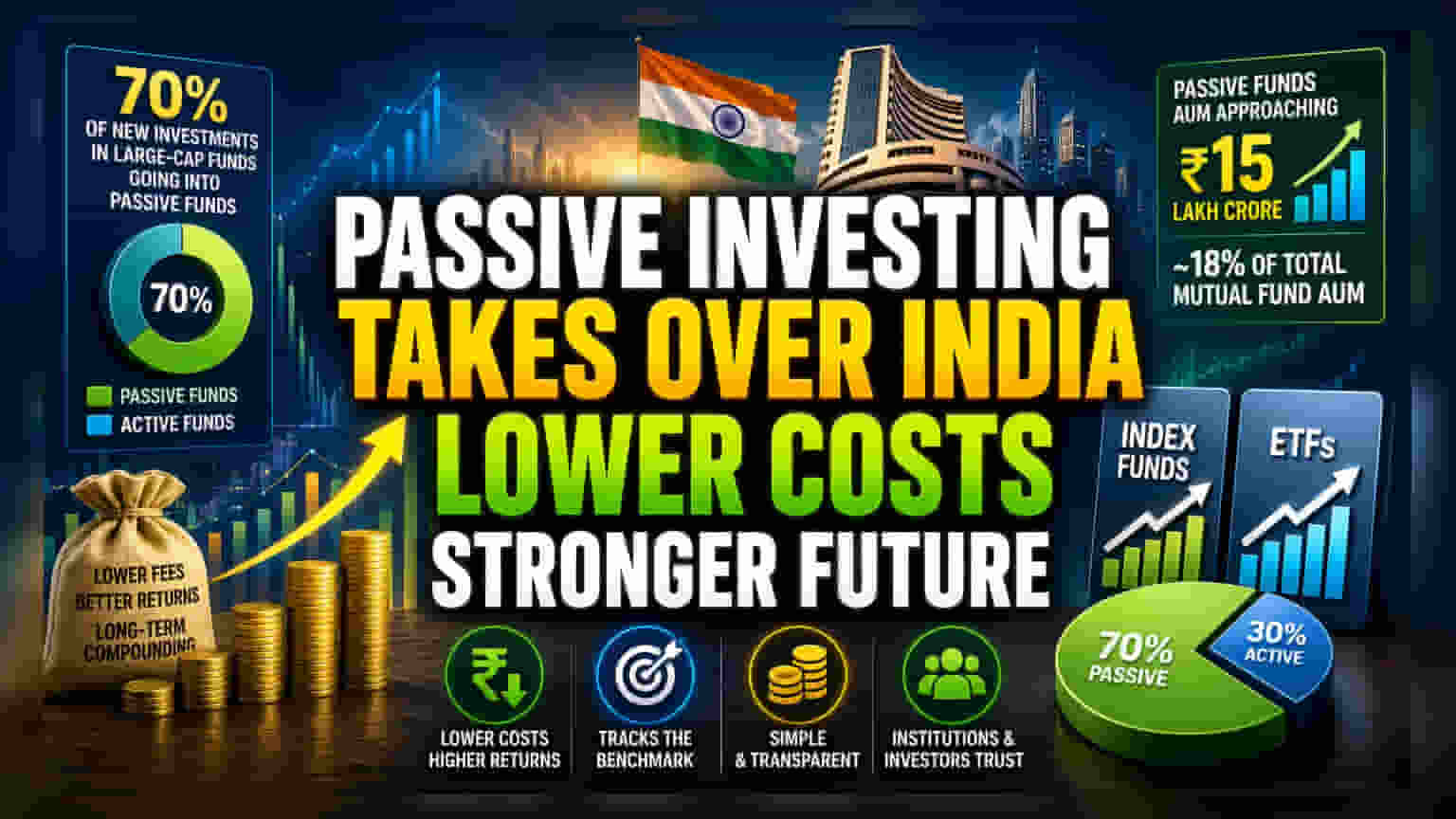
Passive funds like Index funds and ETFs are becoming the top choice for large-cap investing in India, capturing roughly 70% of new inflows. This shift is driven by lower costs and the challenge active fund managers face in beating the market. For investors, this means balancing lower-cost index strategies with active funds, while understanding risks like tracking error, liquidity, and regulatory limits on international assets.
What Happened
Passive investing in India is seeing a major shift. Data shows that nearly 70% of all new investments flowing into large-cap mutual fund schemes are now going into passive products, such as Index funds and Exchange Traded Funds (ETFs). The total assets in these passive instruments have grown significantly, now approaching the ₹15 lakh crore mark. This represents roughly 18% of the total mutual fund industry's assets. This trend is being pushed by both large institutional investors, such as pension funds, and individual investors who are looking for simpler, lower-cost ways to participate in the stock market.
Why Costs and Performance Matter
The primary reason for this shift is cost. Passive funds generally have much lower expense ratios compared to active funds, because they do not employ active fund managers to select stocks. Instead, they simply copy an index like the Nifty 50. Over time, these lower fees can add up and significantly impact long-term compounding. Additionally, many investors are moving to passive funds because active managers in the large-cap space have found it increasingly difficult to consistently outperform the benchmark index. As the market becomes more efficient, finding hidden gems among the largest companies has become harder, leading many investors to accept the index return rather than paying higher fees for active management that may underperform.
Understanding the Risks
While passive funds offer simplicity and lower costs, they are not risk-free. One key concept investors must understand is tracking error. This occurs when the fund's returns do not perfectly match the index it is tracking. This happens due to the fund's management fees, cash holdings, and the cost of buying and selling stocks to match the index. A high tracking error means the fund is not doing a good job of mirroring the index.
Another point is liquidity, especially for ETFs. Unlike regular index funds, ETFs trade on stock exchanges. If there are not enough buyers or sellers for the ETF on the exchange, investors might struggle to enter or exit at a fair price. Furthermore, some specialized ETFs, particularly those investing in international markets, have faced issues where they trade at a significant premium to their Net Asset Value (NAV). This is often due to regulatory limits on overseas investments imposed by the Reserve Bank of India, which can restrict the fund's ability to buy more international shares.
Active vs. Passive: The Strategic Balance
The growth of passive funds does not mean active management is dead. While passive funds often dominate the large-cap segment, active managers may still provide value in the mid-cap and small-cap segments. These areas of the market are often considered less efficient, meaning skilled fund managers may find better opportunities to identify undervalued stocks and generate higher returns than the index. Many experts suggest a balanced approach, where investors may use passive funds for the core large-cap portion of their portfolio to keep costs low, while utilizing active funds for mid-cap or thematic exposure to capture potential growth.
What Investors Should Track
Investors looking to use passive funds should monitor a few specific metrics. First, always check the expense ratio; lower is generally better for passive strategies. Second, look at the tracking error, which is usually mentioned in the fund's monthly fact sheet. A lower tracking error is a sign of a better-managed fund. Finally, consider the fund's AUM (Assets Under Management) or trading volume for ETFs. Larger, more liquid funds are generally easier to trade and maintain lower costs. As the market evolves, keep an eye on how these passive products align with your personal financial goals and time horizon.

