

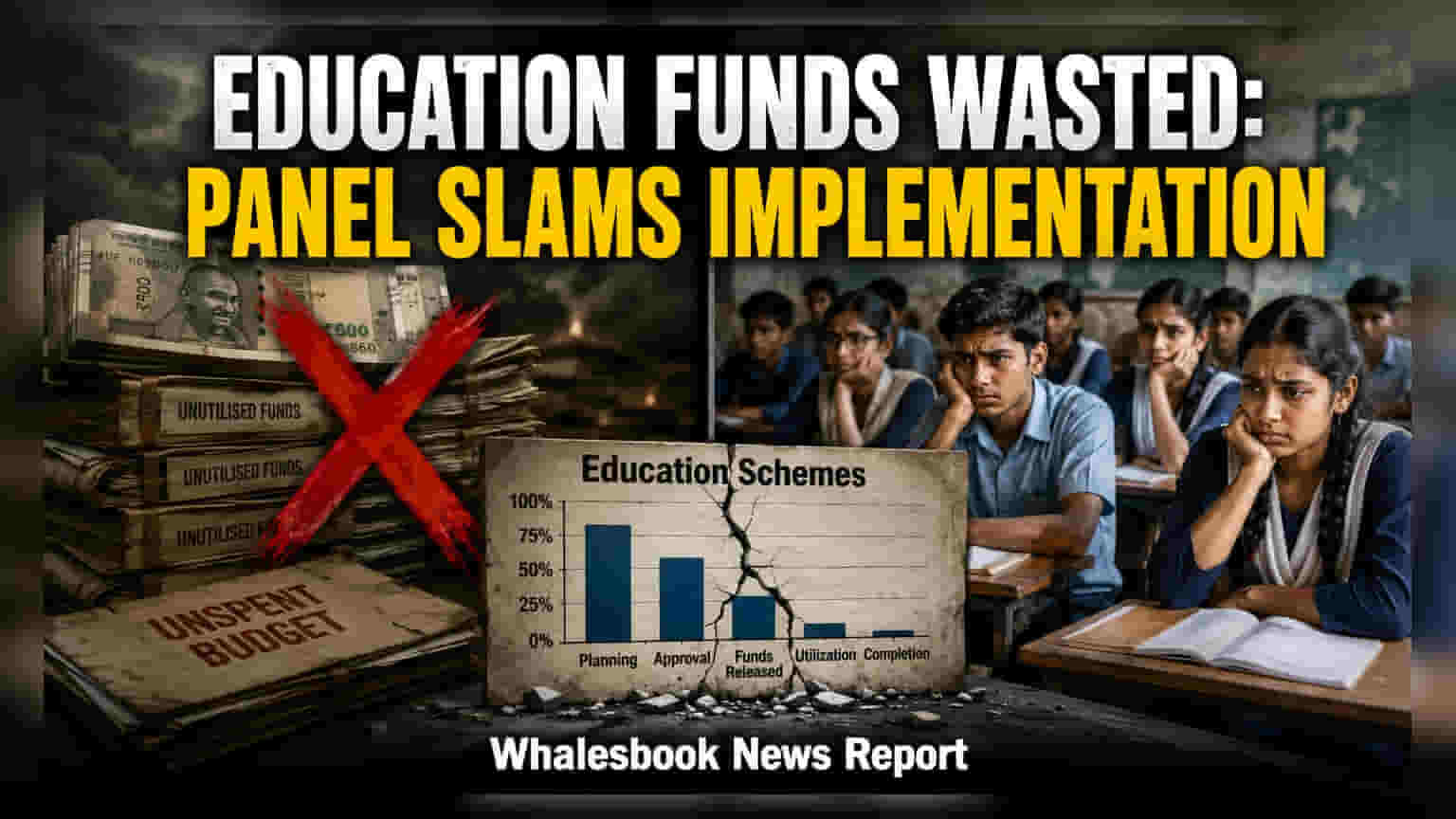
A parliamentary committee has flagged significant delays and poor spending across major government education schemes, including NIPUN Bharat and PM SHRI. The report highlights systemic bottlenecks between central and state governments, raising concerns about the efficiency of national education delivery and infrastructure development projects.
A recent report by the Lok Sabha Committee on Estimates has highlighted a persistent issue of under-utilization of funds allocated for major school education schemes. The committee observed that while significant budgets are approved at the central level, a large portion remains unspent due to implementation delays and poor coordination at the state and union territory levels. For investors and observers of the education sector, this highlights a critical gap in execution that can impact the pace of infrastructure development and program rollouts across the country.
The committee specifically pointed to the National Initiative for Proficiency in Reading with Understanding and Numeracy (NIPUN Bharat), a flagship program aimed at improving foundational literacy. In the 2024-25 fiscal year, approximately 39% of the approved ₹3,029.27 crore remained unspent. Similar concerns were raised regarding Kasturba Gandhi Balika Vidyalayas (KGBV) and initiatives for inclusive education for children with special needs. In some instances, such as the allocation for disabled-friendly toilets, actual spending was negligible, with almost no physical progress reported against the budget. These delays are not just financial figures; they represent stalled development in school infrastructure and essential student services.
The report identifies systemic inefficiencies, including a lack of coherence between central and state administrative machinery, as the primary cause for these funding gaps. The committee noted that delays in releasing funds and a lack of continuity among officers managing centrally sponsored schemes often lead to surrendered funds and poor project outcomes. This bureaucratic friction acts as a drag on the broader education sector, which relies heavily on government spending for large-scale infrastructure and digital resource initiatives.
This finding comes against the backdrop of broader scrutiny over India's education governance. In July 2026, Parliament passed the Public Examinations (Prevention of Unfair Means) Amendment Bill to tackle examination irregularities, reflecting a heightened focus on systemic reforms. However, the committee's report suggests that challenges persist beyond examinations, particularly in the operational implementation of foundational school schemes. The suspension of other programs like the National Talent Search Examination (NTSE) has also been flagged as a blow to student talent pipelines, further indicating that the sector is grappling with both operational and structural hurdles.
For those tracking the education sector, the key monitorable will be whether the Ministry of Education can successfully implement the committee's recommendation for a more robust, outcome-based monitoring framework. Investors may track future updates on fund utilization reports, the progress of infrastructure spending in the PM SHRI scheme, and any policy shifts aimed at reducing state-level implementation bottlenecks. Persistent under-spending in these areas could continue to delay the intended growth and modernization of the government-funded school network.