 Whalesbook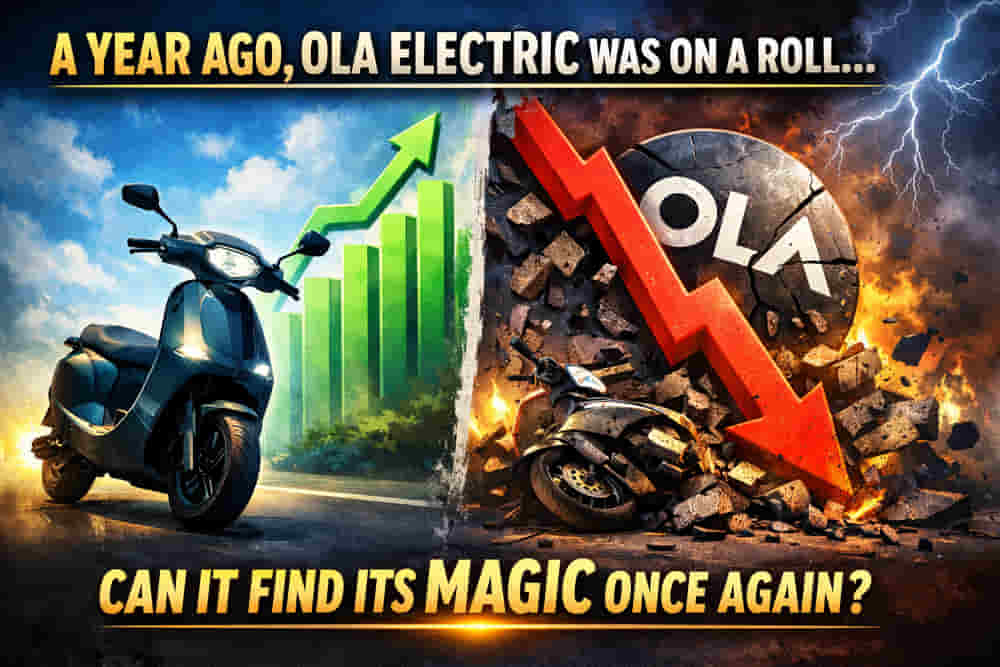
Ola Electric's Steep Fall and Tenuous Comeback Bid
Once hailed as India's answer to Tesla and a leader in the booming electric vehicle market, Ola Electric is now navigating a challenging period. A year ago, the company, led by Bhavish Aggarwal, was celebrated for its strong investor backing and nationalist appeal, seemingly poised for market dominance. However, its market share has significantly eroded, allowing established automakers like TVS Motors and Bajaj Auto to reclaim their positions and emerge as top sellers in India's rapidly expanding electric two-wheeler segment.
The Core Issue
The narrative surrounding Ola Electric has shifted dramatically from one of triumph to one of struggle. What was once the largest electric vehicle maker, selling upwards of 53,000 units monthly, now sells fewer than 9,000 units. This drastic slip to fifth place is attributed by industry experts to a loss of customer trust. Arun Malhotra, former MD of Nissan India, stated that Ola's challenges are largely self-inflicted, emphasizing the urgent need to address this trust deficit.
Financial Implications
The company's financial health has also taken a hit. Ola Electric's valuation has plummeted by over 60 percent, from approximately ₹42,000 crore in December of the previous year to around ₹15,000 crore currently. In a move to shore up confidence and manage finances, CEO Bhavish Aggarwal recently sold a portion of his personal shareholding to fully repay a promoter-level loan of roughly ₹260 crore.
Regulatory Scrutiny
Ola Electric's operational issues have drawn the attention of regulatory bodies. The government of Goa suspended the company's vehicle registrations following numerous complaints from buyers regarding inadequate after-sales service and unavailable spare parts. This action followed a probe by the Central Consumer Protection Authority (CCPA) into alleged violations of consumer rights, service deficiencies, and misleading advertisements, adding another layer of pressure on the EV maker.
Official Statements and Responses
Bhavish Aggarwal has acknowledged the challenges, particularly concerning the ownership experience and service network, stating that "some of the challenges are not just company-linked." He reiterated the company's commitment to offering a superior product in terms of performance, range, and technology at a competitive price, a core value proposition for Indian two-wheeler buyers who often rely on these vehicles for their livelihood.
New Ventures and Cost Management
Despite the setbacks, Ola Electric is diversifying its business. In October, it launched Ola Shakti, a residential power backup solution entering the battery energy storage systems market. The company projects ₹100 crore in revenue from this segment in the first quarter post-launch, selling between 7,000-8,000 units. Internally, Ola is implementing "Operation Lakshya" to reduce costs, successfully cutting monthly auto operating expenses from ₹178 crore to ₹105 crore and improving service centre turnaround time to an average of 1.1 days.
Historical Context
Founded to capitalize on the global shift towards electric mobility, Ola Electric established a large manufacturing plant in Tamil Nadu. It launched its first models, Ola S1 and S1 Pro, in August 2021, based on technology from Etergo, a Dutch company acquired by Ola in May 2020. However, early consumer complaints soon overshadowed these initial successes.
Future Outlook
Industry observers suggest that Ola Electric needs to focus on incremental gains and significantly improve its service network to regain customer trust. Drawing inspiration from the successful turnarounds of automotive giants like Tata and Mahindra, the company faces the monumental task of rebuilding its reputation. The crucial question remains whether Ola Electric can truly deliver on its promise of a superior ownership experience and reclaim its former glory.
Impact
This news is significant for the Indian electric vehicle market. It highlights the intense competition and the challenges faced by new players in establishing customer trust and service infrastructure. The company's performance and strategic shifts could influence investor sentiment towards the EV sector in India and impact consumer purchasing decisions.
Impact Rating: 7/10
Difficult Terms Explained
Blockbuster public listing: A highly successful initial offering of company shares to the public, attracting significant investor interest and strong price performance.
Incumbents: Established companies or players already operating and holding a significant market share in a particular industry.
Homegrown: Developed or manufactured in the country of origin; in this case, India.
Promoter shareholding: Shares of a company held by its founders or key individuals who initiated and control the company.
Promoter-level loan: A loan taken out by the company's promoters or founders, often secured against their personal assets or shareholdings.
Cumulative revenue: The total revenue generated by all companies within a specific group or list over a given period.
Definitive compendium: A comprehensive and authoritative collection or record of information.
Pecking order: A hierarchical ranking or order of importance.
Trust deficit: A lack of confidence or belief that a company or entity will act in a trustworthy or reliable manner.
Show-cause notice: An official document issued by a regulatory body requiring an entity to explain why a penalty or adverse action should not be taken against it.
Central Consumer Protection Authority (CCPA): A statutory body in India established to protect the rights of consumers.
Misleading advertisements: Advertising that deceives or is likely to deceive consumers, leading them to make purchasing decisions they might not otherwise have made.
Livelihood: A means of securing the necessities of life, typically a job or profession.
Research and advisory firm: A company that provides specialized research and consulting services to businesses or industries.
Global electric two-wheeler market: The worldwide market for electric scooters and motorcycles.
Brand proposition: The unique value or benefit that a brand offers to its customers.
Range: The maximum distance an electric vehicle can travel on a single charge.
Ownership experience: The overall satisfaction and ease a customer has with a product or service after purchasing it, including after-sales support.
Service network: The system of facilities and personnel available for the maintenance and repair of products.
Battery energy storage systems: Devices that store electrical energy generated from various sources for later use.
Residential power backup solution: A system designed to provide electricity to homes during power outages.
Variants: Different versions or models of a product, often differing in features, specifications, or price.
kWh (kilowatt-hour): A unit of energy representing the amount of energy consumed or produced by one kilowatt of power over one hour.
Revenue: The total income generated by the sale of goods or services related to the company's primary operations.
Conference call: A telephonic meeting where multiple people can participate simultaneously, often used by companies to discuss financial results.
Average blended selling price: The average price at which a product is sold, considering different variants or models and any discounts offered.
Fundraising: The process of obtaining money for a business or organization, typically through investment or loans.
Equity shares: Units of ownership in a company that represent a claim on its assets and earnings.
Convertible securities: Financial instruments that can be exchanged for a predetermined number of shares of the issuing company's stock.
Automobile customers: Individuals or businesses who purchase vehicles.
Turnaround time: The time taken to complete a specific process or task, such as repairing a vehicle.
Sales productivity: The efficiency and effectiveness of a sales team or individual in generating sales.
Tectonic shift: A fundamental and significant change in the structure or dynamics of an industry or market.
Memorandum of understanding (MoU): A formal agreement between two or more parties that outlines common lines of action.
AppScooter: A specific electric scooter model manufactured by Etergo, which Ola acquired.
Consumer watchdog: An organization that monitors and investigates companies to protect consumers from unfair practices.
Probe: A thorough investigation into an alleged wrongdoing or issue.
Deficiencies: Shortcomings or lack of necessary qualities or components.
Market share: The portion of a market controlled by a particular company or product.