

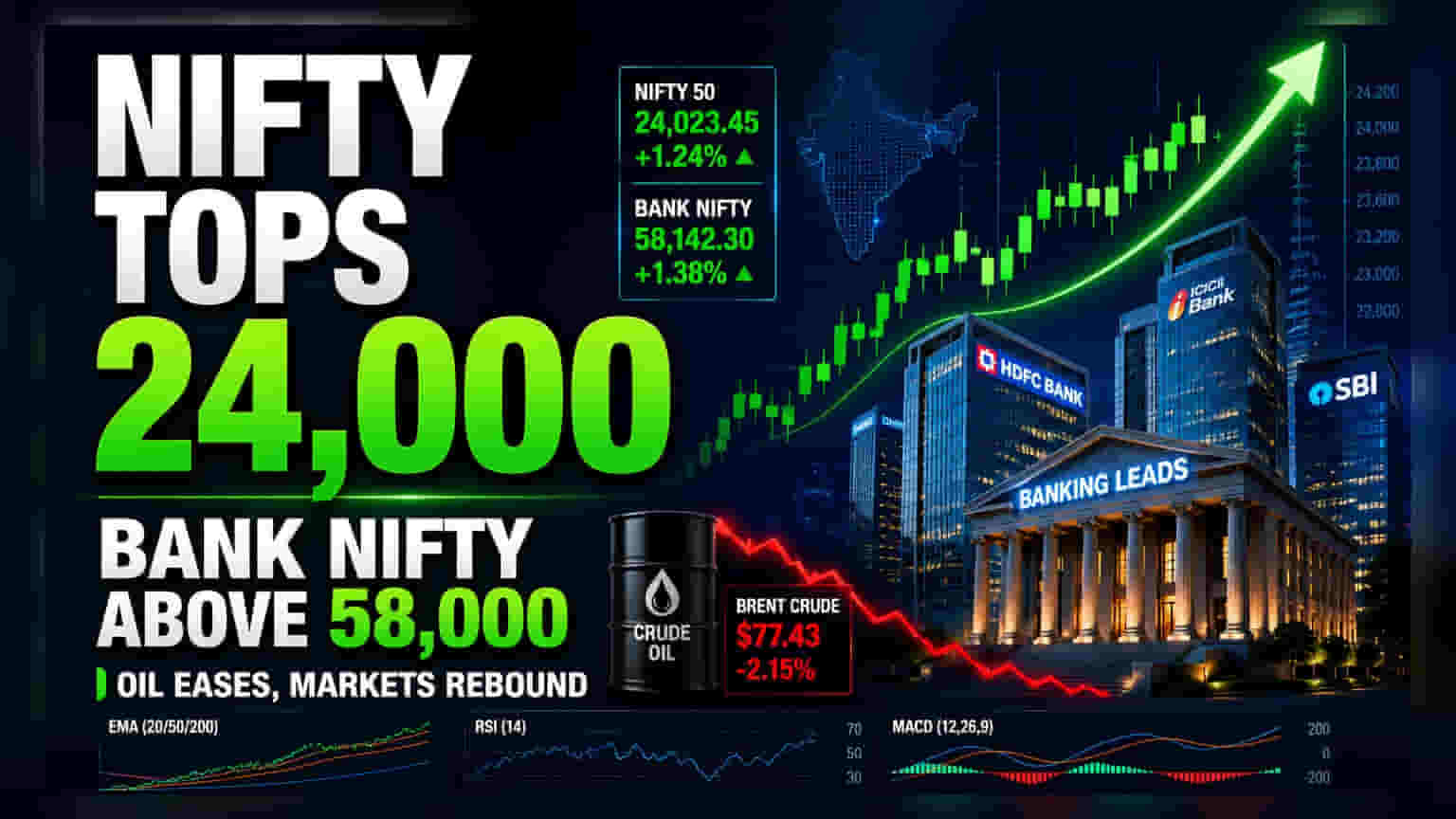
The Nifty 50 climbed 0.6% on July 1 to close above the 24,000 level, supported by easing crude oil prices. The Bank Nifty showed stronger momentum, rising 0.85% to settle above 58,000. Investors are now looking at support and resistance levels as the market consolidates after recent gains.
What Happened
The Nifty 50 index, which tracks 50 of India's largest companies, crossed the 24,000 mark on July 1, recording a gain of 0.6%. This move comes after the index spent a brief period in a correction phase. A key driver for this recovery was the moderation in crude oil prices, which is generally positive for the Indian economy as it reduces the cost of imports. Alongside the broader market, the Bank Nifty index saw stronger participation, gaining 0.85% to close above the 58,000 level.
Why Banking Shares Led The Move
The banking sector played a significant role in pushing the market higher on July 1. When the Bank Nifty outperforms the broader Nifty 50, it often signals that investors are confident about the health of the financial sector. The index closed comfortably above the 58,000 mark, which traders often view as a psychological level. This indicates that buying interest in major banking stocks remained active throughout the session.
Understanding The Technical Signals
Market analysts use various indicators to understand the trend of the market. The Nifty 50 is currently trading above its 10-day, 20-day, and 50-day exponential moving averages. These averages help smooth out price fluctuations to show the general direction of the market. When an index trades above these averages, it is typically viewed as a sign of underlying strength.
Another indicator, the Relative Strength Index (RSI), which measures the speed of price changes, has moved into a more positive range. Additionally, the MACD indicator shows that the overall trend is still positive. However, the momentum, or the speed of the rise, has shown signs of slowing down, as noted by the narrowing gaps in the MACD histogram.
Where The Market May Face Pressure
While the trend remains positive, investors should be aware of potential resistance zones. The Nifty 50 is approaching the 24,200 to 24,300 area, where it may face selling pressure from traders looking to book profits. On the downside, the 23,900 to 23,850 band is being watched as immediate support. If the index fails to hold these levels, it could lead to further consolidation.
What Investors Should Track Next
Options data, which shows where traders are placing their bets, suggests that both 24,000 for the Nifty and 58,000 for the Bank Nifty are key levels for the near future. Significant activity at these strike prices indicates that these levels will likely act as strong support points. Investors should keep an eye on global oil price movements, as any sudden spikes could impact market sentiment. Additionally, tracking how the Nifty 50 behaves near the 24,200 resistance level will be important to understand if the current upward trend has enough strength to continue further.