 Whalesbook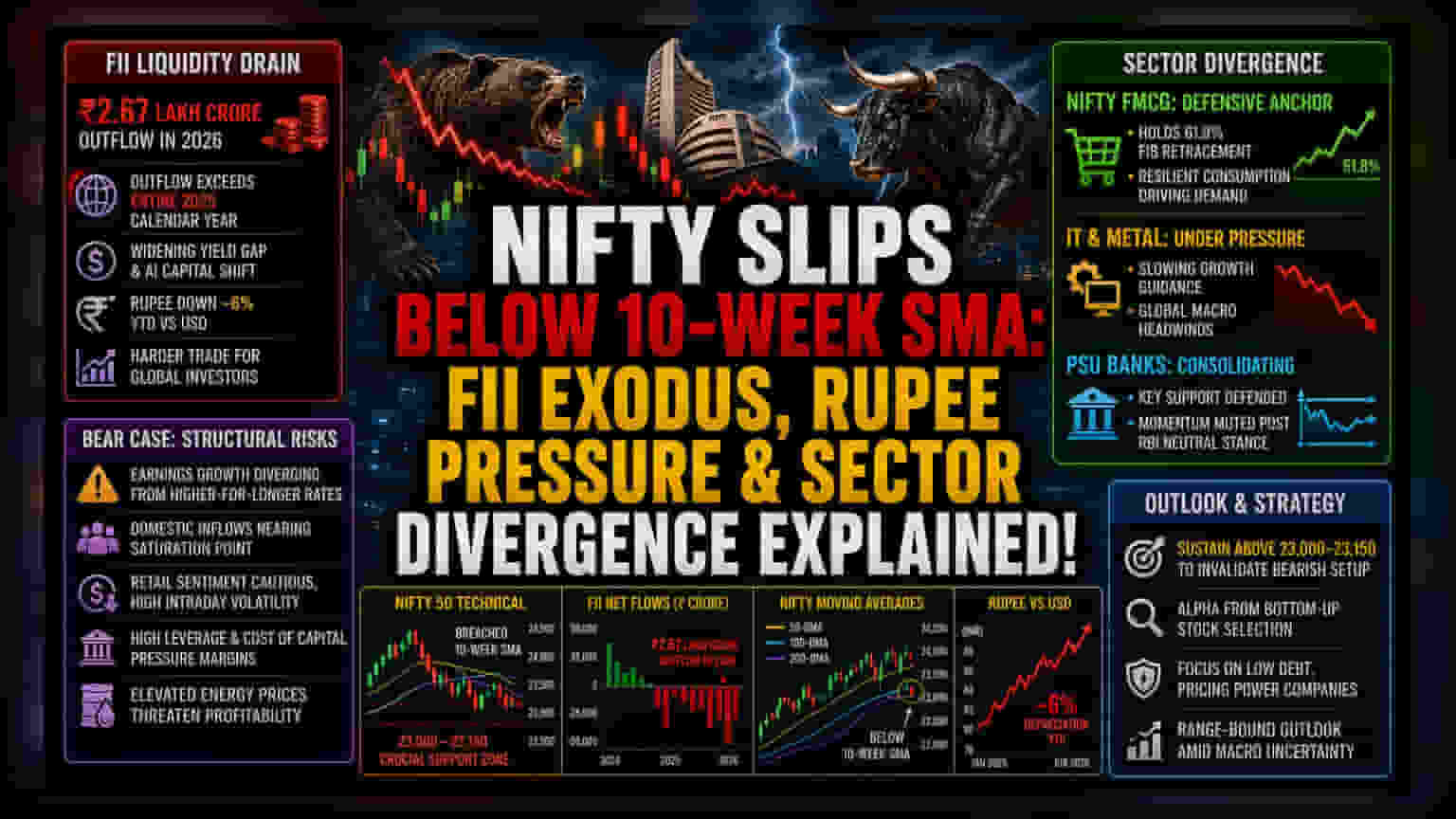


The Institutional Liquidity Drain
The technical breach of the 10-week Simple Moving Average (SMA) marks a structural shift rather than mere profit-taking. This development occurs against a backdrop of historic capital rotation, with Foreign Portfolio Investors (FPIs) offloading ₹2.67 lakh crore in 2026 alone—a figure that has already eclipsed total outflows for the entire 2025 calendar year. The selling is not indiscriminate; it is a systematic response to the widening yield gap and the explosive growth of capital-intensive artificial intelligence ventures globally. As domestic liquidity attempts to cushion the impact, the persistent weakness in the rupee, which has depreciated approximately 6% year-to-date, continues to erode dollar-denominated returns, effectively turning the Indian equity market into a difficult trade for international participants.
Sectoral Divergence and Defensive Positioning
While the benchmark index struggles with technical overhead, the market is witnessing a distinct bifurcation. The Nifty FMCG index has managed to anchor near 61.8% Fibonacci retracement levels, suggesting that investors are rotating into defensive plays to mitigate volatility. This demand absorption is supported by resilient middle-class consumption trends, even as high-growth cyclical sectors—particularly IT and Metal—face pressure from slowing revenue guidance and global macro headwinds. PSU Banks, meanwhile, are traversing a consolidation phase. Although the index has defended critical horizontal support, momentum remains muted as the sector recalibrates following the Reserve Bank of India’s neutral policy stance and revised inflation projections. The focus here remains on individual stock-specific reversals rather than an index-wide breakout.
The Forensic Bear Case: Structural Vulnerabilities
The current market optimism regarding a 'rebound' ignores significant structural risks. The primary headwind is the accelerating divergence between corporate earnings growth and the higher-for-longer interest rate regime. Furthermore, the reliance on domestic institutional inflows to fill the vacuum left by foreign exits is nearing a saturation point. Unlike cycles where institutional selling was countered by retail exuberance, the current retail sentiment is increasingly cautious, as evidenced by the high intraday volatility during the recent RBI policy announcements. Additionally, the increasing cost of capital for highly leveraged constituents within the PSU Bank and manufacturing indices creates a margin compression trap. Should energy prices remain elevated due to geopolitical friction, the operational margins of FMCG and manufacturing firms will face further scrutiny, potentially triggering a secondary wave of valuation downgrades.
Forward Outlook
Market participants are shifting focus to the upcoming weeks, where the index must stabilize above the 23,000–23,150 zone to invalidate the current bearish technical setup. In the absence of a meaningful reversal in the rupee or a pause in the AI-led global capital shift, large-cap stocks are likely to experience range-bound trading. Brokerage consensus suggests that Alpha generation will remain tied to bottom-up stock selection, favoring companies with low debt-to-equity ratios and pricing power, rather than broad-based index participation.