

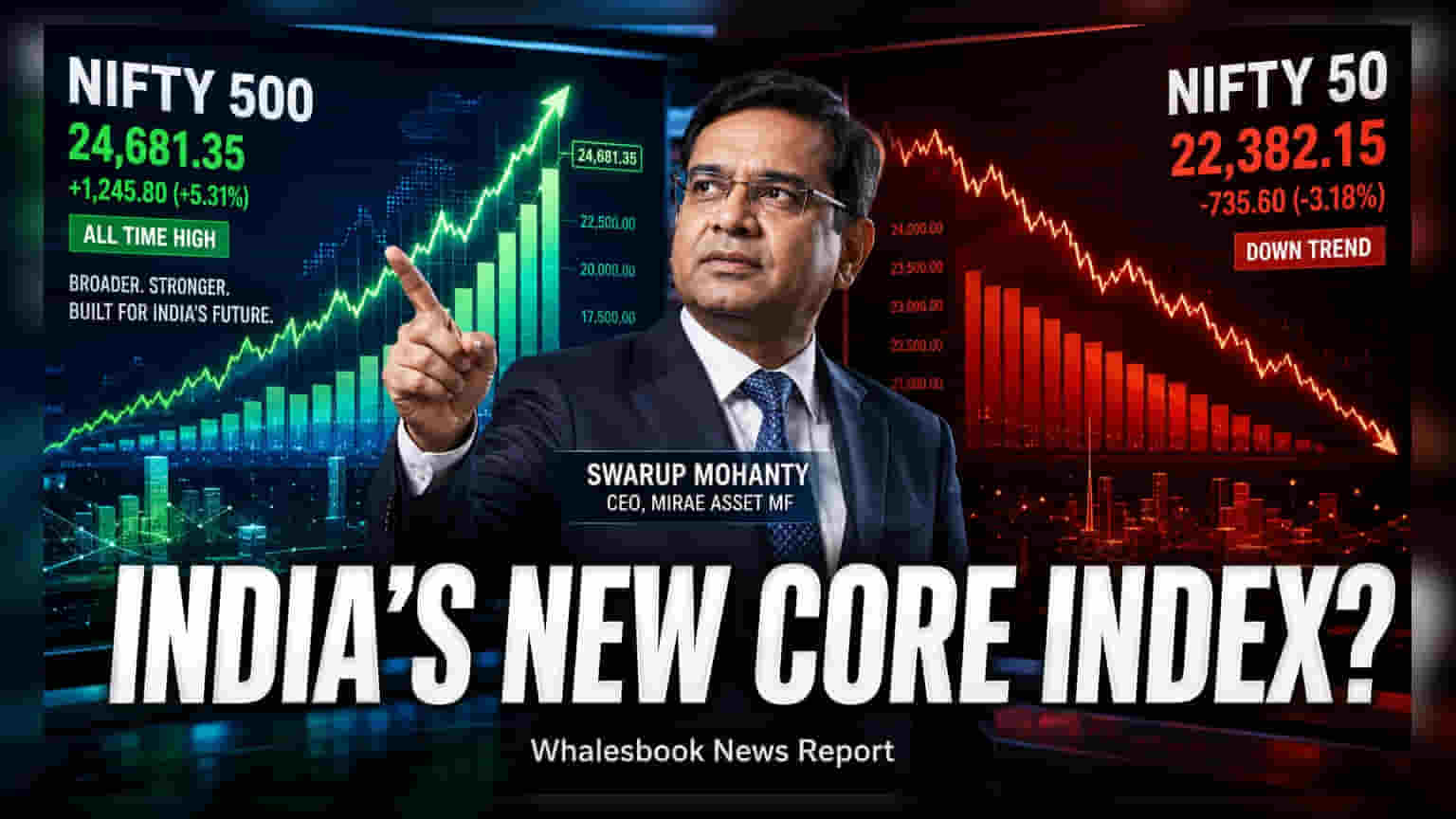
Swarup Mohanty, CEO of Mirae Asset Investment Managers (India), expects the Nifty 500 to replace the Nifty 50 as the primary benchmark for Indian investors. This shift reflects a move toward broader market exposure as the economy and investor base grow. Investors should note that while this offers more diversity, it also introduces higher volatility and liquidity risks compared to the blue-chip Nifty 50.
Swarup Mohanty, the Vice Chairman and CEO of Mirae Asset Investment Managers (India), has shared a projection regarding how Indian investors might measure the market in the coming years. He suggests that the Nifty 500 is likely to become the main reference point for the Indian stock market, moving past the Nifty 50.
The core reason for this view is the change in the composition of the Indian economy. The Nifty 50 index follows only the top 50 largest, most established companies in India. In contrast, the Nifty 500 includes 500 companies, covering both large-sized, mid-sized, and smaller firms. Because the Nifty 500 represents about 92% of the free-float market value on the National Stock Exchange (NSE), many industry experts believe it provides a more complete picture of the country's economic health.
Passive investing, where funds simply track an index rather than trying to beat it, has grown rapidly. Passive investment folios have risen to about 16-17% of total industry folios over the last six years. Mohanty notes that India’s younger investor demographic, with a large portion projected to be under 30 by 2026, is increasingly looking for diverse investment options beyond just the top 50 companies. This demographic often prefers broader and factor-based products, which align well with the structure of the Nifty 500.
However, shifting to a broader index like the Nifty 500 comes with specific considerations for investors. While it offers wider exposure, it also includes many mid-cap and small-cap stocks. These stocks can be much more volatile than the large-cap companies found in the Nifty 50. During market downturns, smaller companies often see sharper price drops and can be harder to trade quickly due to lower liquidity.
Another technical aspect for investors to track is tracking error. When investing in index funds or exchange-traded funds (ETFs) that follow the Nifty 500, the fund's performance may not exactly match the index's performance. This difference, known as tracking error, can be higher in broader indices compared to the highly liquid Nifty 50.
Investors considering this shift should monitor how their investment products manage this liquidity and tracking error. While thematic opportunities in areas like manufacturing, defense, and energy transition are becoming more accessible through passive products, the primary monitorable remains the stability of the underlying companies. As the market matures, the ability of these broader indices to balance diversification with risk management will be the key factor for investors to evaluate.