

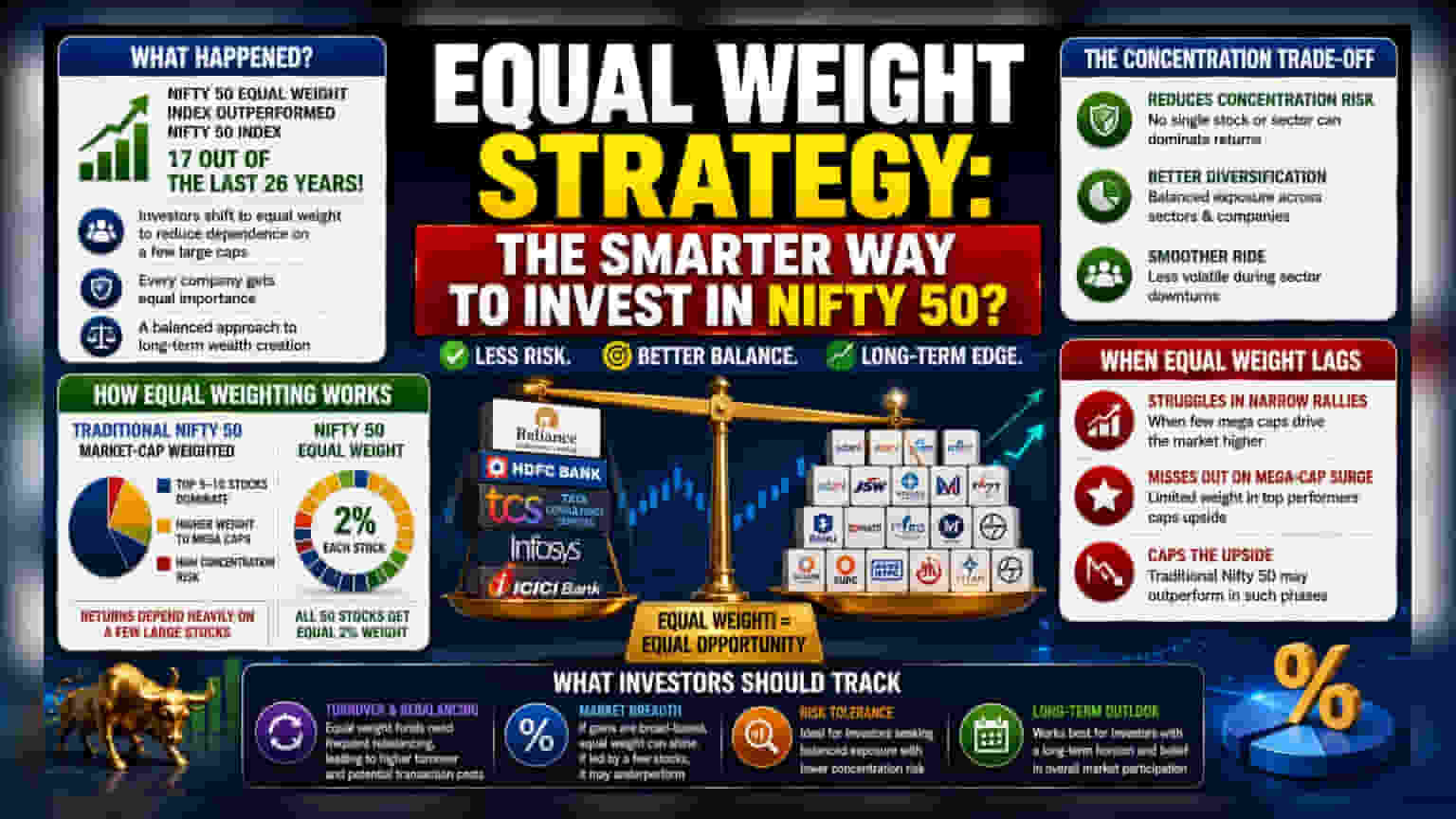
The Nifty 50 Equal Weight Index has outperformed the standard Nifty 50 in 17 of the last 26 years. By giving every stock an equal share, this strategy reduces concentration risk, but behaves differently during narrow market rallies. Investors can use this comparison to understand how different index structures impact long-term portfolio performance.
What Happened
Investors are increasingly looking at "Equal Weight" indices as an alternative to traditional market-capitalization-weighted funds. Data shows that the Nifty 50 Equal Weight Index has outperformed the standard Nifty 50 Index in 17 out of the last 26 years. This shift in interest comes as many investors seek to lower the risk of having too much money tied up in just a handful of large-cap companies. Unlike standard funds that track the market based on company size, this strategy treats every company in the index equally.
How Equal Weighting Works
In a standard Nifty 50 index fund, the money is invested based on the size of the company. A massive company with a huge market value gets a much larger slice of the investment, while smaller companies in the same index get a smaller slice. This means the index performance depends heavily on the top 5 or 10 stocks.
An Equal Weight strategy changes the math. It divides the total investment equally among all 50 companies. If there are 50 stocks, each receives 2% of the total allocation. This ensures that a smaller company within the top 50 has the same impact on the portfolio as a market giant.
The Concentration Trade-Off
The primary benefit of an equal-weight approach is the reduction of concentration risk. In traditional indices, if a single sector—such as banking or IT—goes through a difficult phase, the entire index can fall sharply because those sectors often dominate the weightings. By capping each stock's weight, the equal-weight strategy prevents any single company or sector from overly influencing the total return. This can provide a more balanced experience for investors who want broad exposure to the 50 largest companies without being over-dependent on a few heavyweights.
When The Strategy Lags
While the 17-year outperformance record sounds promising, this strategy is not always a winner. Equal-weight indices often struggle during "narrow rallies." These are periods when the overall market gains are driven by only 3 or 4 mega-cap stocks. Because the equal-weight strategy limits how much of these high-performing giants it can hold, it often misses out on the full upside of those massive rallies. In such market cycles, the traditional market-cap-weighted index usually delivers higher returns because it is heavily skewed toward those few dominant leaders.
What Investors Should Track
Investors evaluating these strategies should look at their own risk tolerance and market outlook. The key monitorables include the turnover ratio, as equal-weight funds require frequent rebalancing to ensure weights remain equal, which can sometimes lead to higher transaction costs compared to standard index funds. Additionally, tracking the market breadth—whether gains are coming from across the board or just a few stocks—can help investors understand why an equal-weight portfolio might be underperforming or outperforming the standard Nifty 50 at any given time.