

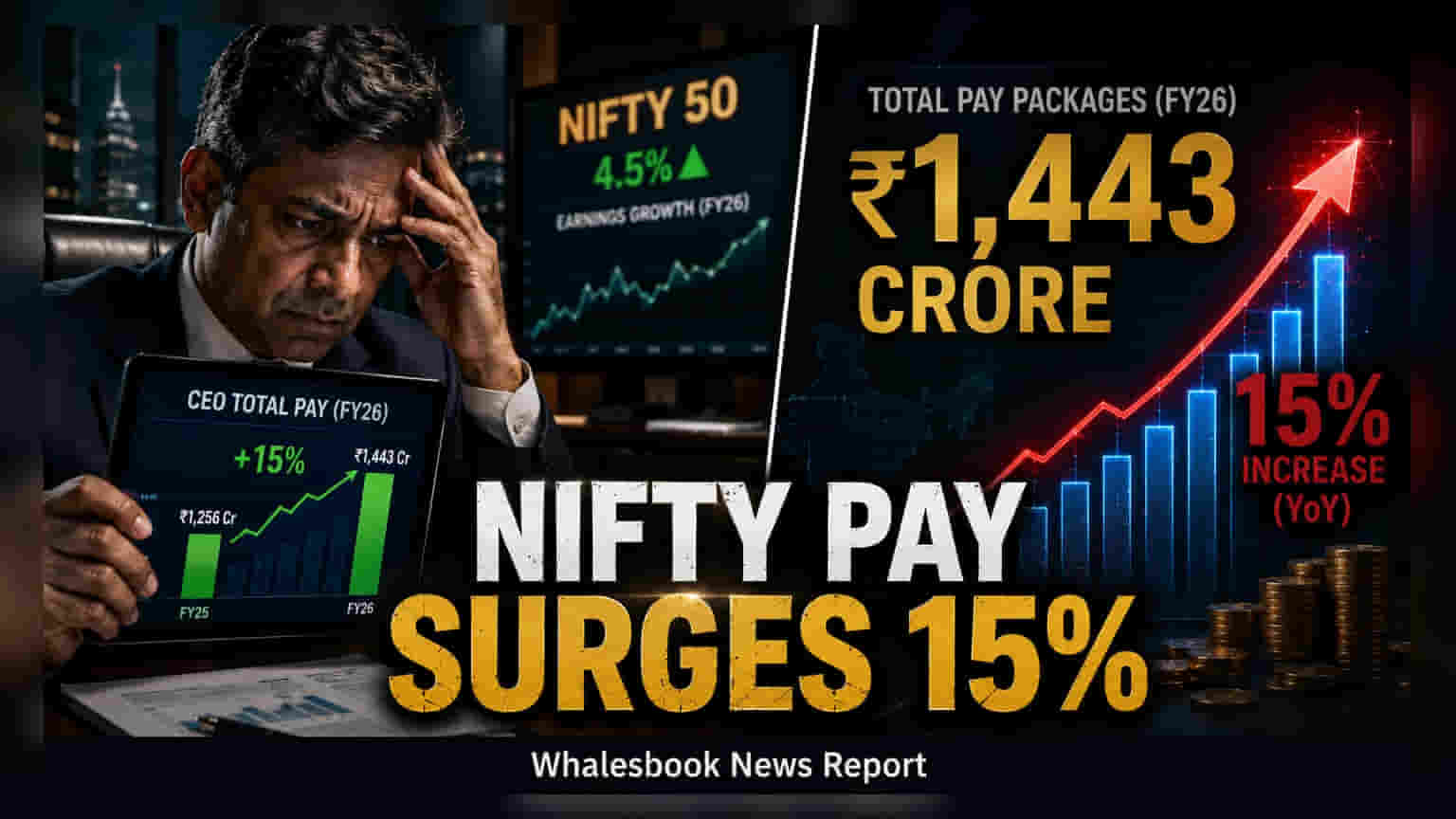
Chief executives of India’s top 50 companies saw their collective remuneration hit a record ₹1,443 crore in fiscal year 2026, marking a 15% annual increase. With average CEO pay reaching ₹29 crore, investors are focusing on the widening gap between rising executive compensation and the slower 4.5% growth in broader index earnings.
Chief executives of India’s top 50 companies saw their total pay packages climb to a record ₹1,443 crore in fiscal year 2026. This represents a 15% increase in average remuneration, which rose to approximately ₹29 crore per CEO, up from ₹25 crore in the previous year. These figures, derived from company annual reports, highlight a trend of rising executive costs among the country’s largest listed firms.
A significant point of interest for market observers is the contrast between the double-digit growth in executive pay and the more modest 4.5% earnings growth reported by the broader Nifty 50 index during the same period. For shareholders, this gap raises questions about how compensation is tied to actual company performance. While many executive packages now include a large component of performance-linked incentives, such as stock options or bonuses, the divergence in growth rates has become a key area for scrutiny during annual general meetings.
The data shows a wide disparity in pay structures across different sectors and ownership models. For instance, top leaders such as HCL Technologies' C Vijayakumar and Larsen & Toubro’s S.N. Subrahmanyan surpassed the ₹100 crore mark in annual compensation. On the other end of the spectrum, executives at public sector entities, including the State Bank of India, continued to receive significantly lower remuneration compared to their private-sector counterparts.
From an investment perspective, the structure of these pay packages matters as much as the total amount. A large portion of these earnings is often variable, meaning it depends on meeting specific targets. If those targets are aggressive, high pay may reflect strong internal performance, but if earnings continue to face pressure, investors may look closer at how companies justify these increases. Governance standards and the transparency of these pay calculations are becoming critical for shareholders when voting on management resolutions.
Going forward, investors may track the disclosures in company annual reports and investor presentations to understand the breakdown of fixed versus variable pay. Whether this trend of rising compensation continues will likely depend on the recovery of profit margins and earnings growth across the Nifty 50, as well as the increasing focus of institutional investors on sustainable pay practices.