

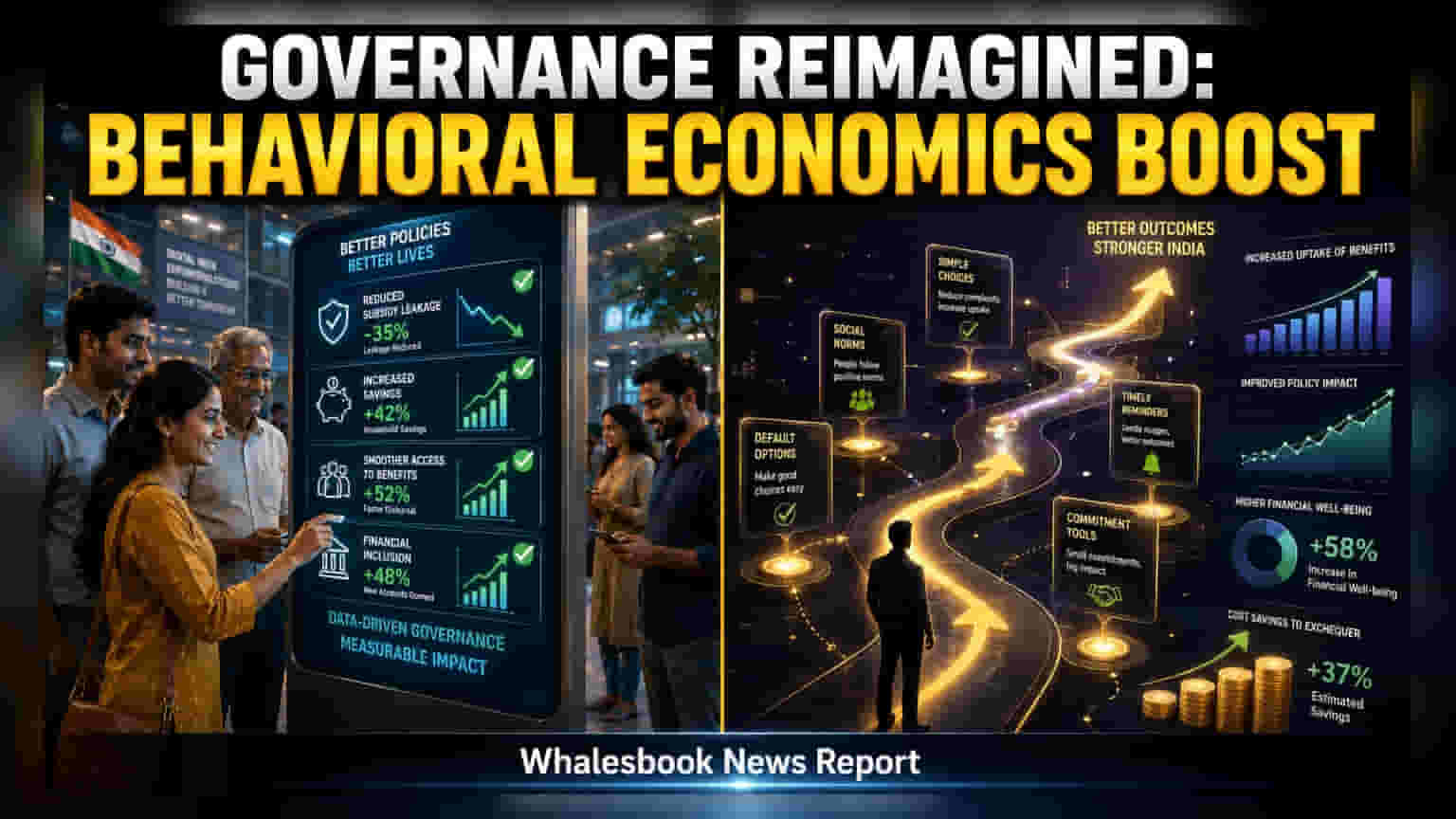
NITI Aayog Vice Chairperson Ashok Lahiri highlighted the role of behavioral economics in improving public policy at the inaugural Cheistha Kochhar Nudge Awards 2026. He advocated for using behavioral insights, audits, and digital tools to make governance more citizen-centric and fiscally efficient, citing past successful initiatives like the Jan Dhan Yojana and LPG subsidy reforms.
NITI Aayog Vice Chairperson Ashok Lahiri has called for the formal integration of behavioral economics into the framework of Indian public policy. Speaking at the inaugural Cheistha Kochhar Nudge Awards 2026, Lahiri emphasized that the future of effective governance lies in understanding how citizens make decisions, rather than relying solely on traditional models that assume people always act in perfectly rational ways.
Behavioral economics is the study of how human psychology influences economic decision-making. By applying this field to governance, policymakers can design interventions, often called 'nudges,' that gently guide individuals toward choices that are better for their own well-being and the broader economy, without limiting their personal freedom or forcing compliance.
Lahiri noted that India has already seen the benefits of this approach through major government schemes. He specifically pointed to the Jan Dhan Yojana, which drove massive financial inclusion, and the LPG subsidy reforms, which improved the efficiency of public resource distribution. These programs were successful partly because they accounted for behavioral barriers and made it easier for the intended beneficiaries to participate.
To institutionalize these insights, NITI Aayog is looking toward a data-driven future. The plan involves conducting behavioral audits, which serve as systematic reviews to test whether a policy design actually produces the desired outcome in the real world. This is paired with the potential use of field experiments and India’s growing digital public infrastructure, which can provide real-time data to measure what works and what does not.
The shift toward this model is intended to make public spending more efficient. By testing small-scale interventions before scaling them nationwide, the government aims to reduce waste and ensure that public resources are directed toward programs with proven, tangible benefits. This method focuses on making systems more responsive to the actual needs of citizens, helping to bridge the gap between policy intent and actual implementation on the ground.
As this approach gains traction, the key monitorable for policy experts and the public will be how these behavioral strategies are scaled. The success of these initiatives will depend on the government's ability to consistently measure outcomes, ensure transparency in how nudges are applied, and adapt quickly when data indicates that an approach is not delivering the expected impact. This evolution in policy design represents a significant move toward governance that is more adaptable, evidence-based, and focused on clear, measurable results for the Indian population.