

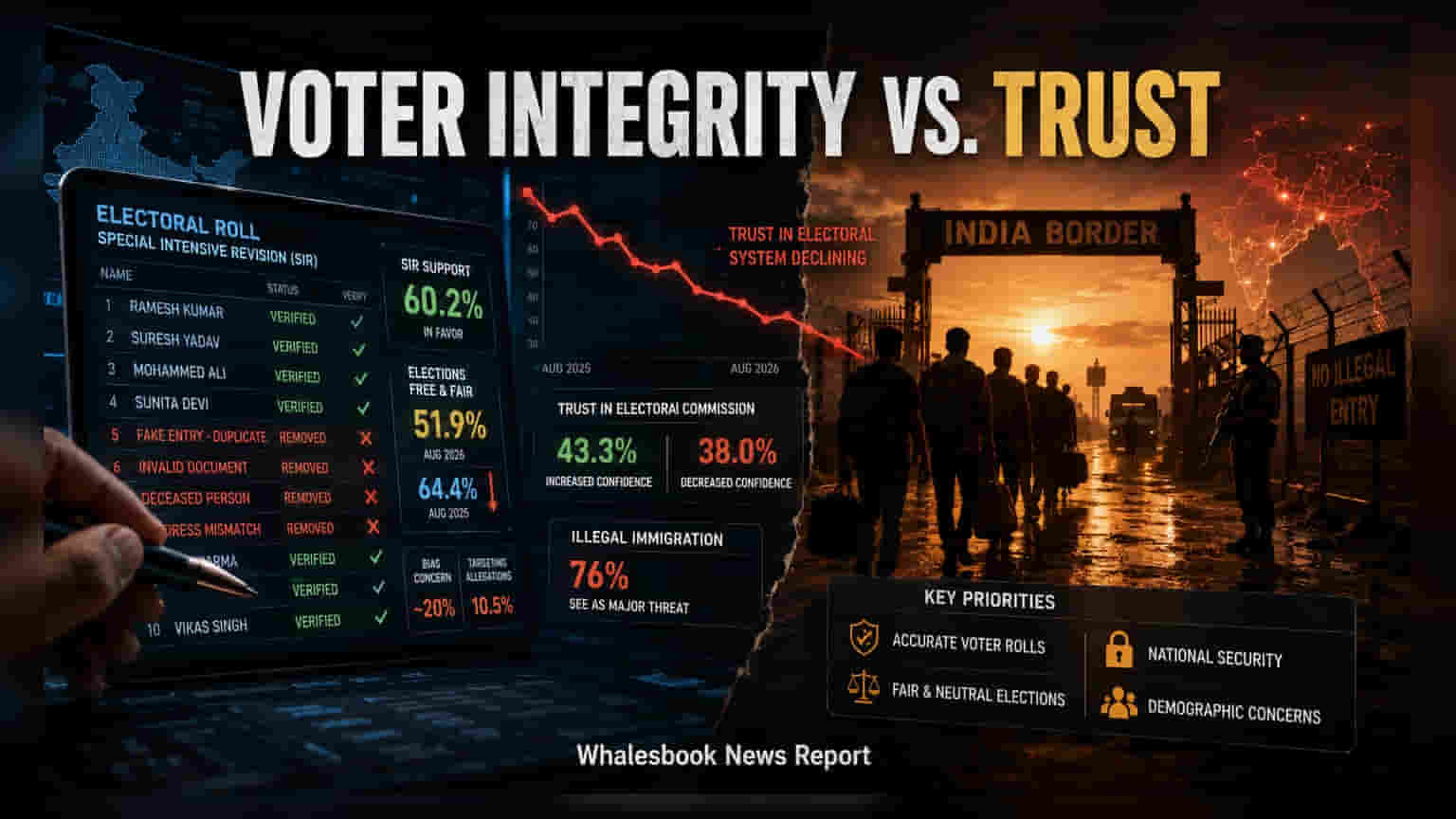
The August 2026 'Mood of the Nation' survey reports that 60.2% of Indians back the Election Commission's voter roll cleanup efforts. However, public confidence in fair elections has fallen to 51.9% from 64.4% last year. Additionally, 76% of respondents view illegal immigration as a major security threat, highlighting complex social and political undercurrents that may influence the national environment.
The latest 'Mood of the Nation' survey for August 2026 reveals a complex shift in public sentiment regarding India's electoral and security framework. While the Election Commission's Special Intensive Revision (SIR) process to remove bogus entries from voter rolls enjoys majority backing—with 60.2% of respondents in favor—the public remains increasingly skeptical of the broader electoral system.
The findings highlight a steady erosion of confidence in the neutrality of elections. Only 51.9% of citizens now believe that Indian elections are free and fair. This figure marks a significant decline from the 64.4% approval rating recorded in August 2025, suggesting that trust in institutional processes is becoming a growing point of discussion for the general public. While the desire for accurate voter registries is high, the survey indicates that administrative execution has become a point of political debate.
Nearly 20% of survey participants raised concerns about potential bias in the verification process, and 10.5% explicitly claimed the initiative could be used to target specific demographics. These doubts suggest that while the goal of administrative integrity is popular, the methods used to achieve it are facing intense scrutiny. This atmosphere of skepticism poses a challenge for election authorities in maintaining public perception.
Simultaneously, the survey identifies national security and demographics as major priorities for the public. A substantial 76% of respondents identified illegal immigration as a critical threat to the country. This concern likely reinforces the demand for stricter verification measures in voter rolls, as public anxiety regarding identity and security continues to drive political discourse. With trust in the poll panel currently divided—43.3% of respondents report increased confidence while 38% report a decrease—the balance between administrative rigor and perceived fairness remains fragile.
For observers of the national environment, the critical monitorable is how the Election Commission manages these competing perceptions. As the country moves forward, the ability of institutions to address concerns about both administrative accuracy and electoral fairness will determine the trajectory of public trust. The data suggests that as long as these debates remain active, they will continue to influence political stability and social cohesion.