 Whalesbook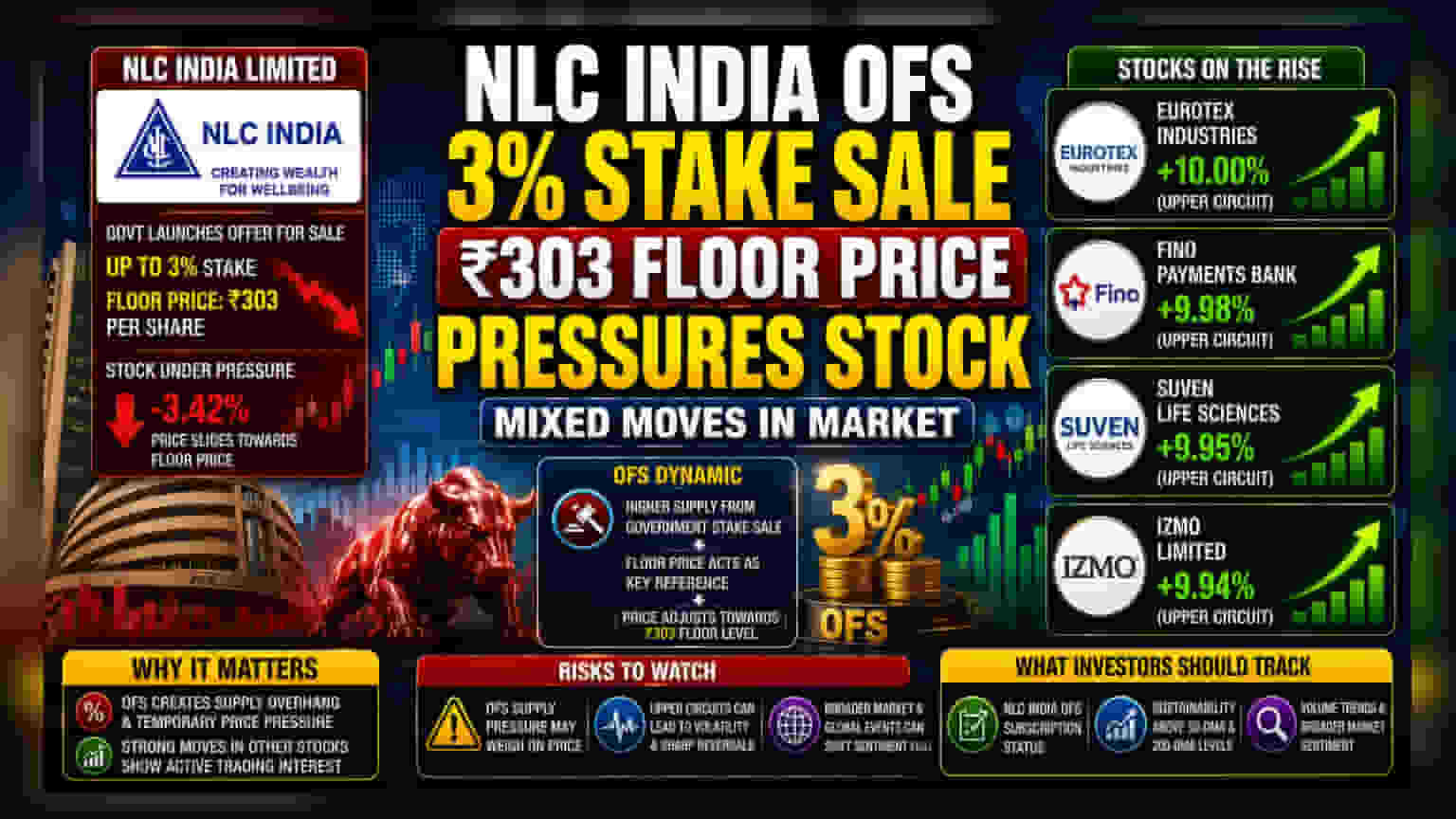


What Happened
On June 9, 2026, the Indian equity market saw mixed trading activity with a focus on specific stock movements and a major government divestment announcement. Shares of NLC India Limited witnessed downward pressure following the government's launch of an Offer for Sale (OFS). The government, aiming to divest up to a 3% stake in the public sector company, set a floor price of ₹303 per share, which was lower than the prevailing market price. Concurrently, other stocks, including Eurotex Industries, Fino Payments Bank, and Suven Life Sciences, displayed strong price action, with some stocks hitting upper circuits—the maximum permissible limit a stock can rise in a single trading session.
Why This Matters For Investors
The NLC India OFS is a significant event for shareholders, as government divestments can temporarily create a supply overhang, often leading to a price adjustment toward the floor price. For retail and non-retail investors, the event highlights the government's ongoing disinvestment program for the fiscal year. Meanwhile, the momentum seen in other stocks, such as Eurotex and Suven Life Sciences, indicates a segment of the market where technical traders are active, looking for breakouts above key moving averages. These price moves are often driven by short-term volume spikes rather than immediate changes in fundamental business value.
How The Stock Reacted
NLC India shares faced selling pressure as the market adjusted to the OFS pricing. Typically, when an OFS is priced at a discount to the market rate, the stock price tends to gravitate toward that floor price as market participants balance their positions. Conversely, stocks like Eurotex Industries and IZMO saw significant gains, with some reaching their upper circuits. This indicates that despite the broader market's cautious approach regarding the NLC OFS, there was robust buying interest in specific smaller or mid-cap companies.
The OFS Dynamic
When a large shareholder like the government decides to sell a stake, it increases the supply of shares available in the market. The floor price of ₹303 acts as a key reference point for investors. If the market price remains significantly above this level, the discount offered in the OFS becomes attractive for institutional investors. However, for existing shareholders, the immediate impact is often a drop in price as the market prices in the dilution or the availability of cheaper shares through the bidding process.
Risks and Market Context
Investors should be cautious when tracking stocks based solely on momentum, such as those hitting upper circuits. High trading volume and sharp price increases without corresponding news can sometimes lead to volatility, where prices may reverse quickly if the buying momentum fades. In the case of NLC India, the primary risk is the near-term supply pressure caused by the OFS. Furthermore, broader market volatility can affect how these stocks perform over the coming days, regardless of individual company strength.
What Investors Should Track
For NLC India, the key monitorable is the subscription status of the OFS from non-retail and retail investors, which will be updated as the offer progresses. For the stocks showing momentum, investors may observe whether they can maintain their positions above their key moving averages (such as the 50-day and 200-day averages) over the next few sessions. Sustained trading above these levels can suggest more than just a short-term breakout. Investors should also keep an eye on broader market sentiment, as geopolitical or macro-economic updates can shift investor focus away from individual stock stories quickly.