

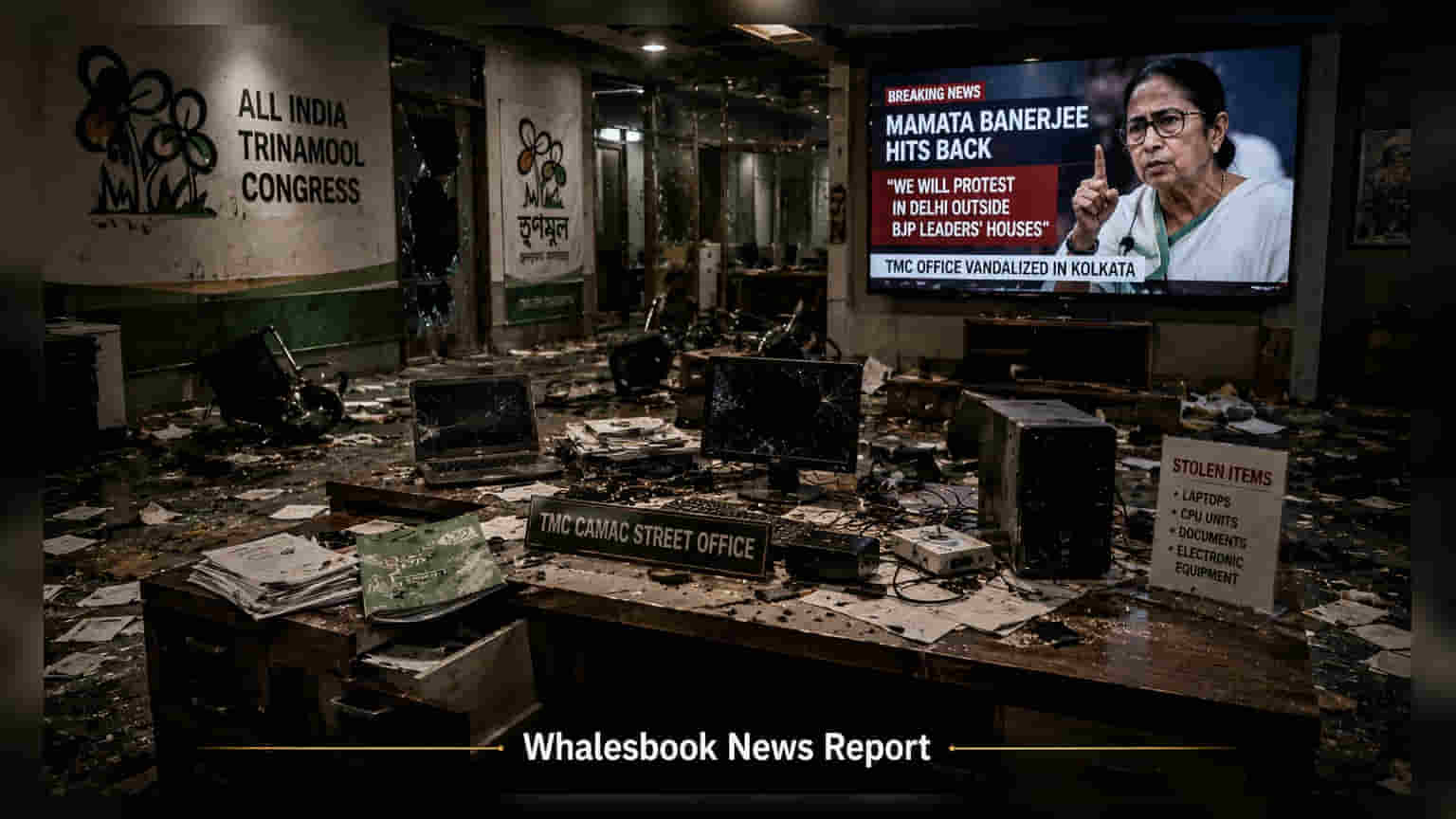
West Bengal Chief Minister Mamata Banerjee has threatened to hold protests in New Delhi outside BJP leaders' homes following the vandalization of a TMC office in Kolkata. While the incident is a political matter, it has intensified regional tensions. Investors often monitor such political volatility, as stable administrative environments are considered essential for smooth business operations and economic planning in the state.
West Bengal Chief Minister Mamata Banerjee has threatened to organize protests in New Delhi outside the residences of Bharatiya Janata Party (BJP) leaders following an incident of vandalism at a Trinamool Congress (TMC) office on Camac Street in Kolkata. The Chief Minister publicly attributed the act to opposition-backed operatives, claiming the incident signals a breakdown in law and order in the state.
Kolkata Police confirmed the detention of six individuals in connection with the raid, which reportedly involved the destruction of office furniture and the theft of electronic equipment and documents. TMC leadership has shared footage of the event to support their allegations of institutional failure, while the BJP has denied involvement in the incident. This has resulted in a sharp escalation of rhetoric between the two political parties.
For investors and the business community, this event draws attention to the stability of the operating environment in West Bengal. While the Indian stock market is primarily driven by national macroeconomic factors, localized political friction can create uncertainty. A stable administrative environment is generally viewed as crucial for the execution of long-term infrastructure projects, the implementation of state policies, and the smooth day-to-day operations of businesses present in the region.
While there is no direct impact on listed company stocks from this specific political event, the regional investment climate often depends on the ability of local authorities to maintain law and order. Prolonged political volatility can sometimes influence sentiment regarding new investments or expansion plans within the state.
The situation remains fluid as both parties continue to trade accusations. The next important developments for observers will be the progress of the police investigation and whether the threatened protests in New Delhi materialize. Investors will also watch to see if the political tension remains limited to specific administrative disputes or if it starts to impact the broader governance and stability of the state.