 Whalesbook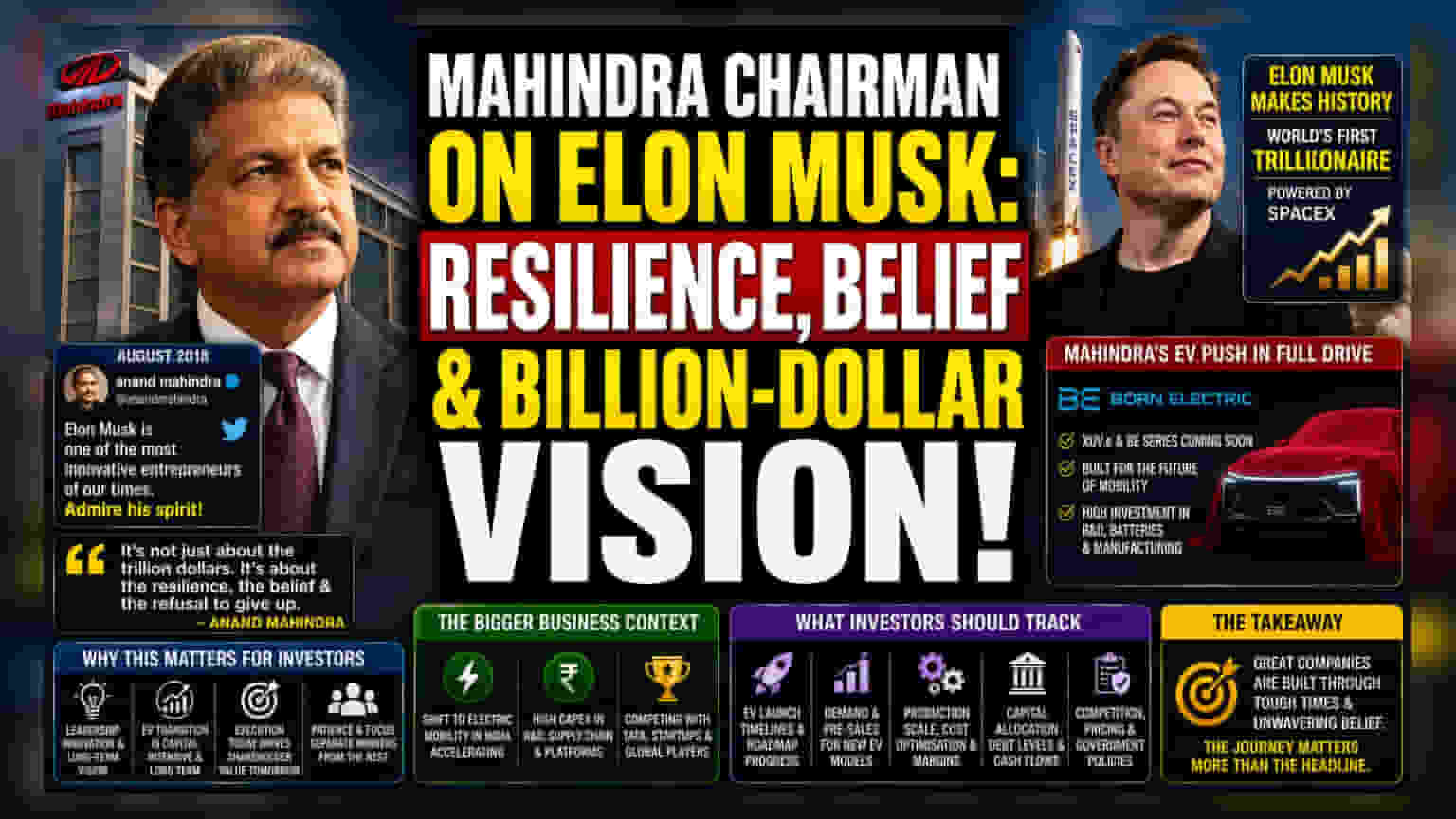


Following Elon Musk’s rise to a trillion-dollar valuation, Chairman Anand Mahindra reflected on his early support for Tesla during its 2018 production crisis. For Indian investors, this highlights the critical role of long-term vision and resilience in the capital-intensive electric vehicle sector. As M&M pivots toward its own electric ambitions, the market continues to track the company's ability to balance innovation with execution and profitability.
What Happened
Anand Mahindra, Chairman of the Mahindra Group, recently reflected on his public message of support for Elon Musk posted in August 2018. At the time, Tesla was navigating a difficult period characterized by production delays and skepticism regarding its future. In his message, Mahindra praised Musk’s innovative spirit. With Musk recently becoming the world’s first trillionaire—driven by the valuation of SpaceX—Mahindra emphasized that the real story behind this milestone is the entrepreneur’s resilience and unwavering belief, rather than just the financial outcome. He noted that true innovation is tested in a leader's toughest moments.
Why This Matters For Investors
For Indian stock market investors, this reflection sheds light on the importance of long-term vision, particularly in sectors undergoing massive technological transformation like the automotive industry. Leadership style, patience, and the ability to maintain focus during high-cash-burn phases are often key to successfully scaling new business segments. As major Indian conglomerates like Mahindra & Mahindra transition toward electric mobility, understanding these leadership traits becomes a factor in evaluating the management's long-term strategy for shareholder value.
The Bigger Business Context
Mahindra & Mahindra is currently in the middle of a significant capital-spending phase aimed at capturing the growing electric vehicle market in India. The company has been building out its 'Born Electric' platform, with specific plans for its XUV.e and BE series of vehicles. This shift involves high investment in research and development, supply chain infrastructure, and manufacturing capabilities. Unlike the internal combustion engine business, the EV segment requires a different set of competencies, including battery technology and software integration. The company is competing in a sector that includes aggressive players like Tata Motors, as well as new entrants and global manufacturers, making the execution of these plans vital for future growth.
How Investors May Read This
Investors often look at how management approaches risk and long-term planning. The transition to electric vehicles is not a short-term project; it requires sustained investment and the ability to navigate initial hurdles, similar to the challenges Tesla faced in its early years. For shareholders, the key focus remains on whether the company can maintain healthy profit margins while funding these expansion plans. The market typically rewards firms that can scale their new-age businesses without significantly compromising their core profitability or stretching their balance sheet beyond sustainable levels.
What Investors Should Track
Moving forward, the primary monitorables for investors include the progress of the company’s EV roadmap and the timeline for vehicle launches. Investors may track the actual consumer demand for upcoming electric models compared to market expectations, as well as the company’s ability to optimize production costs. Keeping an eye on quarterly earnings reports for updates on capital allocation and debt levels will be important to understand how the company is financing its transition. Additionally, watching how the competitive landscape in the Indian EV market evolves—including pricing trends and government policy changes—will help assess the viability of the company’s expansion strategy.