

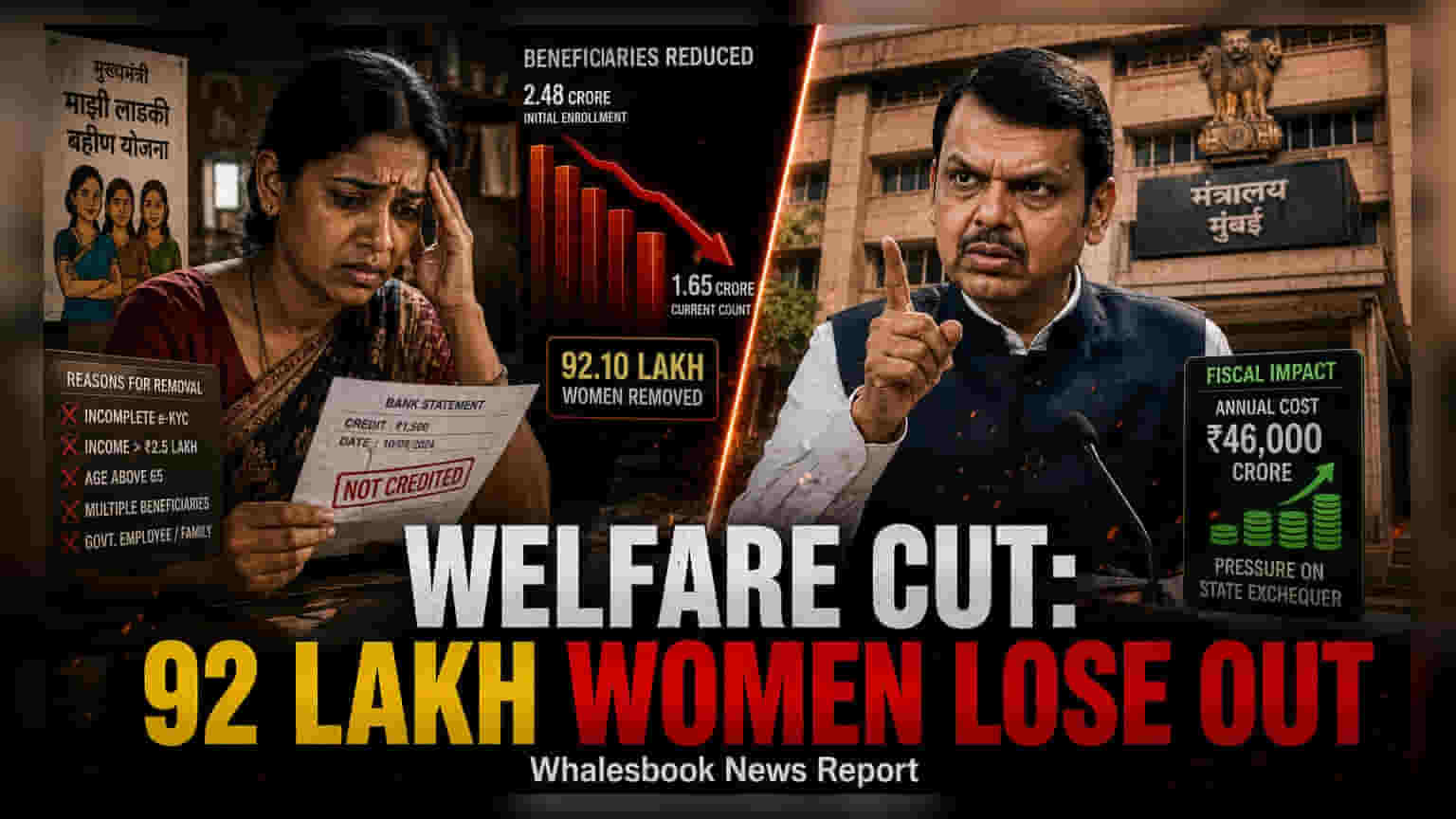
The Maharashtra government has removed 92.10 lakh beneficiaries from the 'Mukhyamantri Majhi Ladki Bahin Yojana', reducing the total count from 2.48 crore to 1.65 crore. The move, attributed to strict eligibility verification, is a critical monitorable for state fiscal health given the scheme’s estimated annual cost of nearly ₹46,000 crore.
The Maharashtra government’s flagship 'Mukhyamantri Majhi Ladki Bahin Yojana' has become the subject of scrutiny following a significant reduction in its beneficiary list. Recent data indicates that the number of registered beneficiaries has dropped to 1.65 crore from an initial enrollment of 2.48 crore, marking a removal of approximately 92.10 lakh individuals. This development has sparked political debate regarding the management and implementation of the welfare scheme, which was launched ahead of the August 2024 assembly elections.
Reasons for Beneficiary Reduction
State authorities have defended the reduction, attributing it to a rigorous verification process. According to the government, the removals were necessary to ensure that only eligible candidates receive the monthly stipend of ₹1,500. The primary reasons cited for disqualification include incomplete e-KYC documentation, failure to meet annual family income criteria (set at ₹2.5 lakh), and age limits (those over 65). Other reasons for removal include instances of multiple beneficiaries within a single household and the disqualification of government employees or their families, who are ineligible for the scheme.
Opposition leaders, including senior Congress leader Vijay Wadettiwar, have challenged this explanation, characterizing the move as a withdrawal of support after the electoral phase. The controversy highlights the complexities of managing large-scale, direct-benefit transfer programs where administrative efficiency often clashes with broad-based public outreach.
Fiscal and Economic Implications
For observers of state economics, this scheme represents a massive financial commitment. With a cost estimated at roughly ₹46,000 crore annually, the program puts significant pressure on the state exchequer. The move to trim the beneficiary list can be viewed as an exercise in fiscal rationalization. By tightening eligibility, the government manages the cash outflow required to maintain the program's sustainability within the state’s overall budgetary framework.
However, the mass removal of beneficiaries also presents administrative and governance risks. The reliance on digital verification tools like e-KYC has been a hurdle for many, particularly in rural or digitally disconnected areas. There is an ongoing challenge to balance fiscal prudence with ensuring that genuine, intended beneficiaries do not lose access to state support due to documentation issues or technical glitches in the verification system.
What Investors and Observers May Track Next
The key monitorable for the coming months will be the stability of the final beneficiary count and the state's ability to maintain the scheme’s funding without disrupting other development projects. Future updates on the fiscal deficit, the consistency of monthly transfers, and the government’s response to concerns regarding the verification process will be essential to gauge the long-term impact on the state’s financial health.