

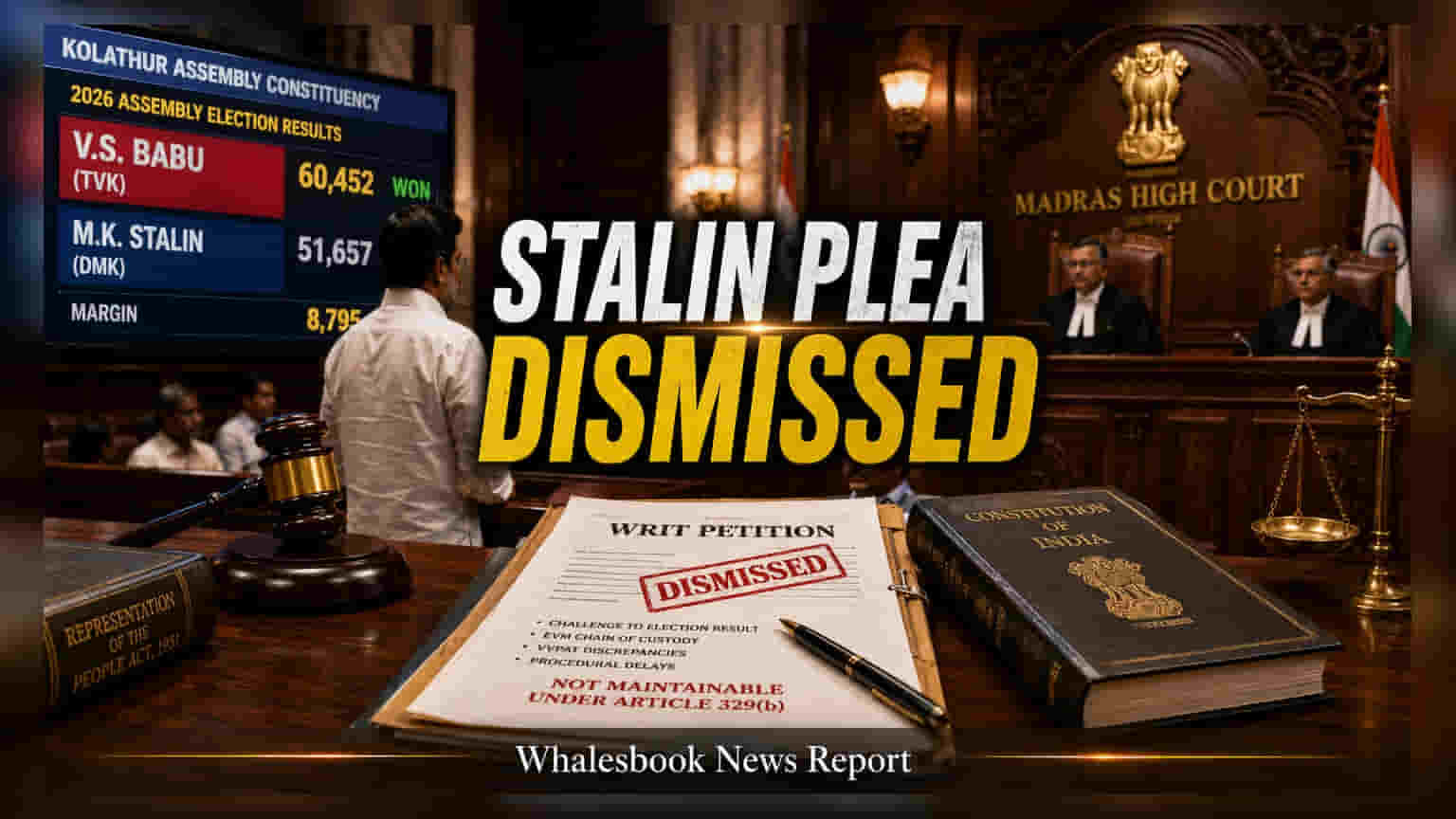
The Madras High Court has dismissed a petition by DMK leader MK Stalin challenging the 2026 assembly election results in the Kolathur constituency. The court ruled that the challenge was non-maintainable, effectively confirming the victory of TVK candidate V.S. Babu. This decision brings legal finality to the current dispute surrounding the seat.
On Thursday, the Madras High Court dismissed a writ petition filed by DMK president and former Tamil Nadu Chief Minister MK Stalin, who had challenged the election outcome in the Kolathur assembly constituency. The court, led by a bench comprising the Chief Justice and Justice G. Arul Murugan, ruled that the plea was not maintainable, effectively upholding the win of Tamilaga Vettri Kazhagam (TVK) candidate V.S. Babu.
The legal dispute originated from the 2026 assembly elections, where Mr. Stalin was defeated by a margin of 8,795 votes. Following the declaration of results on May 4, 2026, the DMK leader had approached the court citing concerns over the electoral process. The petition alleged various irregularities, including issues with the chain of custody for Electronic Voting Machines (EVMs) and discrepancies in Voter Verified Paper Audit Trail (VVPAT) slips, alongside claims of procedural delays in the verification process.
The court’s decision was rooted in constitutional and procedural law. It upheld the Election Commission of India’s (ECI) argument that election disputes are governed by Article 329(b) of the Constitution and the Representation of the People Act, 1951. Under these laws, challenges to election results must be submitted through formal election petitions rather than through writ petitions. Because the petitioner did not follow this specific statutory route, the bench determined the current challenge could not proceed.
For those observing the political and governance environment in Tamil Nadu, the resolution of such legal disputes is relevant as it relates to political stability. A clear and settled electoral process is generally considered supportive of a stable policy environment, which is a factor often monitored by stakeholders assessing the state’s long-term administrative continuity. By resolving this specific challenge, the court has provided immediate legal clarity regarding the Kolathur seat.
While this specific legal challenge has been dismissed, the broader discussions concerning EVM protocols and electoral processes continue to be a subject of public debate. Investors and market watchers generally monitor these developments as part of the broader political landscape, which influences the state’s legislative and administrative climate. The next steps in the matter, such as whether further legal remedies are pursued under the appropriate statutory framework, will depend on the strategy adopted by the involved parties.