 Whalesbook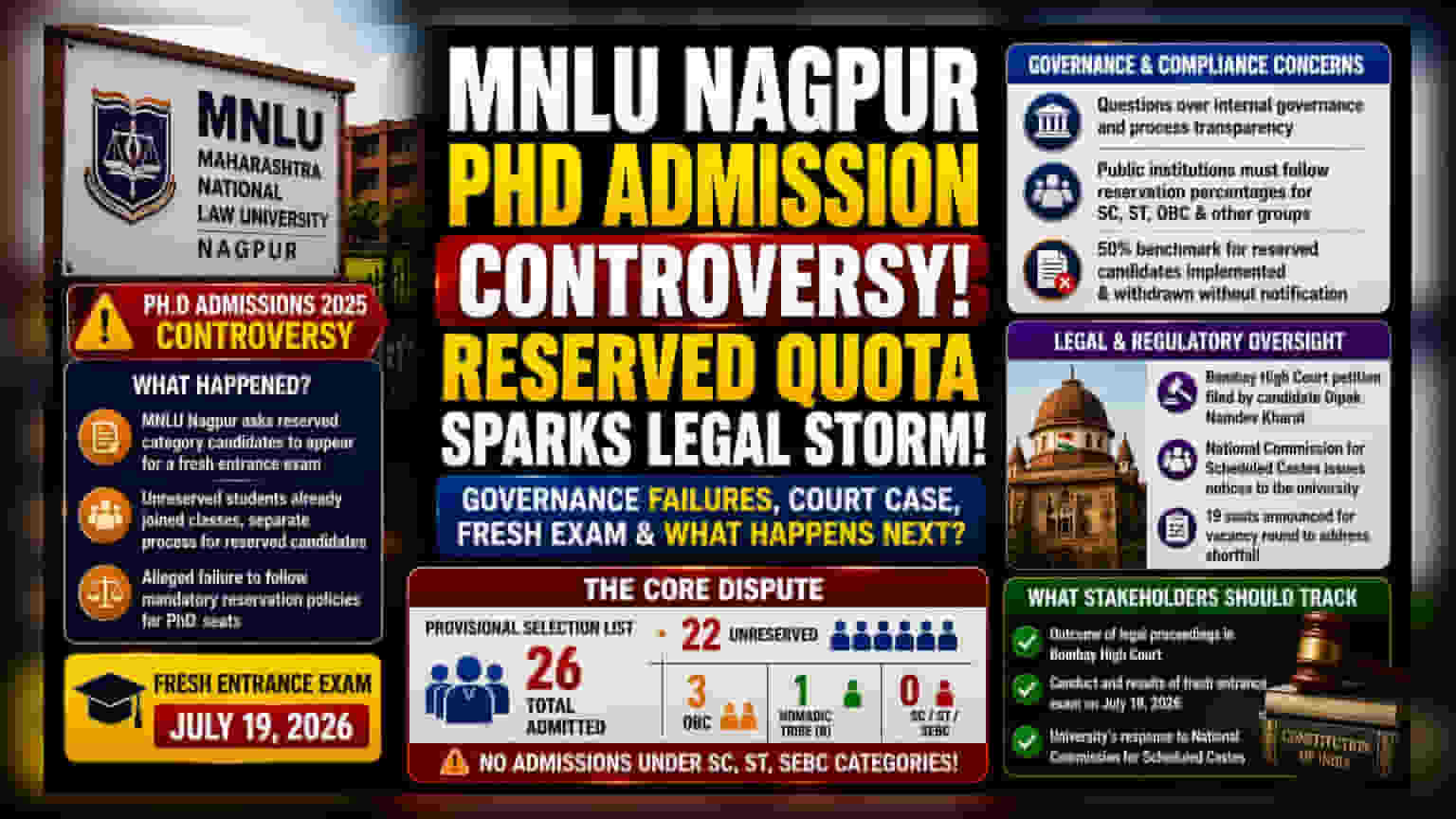


Maharashtra National Law University (MNLU), Nagpur, is under scrutiny for its 2025 PhD admission process. The institution has announced a new entrance exam for reserved category candidates amid allegations that it failed to implement mandatory reservation quotas. The issue has drawn attention from the National Commission for Scheduled Castes and is being contested in the Bombay High Court due to concerns regarding fair representation and admission transparency.
What Happened
Maharashtra National Law University (MNLU), Nagpur, has sparked controversy regarding its PhD admission process for the 2025 academic batch. The university recently issued a notification requiring reserved category candidates to appear for a fresh entrance examination. This decision follows growing criticism regarding the university's alleged failure to follow mandatory reservation policies for PhD seats. The move has led to a disjointed admission cycle, where unreserved category students have already begun classes, while a separate process is now being organized for reserved category applicants.
Governance and Compliance Concerns
For any public institution, the fair implementation of reservation quotas is a core administrative requirement. The current situation at the university raises significant questions about internal governance and process transparency. Public institutions in India are mandated to adhere to specific reservation percentages for SC, ST, OBC, and other groups. When a selection process appears to deviate from these norms, it often leads to administrative and legal challenges, which can disrupt the academic calendar and damage the institution's reputation.
The Core Dispute
Concerns were initially raised after the university released a provisional selection list in February 2026. Out of 26 admitted candidates, 22 were from the unreserved category. Only four candidates from reserved categories—three OBC and one Nomadic Tribe (B)—secured admission. There were no candidates admitted under the SC, ST, or SEBC categories, which triggered protests and formal complaints. The university had reportedly implemented and then withdrawn a 50% benchmark for reserved candidates, which was not initially notified. This specific issue was raised in the Bombay High Court by a candidate, Dipak Namdev Kharat, who had qualified for a reserved seat but was not admitted.
Legal and Regulatory Oversight
The National Commission for Scheduled Castes has issued notices to the university regarding the implementation of these quotas. This regulatory attention adds a layer of complexity to the university’s administrative decisions. The university has now announced a vacancy round for 19 seats to address the shortfall, with a fresh entrance exam scheduled for July 19, 2026. However, observers have pointed out that even with these additional seats, the total allocation for reserved categories may still fall short of the percentages required by law. For instance, calculations suggest that the OBC reservation quota, which should align with a specific seat count based on the total intake, does not match the actual number of allocated seats.
What Stakeholders Should Track
As the situation develops, there are several key areas to monitor. The outcome of the legal proceedings in the Bombay High Court remains a critical factor for the university's admission policy. Furthermore, stakeholders will be watching how the university manages the new entrance exam scheduled for July 2026 and whether this results in a fair and transparent admission process for all reserved category applicants. The university's response to the inquiries from the National Commission for Scheduled Castes will also be a primary indicator of how the institution plans to resolve these governance concerns.