

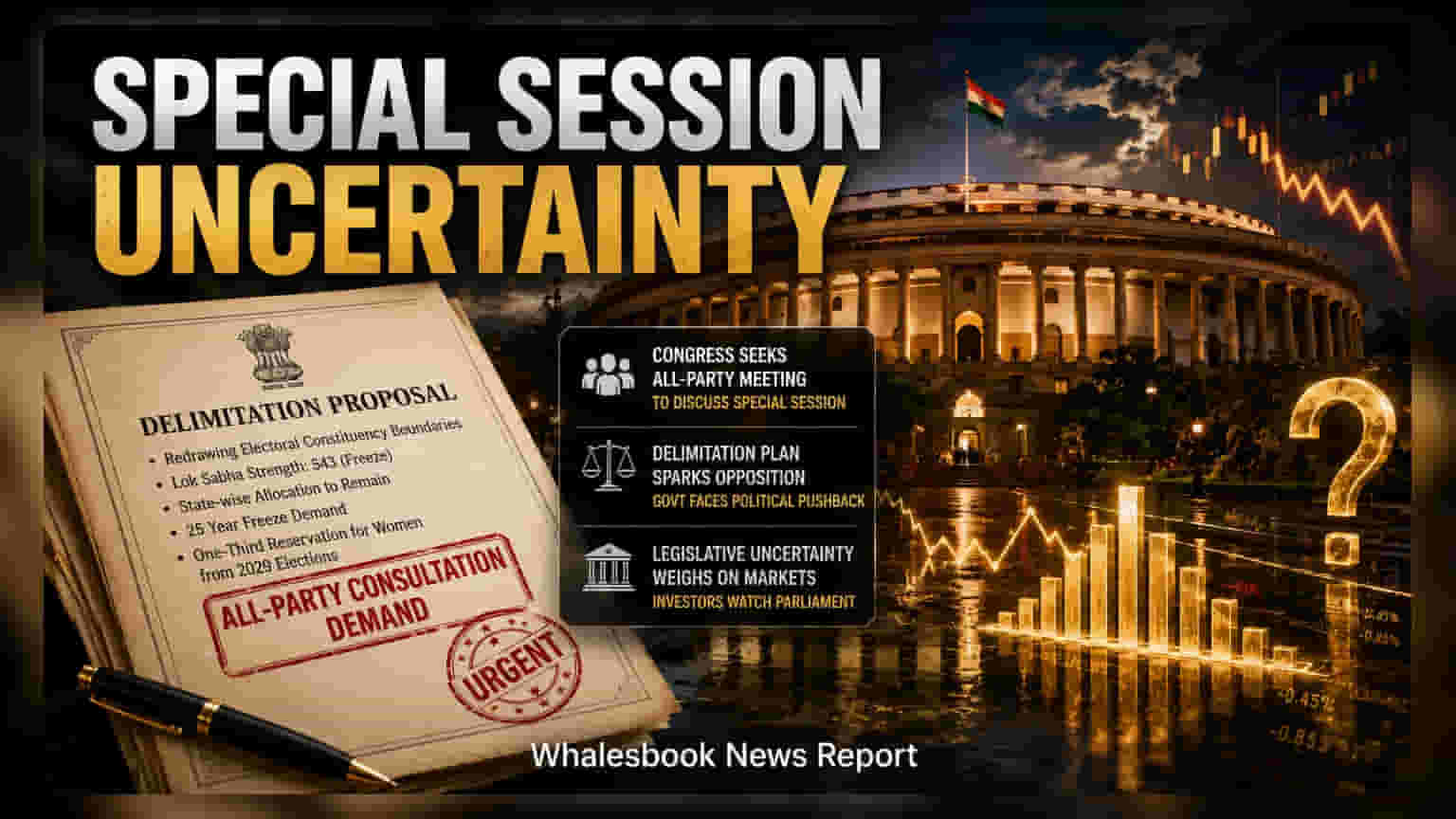
Congress President Mallikarjun Kharge has urged Prime Minister Narendra Modi to convene an all-party meeting regarding a possible special Parliament session on delimitation. This follows recent comments by Parliamentary Affairs Minister Kiren Rijiju. For investors, renewed political friction and the potential for legislative gridlock over constitutional amendments create policy uncertainty, which is a key monitorable for market sentiment.
Congress President Mallikarjun Kharge has written to Prime Minister Narendra Modi, demanding an all-party meeting to discuss the government's plans for a potential special session of Parliament. The request follows recent remarks by Union Minister of Parliamentary Affairs Kiren Rijiju, who noted the possibility of reconvening the House. The Monsoon Session, which concluded in mid-August 2026, was adjourned sine die rather than prorogued, leaving the procedural door open for the government to call a fresh sitting if required.
The Delimitation Agenda and Policy Uncertainty
The central issue causing friction is the government's proposed plan for delimitation, the process of redrawing electoral constituency boundaries. Mallikarjun Kharge has expressed strong reservations, emphasizing that any such move requires broad political consultation. The Opposition has outlined specific conditions, including a demand to freeze the current Lok Sabha strength of 543 seats and maintain existing state-wise allocations for at least 25 years. They also continue to advocate for the implementation of one-third reservation for women, proposing its integration into the 2029 electoral cycle.
For the markets and investors, legislative stability is a priority. The government previously faced a setback in April 2026, when the Constitution (131st Amendment) Bill—which aimed to address aspects of delimitation and reservation—failed to secure the necessary two-thirds majority in the Lok Sabha. When legislative efforts regarding significant constitutional changes hit a roadblock, it can signal deeper political divides, potentially delaying other policy reforms or creating an environment of uncertainty that investors generally prefer to avoid.
Monitoring Legislative Risks
The current situation creates a dynamic where policy direction regarding federal representation remains unclear. Investors typically watch parliamentary sessions closely because they determine the pace of economic and structural reforms. If the government proceeds with a special session without building a consensus, it could lead to increased parliamentary disruption. Such volatility in the legislative process often translates into short-term market anxiety, as institutional and retail investors assess the likelihood of key bills being passed or stalled.
As of now, the government has not provided a formal response to the demands for consultation or confirmed the schedule for a special session. The next phase to track will be any official communication from the Parliamentary Affairs Ministry regarding the session dates or the agenda for the legislative business. Investors will likely watch for signs of either a cross-party consensus, which would lower political risk, or a continued standoff, which could prolong policy ambiguity in the coming months.