

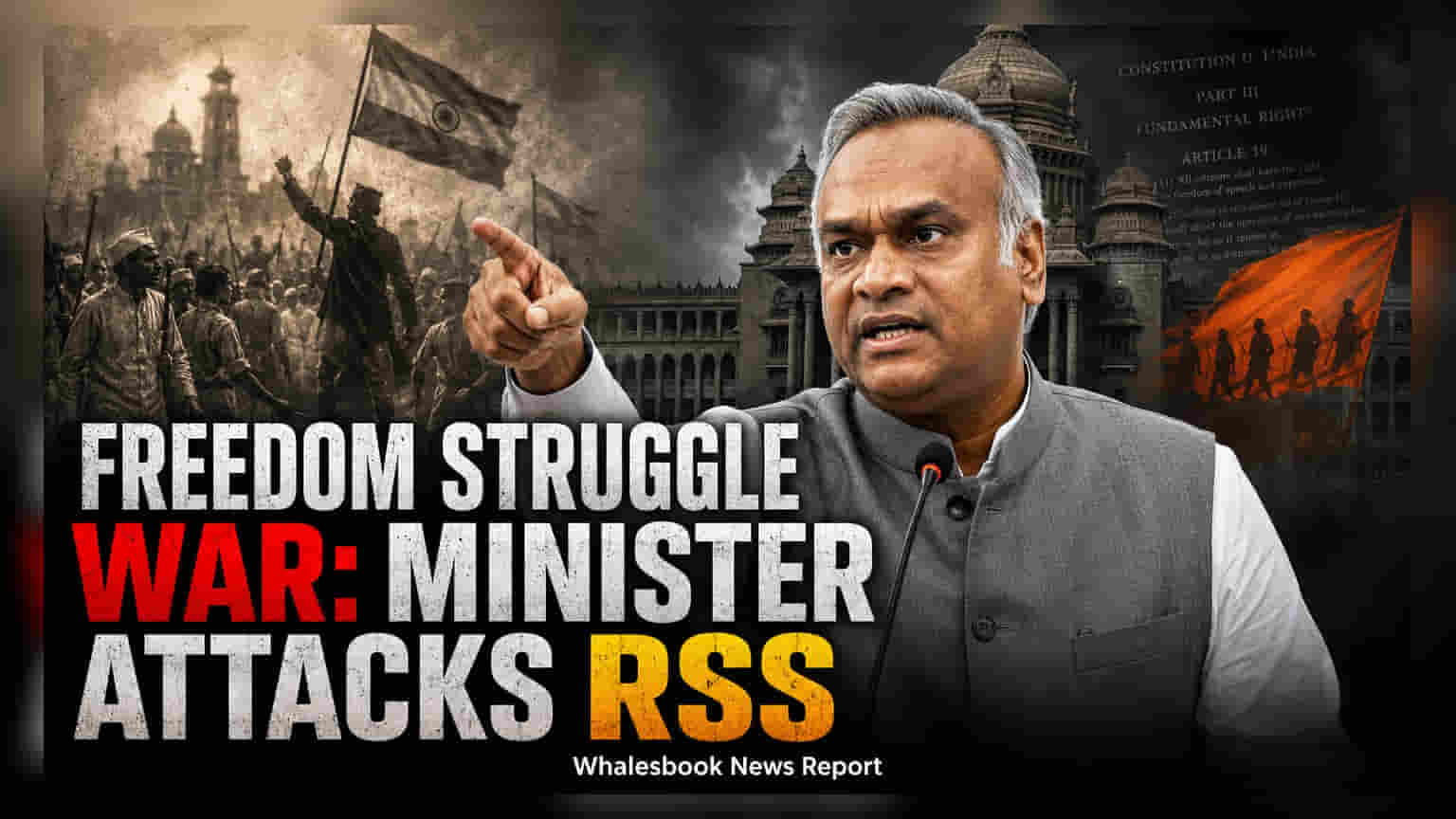
Karnataka Home Minister Priyank Kharge has questioned the RSS over its freedom struggle history and registration status, coinciding with the state government's new bill to regulate public property usage. This political development has no impact on listed stocks or Indian financial markets, as the RSS is not a corporate entity.
Karnataka Home Minister Priyank Kharge has publicly criticized the Rashtriya Swayamsevak Sangh (RSS) regarding its historical role during India's freedom struggle and its lack of formal registration. This statement follows the Karnataka government's recent cabinet approval of the 'Karnataka Regulation of Use of Government Premises and Public Property Bill, 2026'.
The proposed legislation mandates that organizations must obtain prior permission from a competent authority before utilizing government premises or public property. The state government maintains that this measure is a neutral, administrative step aimed at ensuring the regulated use of public spaces in accordance with past judicial directives. Officials have rejected claims that the bill specifically targets the RSS, asserting that it is intended to create a standardized framework for all organizations seeking to operate in public facilities.
In response to these developments, BJP leader B.L. Santhosh stated that the RSS does not require formal registration to operate. He emphasized that the organization functions based on public trust and has been active for decades without the need for official corporate documentation, contrasting this with the government's focus on formal registration status.
For investors and market participants, it is crucial to understand that the RSS is not a listed company, nor is it a commercial entity traded on the National Stock Exchange (NSE) or the Bombay Stock Exchange (BSE). Consequently, this political and administrative controversy does not carry any financial, regulatory, or operational implications for the stock market or any listed corporate entities in India. Readers following this news should categorize it as a matter of public policy and political discourse rather than an event with business or investment consequences.