

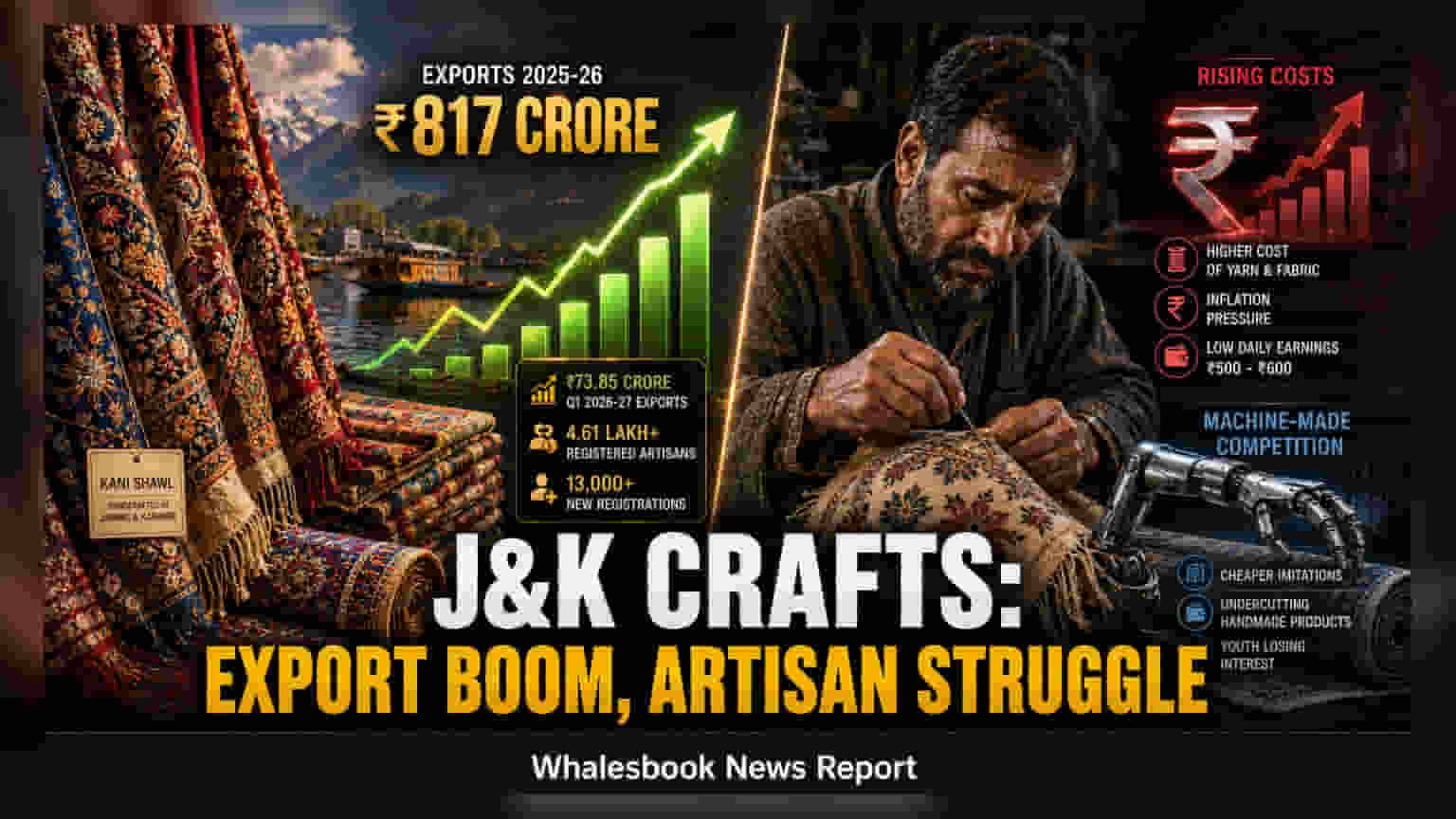
Jammu and Kashmir’s handicraft exports grew to ₹817.39 crore in fiscal year 2025-26, supported by over 4.6 lakh registered artisans. However, the sector faces a reality gap as craftsmen struggle with stagnant daily wages, rising material costs, and competition from cheaper machine-made alternatives. This creates a long-term sustainability risk for the region's traditional craft industry.
The handicraft sector in Jammu and Kashmir has reported a significant performance in the export market, with total exports reaching ₹817.39 crore during the 2025-26 fiscal year. This upward trend continued into the current year, with the first quarter of 2026-27 already recording exports worth ₹73.85 crore. The official registry of artisans and weavers has also expanded, with over 13,000 new registrations contributing to a total base of more than 4.61 lakh individuals.
The Artisan Income Squeeze
Despite the growth in export volumes, a stark divide remains between trade figures and the economic well-being of the actual craftsmen. Many artisans report that their daily earnings, often ranging between ₹500 and ₹600, have remained largely unchanged for years. This income stagnation is being compounded by the rising cost of raw materials, such as high-quality fabric and thread. Because traditional crafts like Kani shawls and hand-knotted carpets are highly labor-intensive—sometimes requiring months or years to complete—the limited daily wage makes it difficult for many families to keep up with rising household expenses.
Competition and Sustainability Risks
The most pressing challenge for the sector is the proliferation of machine-made imitations. These mass-produced items are sold at much lower price points than authentic handmade products, effectively undercutting the market for traditional weavers. This economic pressure is not only affecting current livelihoods but also acting as a deterrent for younger generations. Many artisans fear that the combination of low wages and the intense training required to master these crafts is driving the youth away from the profession, threatening the survival of centuries-old skills.
Strategic Efforts to Protect Craft Integrity
To address these issues, the Handicrafts Department has ramped up efforts to safeguard the region’s traditional products. A key pillar of this strategy is the use of Geographical Indication (GI) tags, which certify that a product is authentically made in the region and follows traditional methods. Currently, 18 out of 68 notified crafts have received GI tags. Additionally, the government is focusing on digital integration, encouraging artisans to sell directly through platforms like the Open Network for Digital Commerce (ONDC) to bypass intermediaries and capture a larger share of the final sale price.
Monitorables for the Sector
The long-term viability of the industry will likely depend on whether these protective measures, such as GI tagging and credit access through schemes like the Artisans/Weavers Credit Card, can effectively translate into higher net income for the craftsmen. Key indicators to watch in the coming quarters include the adoption rate of digital platforms by small-scale artisans, the success of GI-tagged products in commanding a premium price in export markets, and the ability of the sector to curb the flow of low-cost imitations that continue to compress artisan margins.