 Whalesbook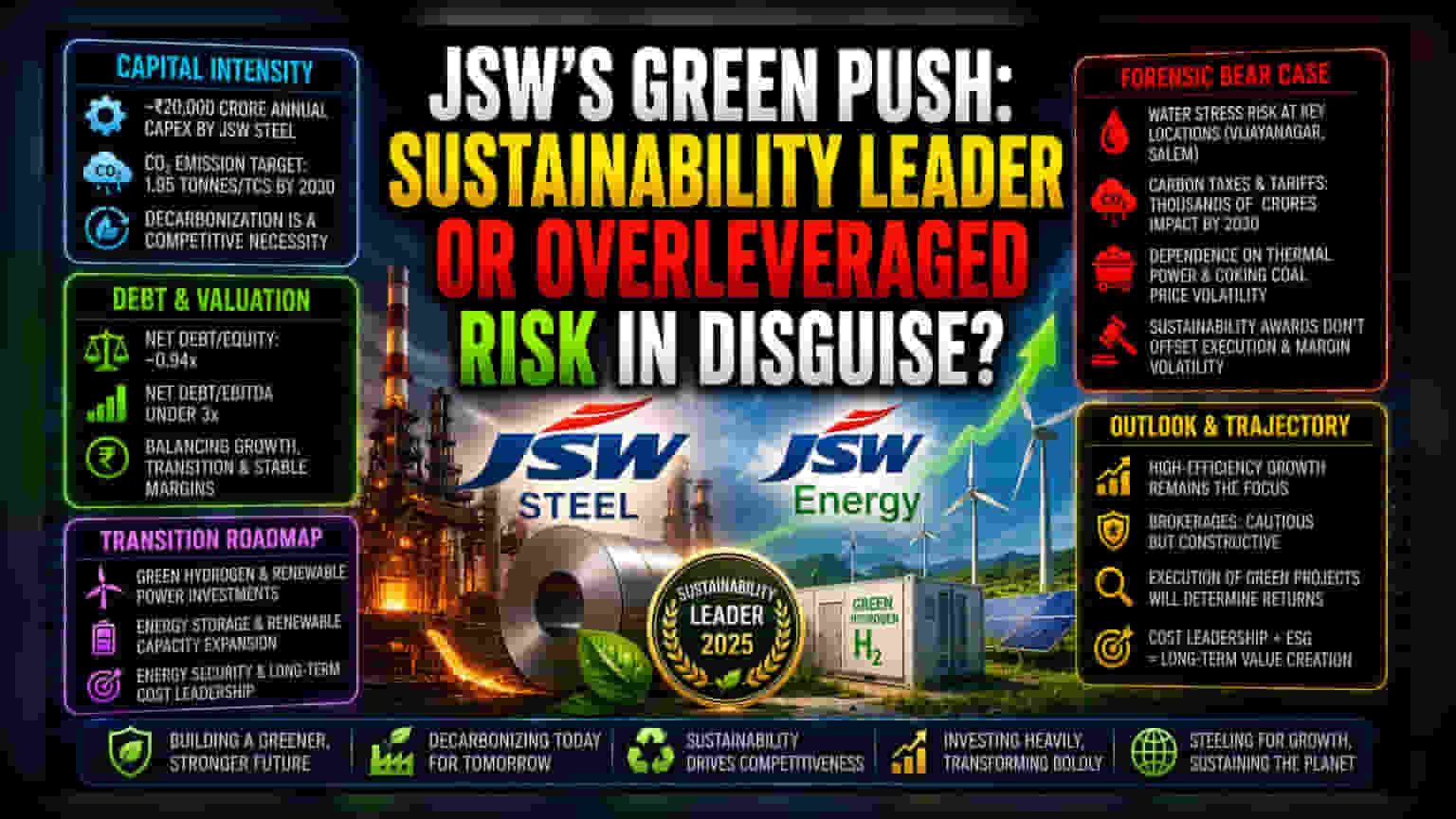


The Capital Intensity of Decarbonization
While industry accolades often focus on the ceremonial aspects of sustainability, the operational reality for JSW Steel and JSW Energy is significantly more complex. The group is currently navigating a period of heavy capital allocation, with JSW Steel maintaining an annual capital expenditure of approximately ₹20,000 crore. This spending is not merely for expansion but is essential to meet its decarbonization targets, including a specific goal to reduce carbon dioxide emissions to 1.95 tonnes per tonne of crude steel by 2030. For a company operating in one of the most carbon-intensive sectors globally, these investments are a competitive necessity to avoid future margin compression from emerging trade-related carbon border adjustment mechanisms.
The Valuation and Debt Balancing Act
Market participants continue to weigh these heavy environmental investments against the company's balance sheet strength. JSW Steel has maintained a net debt-to-equity ratio that reflects its ongoing growth phase, currently hovering around 0.94x as of recent filings. Unlike smaller, less-leveraged peers, JSW’s strategy relies on operational efficiency and scale to keep its net debt-to-EBITDA ratio under 3x. This balancing act is critical; the company must fund its transition to green hydrogen and renewable power without compromising the stable margins that investors have come to expect. While institutional investors watch these ESG metrics closely, the broader market often remains skeptical of whether such capital-intensive transitions can consistently generate the same historical shareholder returns in an era of tightening environmental regulations.
The Forensic Bear Case: Transition Risks
Investors remain wary of the structural risks inherent in the group's transition. A primary concern is the vulnerability of its facilities to physical climate risks, such as water stress at critical locations like Vijayanagar and Salem. Furthermore, the implementation of carbon taxes and tariffs poses a tangible threat to future margins, with estimates suggesting potential financial impacts running into thousands of crores by 2030. Unlike competitors with lighter asset footprints, JSW’s heavy dependence on traditional thermal power and steelmaking means it is uniquely exposed to the volatility of global coking coal prices and rising regulatory compliance costs. The sustainability awards, while positive for brand optics, do not mitigate the underlying volatility of a massive, capital-heavy infrastructure business attempting to reinvent its core production model.
Outlook and Strategic Trajectory
Forward-looking guidance suggests the firm will continue to prioritize high-efficiency growth and energy security. By diversifying into energy storage and renewable capacity, the group aims to hedge against the volatility of fossil fuel markets. Analysts at major brokerages generally maintain a cautious but constructive view, betting on the firm's ability to execute its roadmap despite the high input costs and geopolitical uncertainty. Future performance will depend less on ceremonial recognition and more on the tangible, quarterly ability to maintain cost leadership while successfully commissioning its green hydrogen and renewable energy projects.