

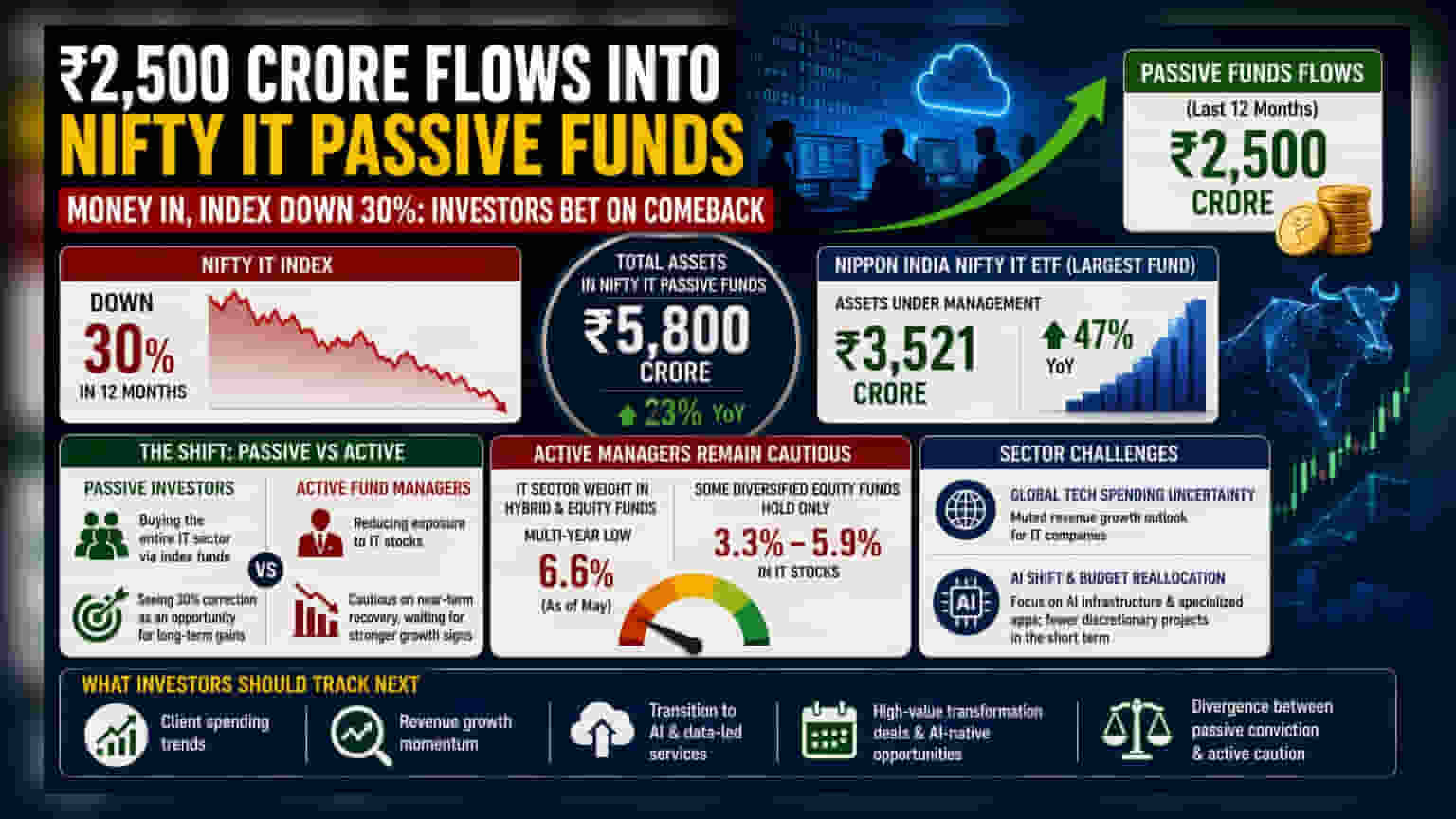
While the Nifty IT index has fallen 30% over the past year, passive IT-tracking funds have seen Rs 2,500 crore in fresh investments. This trend shows investors are betting on a long-term sector recovery through index funds, even as professional fund managers remain cautious due to global spending uncertainties and the impact of AI.
What Happened
Investors have poured approximately Rs 2,500 crore into passive funds that track the Nifty IT index over the last 12 months. This inflow has pushed the total assets managed by these passive schemes to Rs 5,800 crore, a 23% increase from the previous year. This rise in investment has occurred even though the Nifty IT index itself has declined by 30% during the same period. The data highlights a clear strategy among investors: rather than betting on individual technology companies, many are choosing to buy the entire sector through index-based funds, expecting a future turnaround.
The Shift Toward Passive Investing
Passive funds are investment products designed to track a specific stock market index, such as the Nifty IT index, rather than relying on a fund manager to pick winning stocks. The Nippon India Nifty IT ETF, which is the largest fund in this category, has seen its assets grow by 47% in the past year to reach Rs 3,521 crore. This trend suggests that retail investors may be treating the 30% correction in technology stocks as an opportunity to average their costs, believing that the sector’s current challenges are temporary.
Active Managers Remain Cautious
While passive investors are adding to their IT holdings, professional fund managers—who handle active mutual fund schemes—are going in the opposite direction. Portfolio data indicates that the IT sector's weight in hybrid and equity mutual fund portfolios dropped to a multi-year low of 6.6% by the end of May. Some major fund houses have reduced their exposure even further, with specific diversified equity schemes holding as little as 3.3% to 5.9% in IT stocks. This shows that the "smart money" is currently skeptical about the sector’s immediate recovery, preferring to wait for more concrete signs of growth.
The Sector Challenges
Information technology companies are currently facing two major hurdles. First, global technology spending remains uncertain, which has muted revenue growth forecasts for both domestic and international firms. Second, the rapid rise of artificial intelligence (AI) is forcing companies to reallocate their budgets. Traditionally, IT firms relied heavily on outsourcing projects, but there is now a shift where clients are prioritizing spending on AI infrastructure and specialized applications. Experts point out that while this may lead to fewer "discretionary" or non-essential projects in the short term, the industry could see a medium-term boost from high-value transformation deals and AI-native services.
What Investors Should Track Next
For those interested in the IT sector, the key monitorables are shifts in client spending and revenue growth. Investors may track whether IT companies can successfully transition their business models to capture demand for AI and data modernization, which is expected to be the next major driver of revenue. As long as uncertainty over global tech budgets persists, the divergence between passive inflows—which reflect a long-term bet—and the cautious stance of active fund managers—which reflects short-term data—will remain a critical trend to watch.