 Whalesbook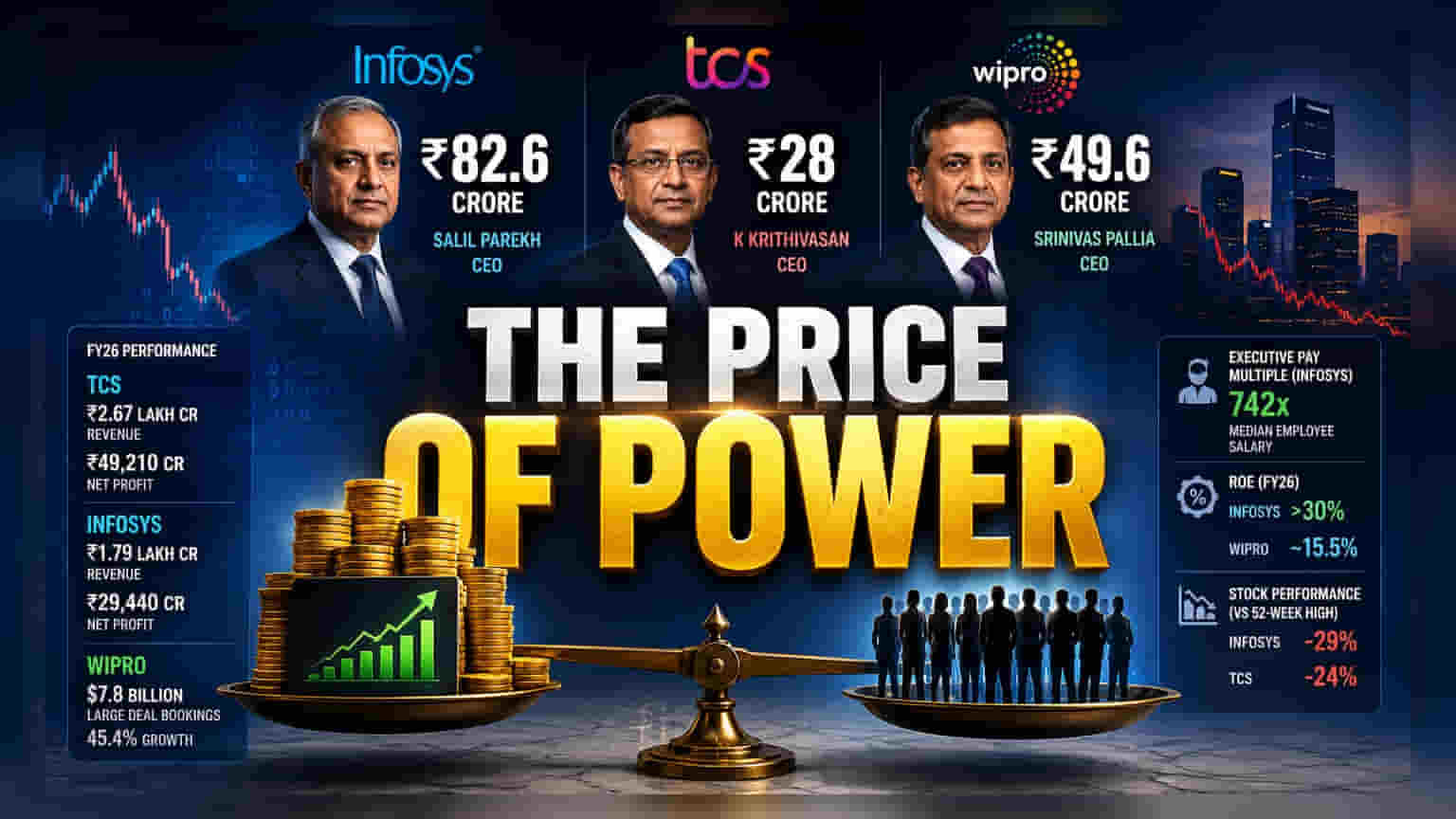


The Valuation of Leadership
The disclosure of executive compensation for fiscal year 2026 has brought the widening disparity in leadership pay within the Indian information technology sector into sharp focus. Infosys CEO Salil Parekh’s total remuneration of ₹82.6 crore represents a notable contrast to his peers at other market leaders, most notably Tata Consultancy Services (TCS) CEO K Krithivasan, whose annual package was reported at ₹28 crore. The variance reflects not only different corporate governance philosophies but also diverging strategies in how these firms retain top-tier management through variable and equity-based compensation.
The Equity Catalyst
Unlike traditional salary structures, the compensation of IT leadership is increasingly tethered to stock-based incentives. For Parekh, the primary driver was the exercise of restricted stock units (RSUs) from the 2015 and 2019 plans, which contributed ₹50.75 crore to his total earnings. This heavy weighting toward equity highlights a trend where Indian IT giants are benchmarking their executive pay against global practices, shifting from fixed cash salaries toward performance-linked ownership. In contrast, Wipro CEO Srinivas Pallia saw his total remuneration decline to ₹49.6 crore from ₹53.6 crore in the previous year, a move largely linked to lower performance-based commission payouts during a period of intense operational recalibration.
Sector Benchmarking and Operational Reality
While executive packages draw public scrutiny, the operational metrics of these firms provide a more sobering view of the current industry climate. TCS remains the sector's anchor, reporting revenue of ₹2.67 lakh crore and a net profit of ₹49,210 crore for FY26. While Infosys reported healthy financials—with revenue of ₹1.79 lakh crore and net profit of ₹29,440 crore—the executive pay multiple of 742 times the median employee salary at Infosys underscores a deepening inequality narrative. Even as Wipro recorded a 45.4% surge in large deal bookings to $7.8 billion, the firm's ROE of approximately 15.5% trails the more efficient compounding machine at Infosys, which continues to deliver ROE north of 30%.
The Structural Weakness
The aggressive pursuit of equity-based rewards has not gone without friction. With the IT sector currently navigating a complex global demand environment and cautious client spending, the disparity between leadership windfalls and broader workforce salary revisions—which remain under pressure—creates a sensitive corporate governance risk. Furthermore, while companies point to global pay benchmarking to justify these packages, the significant underperformance of stock prices over the past year—with Infosys and TCS down significantly from their 52-week highs—invites questions regarding whether such high variable payouts are truly aligned with shareholder value creation. Investors remain wary of a sector where operational costs are being slashed while executive, performance-linked pay packages remain at the top end of the spectrum.