 Whalesbook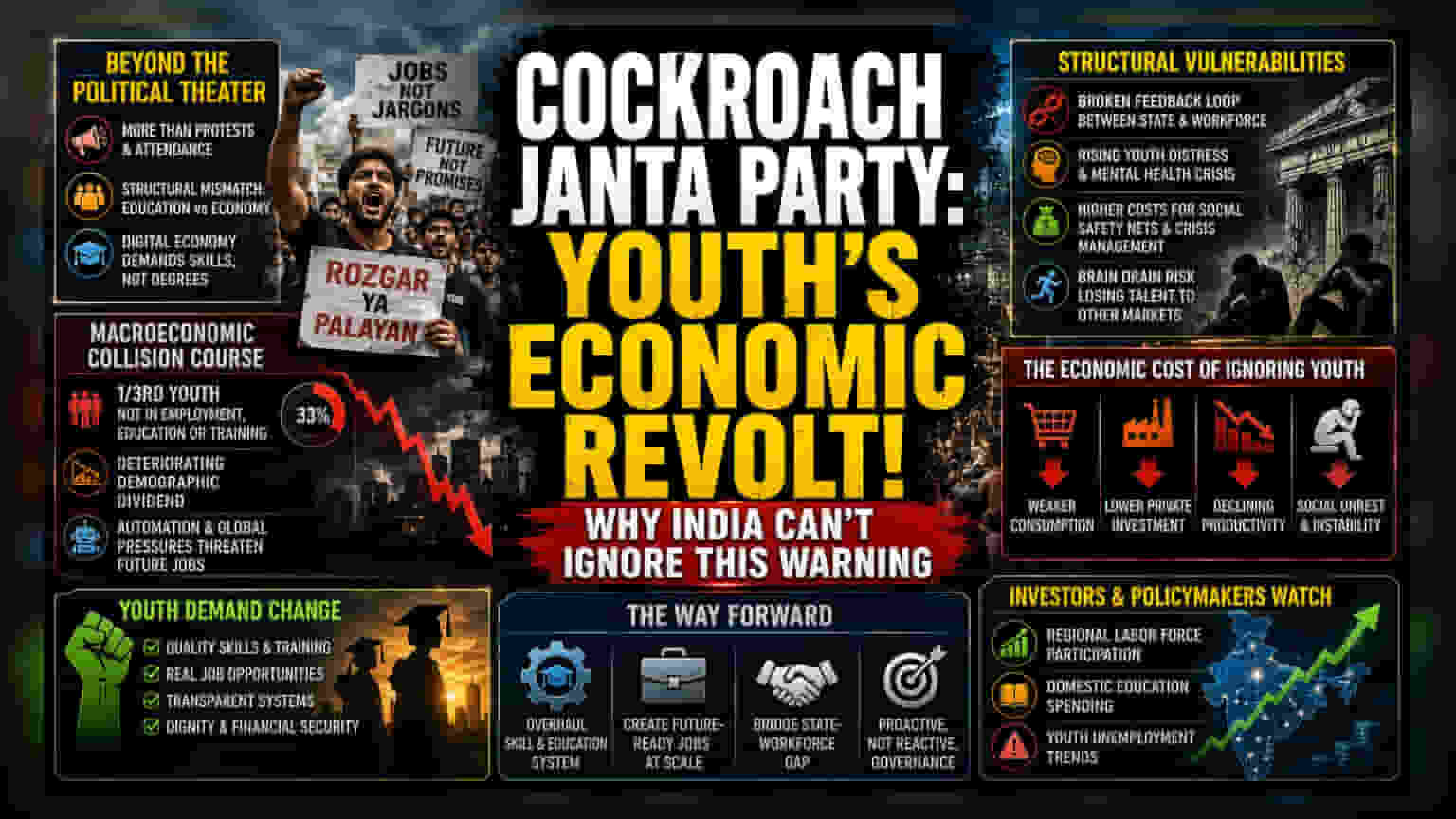


Beyond The Political Theater
The arrival of the Cockroach Janta Party signifies a deepening fracture between India’s administrative framework and the aspirations of its youngest cohort. While conventional analysts attempt to quantify the movement by attendance at demonstrations or alignment with established opposition blocs, these metrics miss the underlying structural instability. The dissatisfaction currently circulating online is less about traditional electoral cycles and more about a fundamental mismatch between current educational outcomes and the requirements of an increasingly digitized, capital-intensive economy.
The Macroeconomic Collision Course
India remains anchored by the promise of a demographic dividend, yet current employment data suggests that this advantage is deteriorating. With approximately one-third of the youth population currently outside the spheres of employment, education, or training, the potential for long-term economic scarring is high. The failure to pivot education policy toward technical proficiency leaves a vast labor force vulnerable to automation and global competitive pressures. Unlike historical instances where youth agitation was largely tied to ideological shifts, this current wave is driven by a tangible, immediate anxiety regarding personal financial survival. Should this discontent continue to bypass traditional institutional channels, the impact on domestic consumption, private investment, and overall economic productivity could be significant.
Structural Vulnerabilities and Economic Costs
From a risk-mitigation perspective, the government’s apparent detachment from these societal trends introduces a high degree of policy uncertainty. The rise of groups like the CJP highlights a failure in the feedback loop between the state and the workforce. When the primary engine of long-term economic growth—human capital—is ignored, it leads to social friction that often manifests as labor unrest or, more severely, the loss of skilled migration to more hospitable markets. The increasing frequency of youth-related distress, as noted by judicial authorities, points toward an intensifying mental health and societal crisis that, if left unaddressed, will necessitate higher public spending on social safety nets and crisis management, effectively diverting capital away from infrastructure and industrial development.
The Future Outlook
The ability of the current establishment to regain credibility hinges on a shift from reactionary governance to proactive economic integration. Absent a substantial overhaul in skill development and a measurable decline in youth joblessness, the existing political volatility is likely to persist. Investors and policymakers should monitor shifts in regional labor force participation and domestic education spending as primary indicators for future stability. Relying on traditional political consensus to resolve these tensions will likely prove insufficient as the demographic pressure continues to mount against an rigid, unresponsive administrative structure.