 Whalesbook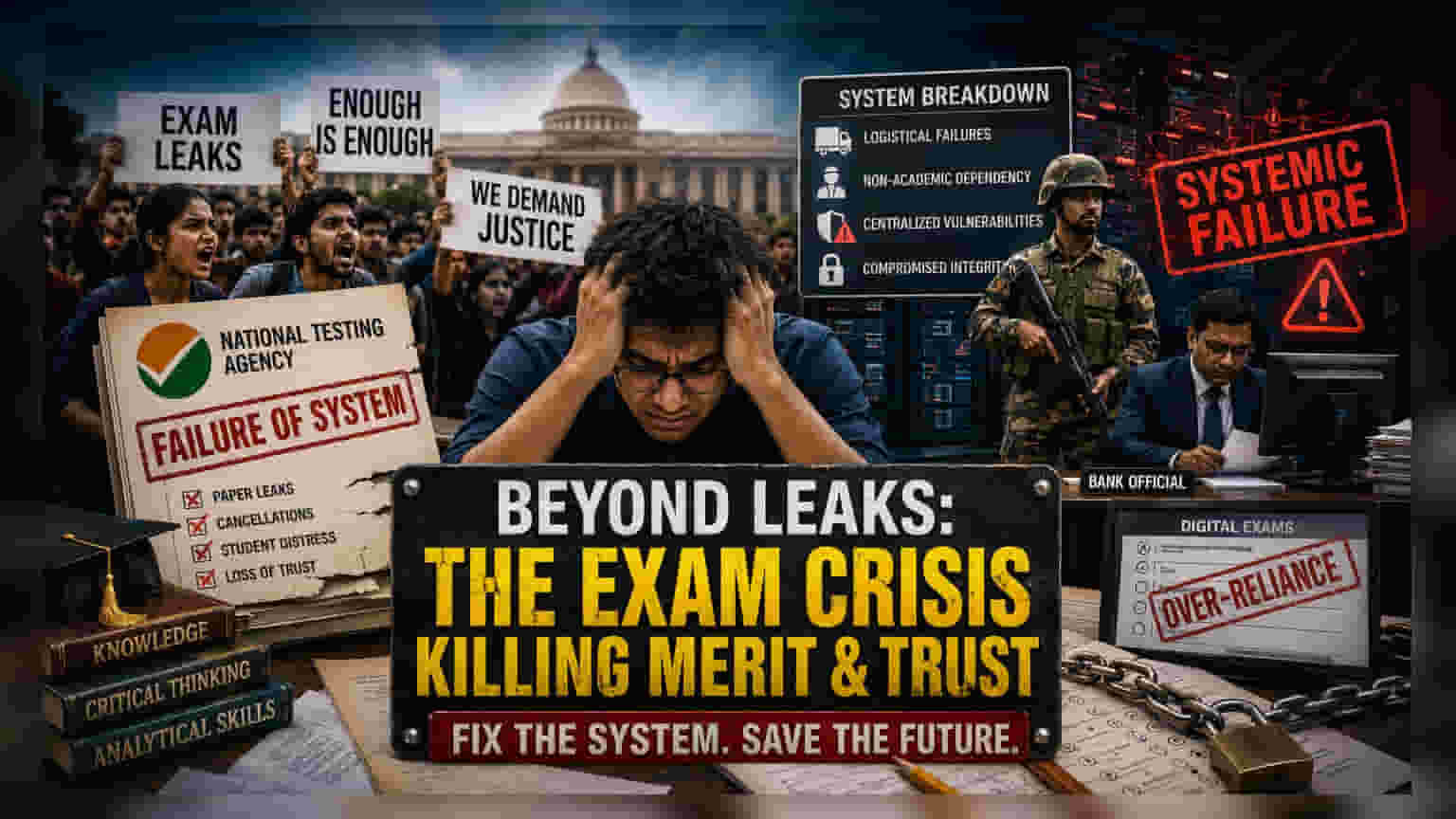


The Logistics-Pedagogy Mismatch
The current crisis within Indian competitive examinations represents more than simple administrative failure; it highlights a dangerous trend of bureaucratic bloat. When the National Testing Agency (NTA) shifts the burden of logistical security to military personnel or relies on banking staff to audit academic assessments, the core mission of education is compromised. This forced reliance on non-academic bodies reveals an infrastructure unable to scale its own operations without outsourcing its credibility. The shift creates a fragile ecosystem where institutional survival depends on external force rather than robust, internal academic rigor.
The Failure of Computational Ordering
Administrative efforts to streamline high-stakes testing have prioritized digital delivery over intellectual depth. By converting the examination process into a purely computational task, the system inherently favors mass-market, multiple-choice formats that prioritize rote memory over critical inquiry. This digital reliance creates a dangerous paradox: while intended to ensure efficiency, it has instead standardized the entry points to top-tier institutions, making the entire pipeline susceptible to single-point failures. Unlike decentralized assessment models that utilize localized evaluation, this hyper-centralized framework lacks the granularity needed to identify talent, effectively turning both examiners and examinees into algorithmic variables rather than human participants.
Economic and Institutional Risks
Beyond the technical disruptions, the reliance on mass-scale electronic assessment introduces significant socioeconomic barriers. The current model inadvertently benefits candidates with the financial capacity to bypass traditional testing through private coaching or, worse, systemic exploitation. This creates a dual-threat environment where institutions suffer from a crisis of legitimacy while high-performing, lower-income students face an increasingly rigged playing field. The reliance on centralized, opaque testing mechanisms encourages a “gaming the system” mentality, where the primary objective becomes navigating the vulnerability of the architecture rather than mastering the underlying curriculum.
Structural Limitations and Oversight
The path toward modernization has ironically moved the system further away from academic expertise. By elevating speed and mechanical accuracy above pedagogical nuance, the NTA’s current oversight model has reduced human teachers to mere monitors of digital systems. Reclaiming the integrity of Indian entrance examinations requires a shift toward decentralized, diverse evaluation formats. Unless the reliance on third-party, non-academic entities is replaced by a return to institutional accountability and more sophisticated, essay-driven testing methods, the cycle of leaks and cancellations will likely persist, further undermining the competitive standing of the nation's academic institutions.