 Whalesbook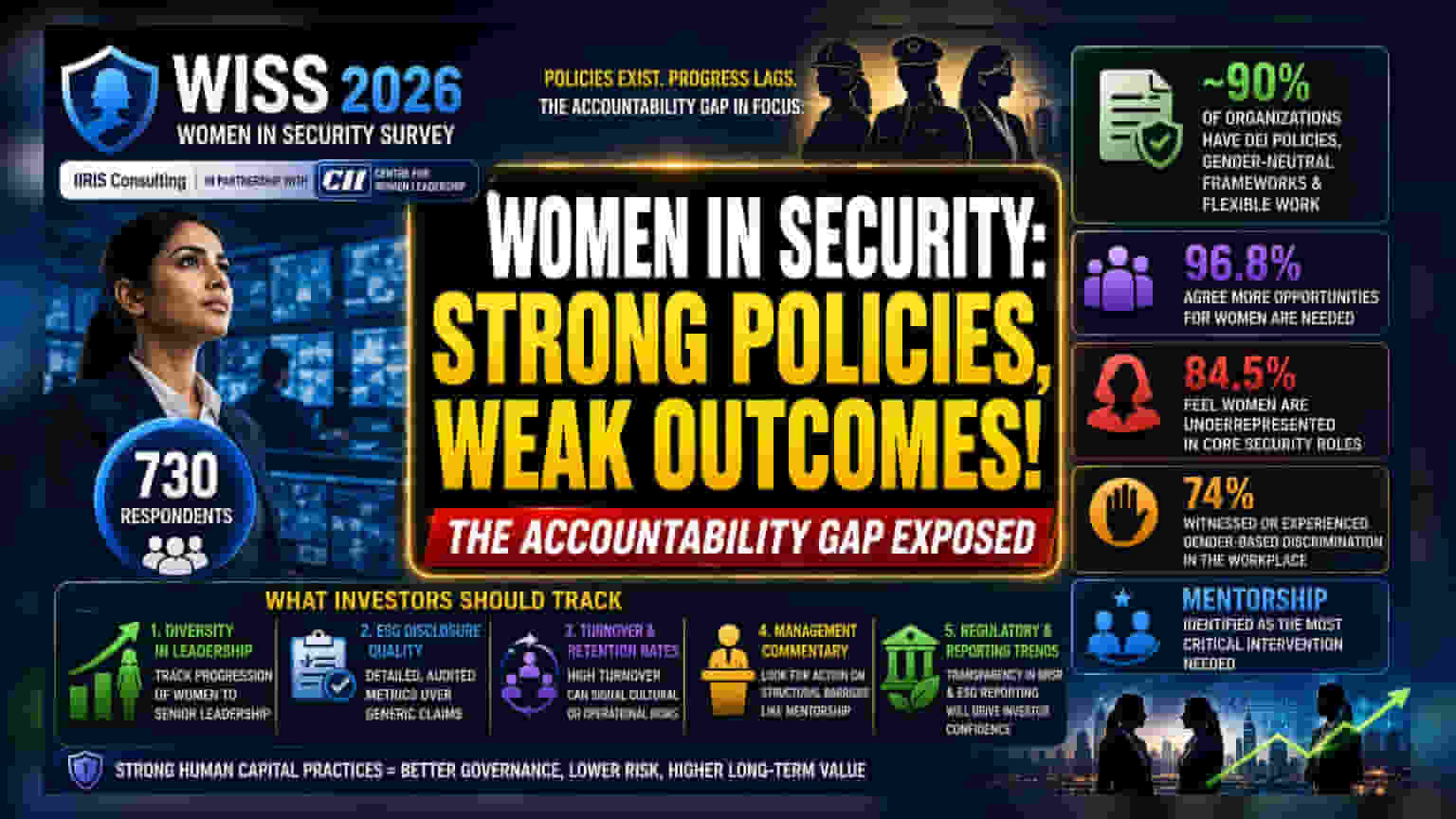
A new industry survey finds that while 97% of security professionals want more gender diversity, a persistent 'accountability gap' remains. Companies report having diversity policies, but 74% of employees still report witnessing or experiencing discrimination, signalling a potential governance and human capital risk for investors.
What Happened
The 2026 Women in Security Survey (WISS), conducted by IIRIS Consulting in partnership with the CII Centre for Women Leadership, has highlighted a critical disconnect in the Indian security sector. While nearly all industry professionals (96.8%) agree that there is a need to create more opportunities for women, the sector is struggling to convert stated diversity policies into tangible results.
According to the survey, which gathered 730 responses, there is a clear contrast between corporate policy and workplace reality. A vast majority of organizations (approximately 90%) report having formal diversity, equity, and inclusion (DEI) policies, gender-neutral frameworks, and flexible work arrangements. However, 84.5% of respondents still feel that women are underrepresented across core security functions. Furthermore, 74% of professionals stated they have either witnessed or personally experienced gender-based discrimination in the workplace, suggesting that internal policies are not effectively curbing behavioral issues.
Why This Matters For Investors
For investors, the findings highlight a growing risk related to Human Capital Management, which is a key component of the 'Social' pillar in Environmental, Social, and Governance (ESG) frameworks. As institutional investors in 2026 increasingly scrutinize the link between diverse, inclusive workplaces and long-term business performance, an 'accountability gap'—where a company claims to have inclusive policies but fails to deliver a safe or equitable environment—can signal weak corporate governance.
Companies that struggle with high turnover, cultural bias, or failing to nurture leadership pipelines may face operational risks, including difficulties in talent retention and potential reputational damage. In a sector that is increasingly data-driven and risk-focused, the inability to tap into the full talent pool can also limit operational competitiveness. Investors often view strong human capital practices as a proxy for management quality and operational efficiency.
The Accountability Gap Explained
The 'accountability gap' identified in the report refers to the divide between what companies claim in their corporate disclosures and what employees experience on the ground. While many firms have introduced standard initiatives like unconscious bias training and flexible hours, the survey suggests these have not been enough to overcome deep-seated cultural barriers.
Respondents identified male-dominated environments and persistent stereotypes as primary obstacles to women’s career progression. The data also revealed a structural issue: while there are entry-level pipelines for women, these often thin out at higher management levels, creating a fragile leadership pipeline. Mentorship emerged as the most critical intervention desired by professionals to bridge this gap, yet it is often less prioritized than simpler policy implementations.
What Investors Should Track
Investors monitoring the security sector and broader service industries may look beyond surface-level DEI policy claims. Important monitorables include:
- Diversity in Leadership: Tracking the progression of women from mid-level to C-suite roles rather than just total headcount.
- ESG Disclosure Quality: Watching for companies that provide detailed, audited workforce metrics in their Business Responsibility and Sustainability Reports (BRSR) versus those that provide generic, non-verifiable statements.
- Turnover and Retention Rates: High turnover in specific demographics can be a leading indicator of cultural or operational issues.
- Management Commentary: Listening for how leadership discusses structural barriers, such as the need for formal mentorship programs, rather than just referencing standard policy adoption.
As regulatory frameworks in India continue to push for greater transparency in sustainability and social impact, companies that can prove they are closing the gap between policy and practice are likely to be viewed more favorably by long-term capital providers.

