

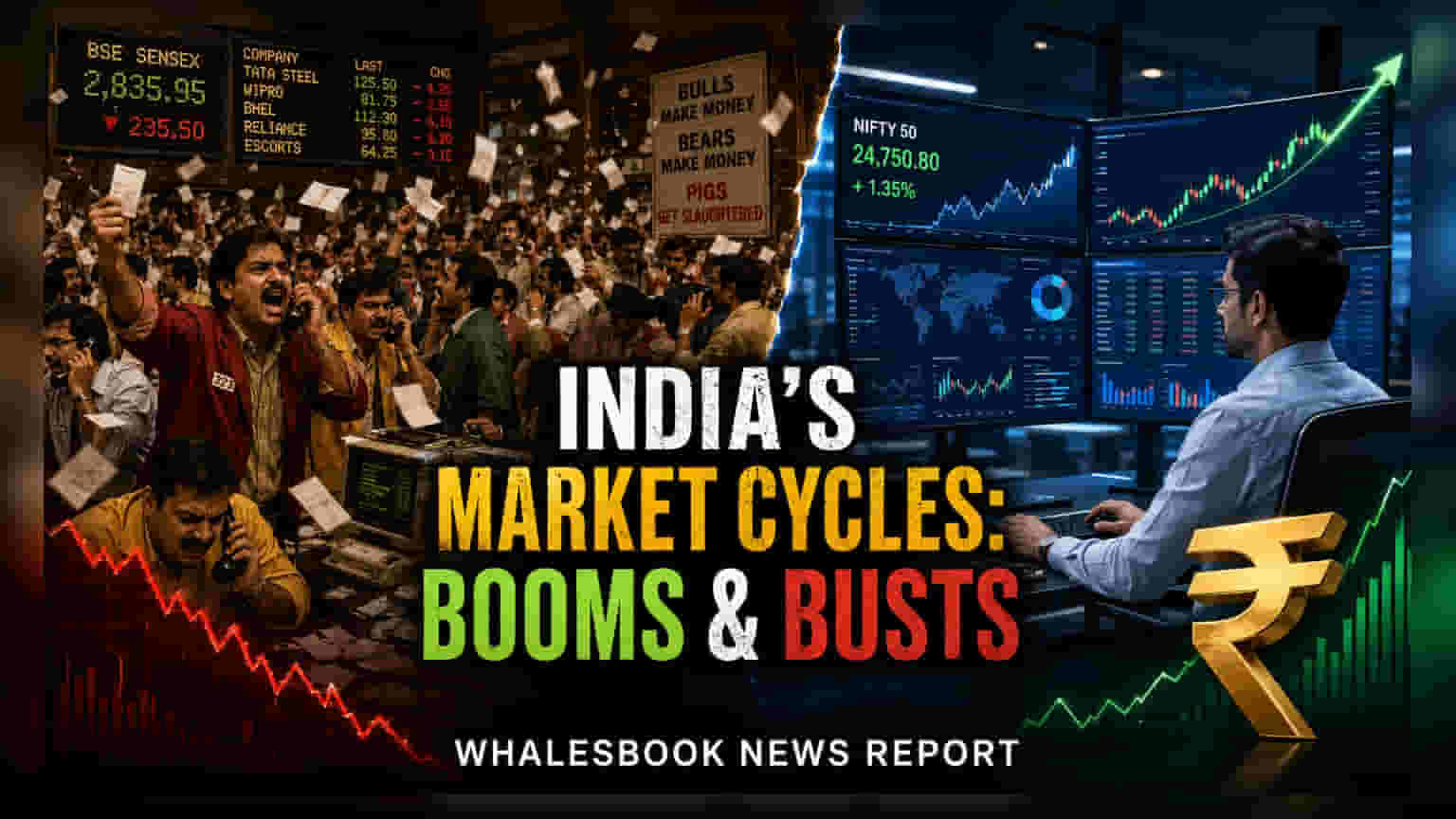
Indian markets have evolved from banking-system-fueled scams in the 1990s to modern retail trading challenges. While market infrastructure is safer today, historical cycles show that risks have shifted from systemic loopholes to individual speculative behavior. Recent 2026 data reveals that 93% of individual F&O traders incurred losses, serving as a reminder of the dangers of chasing trends over fundamentals.
Since the 1992 Harshad Mehta scam, Indian equity markets have gone through several cycles of excitement and correction. History shows that while the reasons for market crashes change—shifting from banking scams in the early 90s to tech-bubble hype in the early 2000s—the underlying pattern of human behavior often repeats.
In the early 1990s, the bull run was fueled by liquidity siphoned from the interbank securities market. The Sensex surged from 1,000 to 4,500 in just 15 months, supported by fake bank receipts rather than real earnings. Later, the dot-com bubble of the late 1990s and early 2000s saw speculative frenzy in IT and communication stocks. Companies with no real business model doubled their stock prices simply by adding "infotech" to their names, while established firms traded at over 100 times their earnings. Both episodes demonstrated how easily investor excitement can cause them to ignore basic business arithmetic.
Today, the Indian market is structurally different. Infrastructure has improved significantly, with real-time online trading, electronic depositories, and stronger regulations from SEBI. These changes have plugged many of the systemic loopholes that allowed the massive frauds of the past. However, a safer infrastructure does not mean there are no risks.
Recent data from 2026 highlights that the risk has shifted from systemic banking issues to individual retail behavior. While institutional participation remains strong, a significant portion of retail capital has moved into the Futures and Options (F&O) segment. Data covering the period between FY22 and FY24 shows that 93% of individual traders incurred losses in equity F&O trading, with aggregate losses exceeding ₹1.8 lakh crores. This indicates that while the market is more transparent than in the 90s, the tendency for individual investors to prioritize speculation over long-term investing continues to cause significant wealth erosion.
Historical cycles teach consistent lessons. First, valuations always matter. When stock prices rise much faster than company earnings for a long time, it is often a sign of a bubble. Second, borrowed money—whether through the old badla financing of the 90s or modern margin trading—always increases the danger of a sharp crash. Third, business quality, measured by actual cash flow and sustainable debt levels, is the only thing that holds value when liquidity dries up.
For investors, the timeline from 1992 to 2026 confirms that patience is a vital tool. Trying to catch short-term market trends often leads to losses, whereas staying invested in fundamentally sound companies helps build wealth. The primary lesson for modern investors is to look beyond current market noise and focus on balance-sheet strength.