

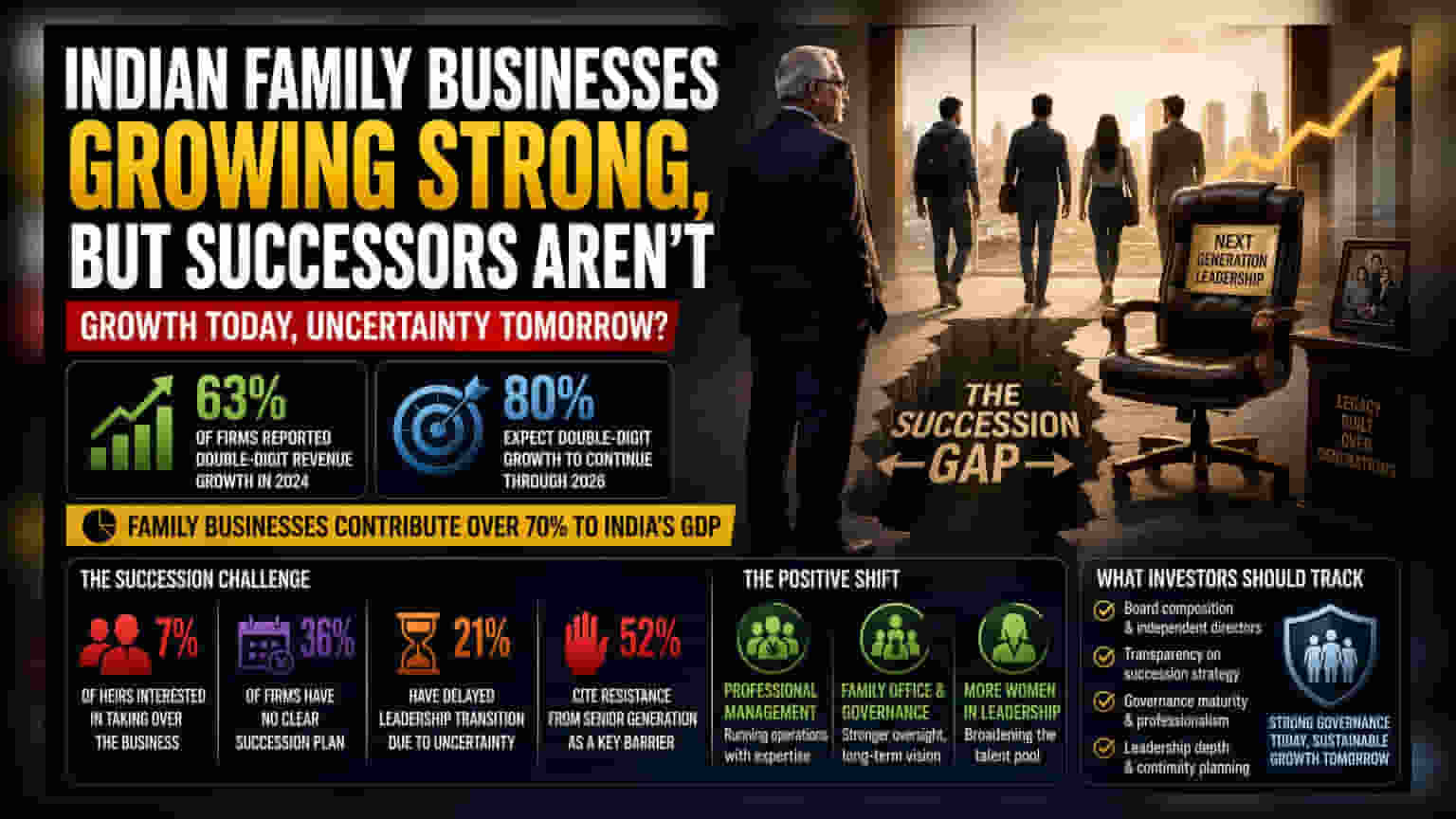
While Indian family-owned firms contribute over 70% of the GDP and report strong revenue growth, a succession gap is emerging. With fewer than 7% of next-gen heirs eager to take the helm, the shift toward professional management is becoming a key factor for long-term business stability. Investors should now evaluate governance and leadership transition plans more closely.
What Happened
Indian family-owned enterprises are currently experiencing a significant growth phase. Recent data shows that nearly 63% of these firms reported double-digit revenue increases in 2024, with 80% expecting to maintain this upward momentum through 2026. These businesses are vital to the Indian economy, contributing over 70% of the national GDP. However, while the business performance remains strong, a disconnect is emerging regarding who will lead these companies in the future. Many of these firms are expanding internationally, yet they face a narrowing pool of internal successors prepared to take over operations.
The Succession Gap
The traditional model of family succession is changing rapidly. Current data indicates that only about 7% of potential heirs are interested in taking over their family’s business operations. Instead, the younger generation is choosing career paths in startups, technology, and finance. This shift is supported by family values, with 83% of firms encouraging their heirs to explore outside interests. As these heirs drift away from operational roles, a vacuum is forming in the C-suite for the next decade.
The Risk For Shareholders
For investors, the primary concern is business continuity. A substantial 36% of these family-owned firms currently lack a clear succession plan. Additionally, 21% have postponed leadership transitions entirely due to uncertainty. A major hurdle is resistance from the senior generation, with 52% of firms citing this as a key barrier to smooth planning.
When a company lacks a clear roadmap for leadership change, it introduces 'key person risk.' If a sudden transition occurs without a professional plan in place, it can lead to operational instability, strategy drift, and investor uncertainty. In the stock market, companies with transparent, professionalized leadership structures tend to trade with higher predictability than those reliant solely on individual family members.
The Shift Toward Professional Management
The industry is responding by redefining what it means to be a 'family business.' Many firms are moving toward a model where the family acts as a custodian of the business vision, while professional management handles daily operations. This separation of ownership and management is a positive trend for corporate governance. The rise of family offices and the inclusion of women in succession discussions are further broadening the talent pool, aiming to bridge the gap left by heirs who choose other paths.
What Investors Should Track
Investors looking at family-run stocks should look beyond just the quarterly revenue figures. The key monitorables for long-term health now include the composition of the board, the presence of independent directors, and the management's transparency regarding succession. During earnings calls or investor presentations, monitoring the clarity of the company’s succession strategy can provide insight into how well the firm is prepared for leadership transitions. Companies that embrace professional management alongside family ownership are generally better positioned to mitigate the risks associated with the shrinking pool of internal successors.