 Whalesbook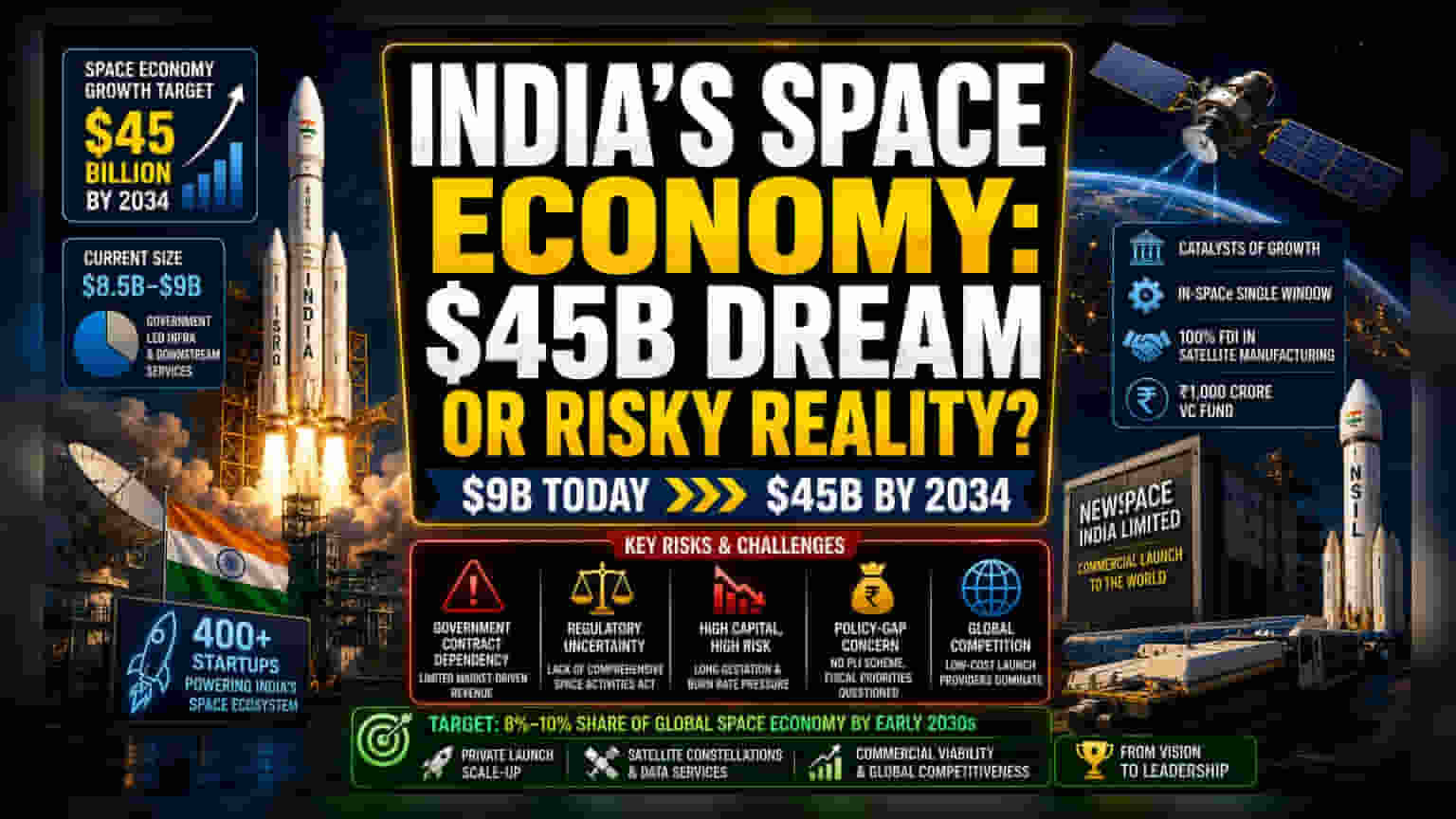


The Valuation Gap
India’s space economy, currently valued at approximately $8.5 billion to $9 billion, is officially positioning itself for a quantum leap toward a $45 billion valuation over the next eight to ten years. This projected fivefold increase is framed as a shift from a marginal government-led scientific effort to a commercially integrated industry. However, the current valuation remains heavily anchored in state-led infrastructure and traditional downstream services like satellite television and navigation, which provide stable cash flows but lack the hyper-growth profile of the burgeoning upstream space manufacturing sector.
The Catalyst of Privatization
The sector’s structural transition is defined by the liberalization of the space industry since 2020. The establishment of the Indian National Space Promotion and Authorization Centre (IN-SPACe) serves as the primary mechanism for this change, acting as a single-window interface for private entities. With nearly 400 startups now operational, the ecosystem has moved beyond basic conceptualization into hardware development for launch vehicles, satellite constellations, and propulsion systems. Recent policy initiatives, including 100% Foreign Direct Investment (FDI) in specific satellite manufacturing segments and the creation of a ₹1,000 crore venture capital fund, are designed to bridge the 'death valley' of funding that typically plagues early-stage deep-tech companies.
The Forensic Bear Case
Despite the optimistic growth narrative, serious structural hurdles remain. Investors should note that a significant portion of the current 400-strong startup ecosystem relies on government-led contracts or collaborative technology transfers with the Indian Space Research Organisation (ISRO) rather than independent, market-driven revenue. The sector lacks a comprehensive Space Activities Act, creating potential regulatory ambiguity regarding liability and long-term private sector roles. Furthermore, the high capital intensity and long gestation periods for hardware projects create significant burn-rate risks for startups that may struggle to compete with low-cost global launch providers. Critics also point to a disconnect between government rhetoric and fiscal reality, as recent budgets continue to favor direct support for ISRO’s core R&D over the broad-based structural incentives—such as a dedicated Production Linked Incentive (PLI) scheme—that industry bodies have repeatedly requested.
The Future Outlook
The path to $45 billion is predicated on India capturing an 8% to 10% share of the global space economy by the early 2030s. Success depends on the ability of the private sector to scale from prototype manufacturing to consistent, high-frequency launch services and advanced data monetization. As the government continues to offload operational launch vehicle responsibilities to NewSpace India Limited (NSIL) and private consortia, the real measure of success will not be the number of startups, but the emergence of self-sustaining, commercially viable enterprises capable of competing on the global stage.