

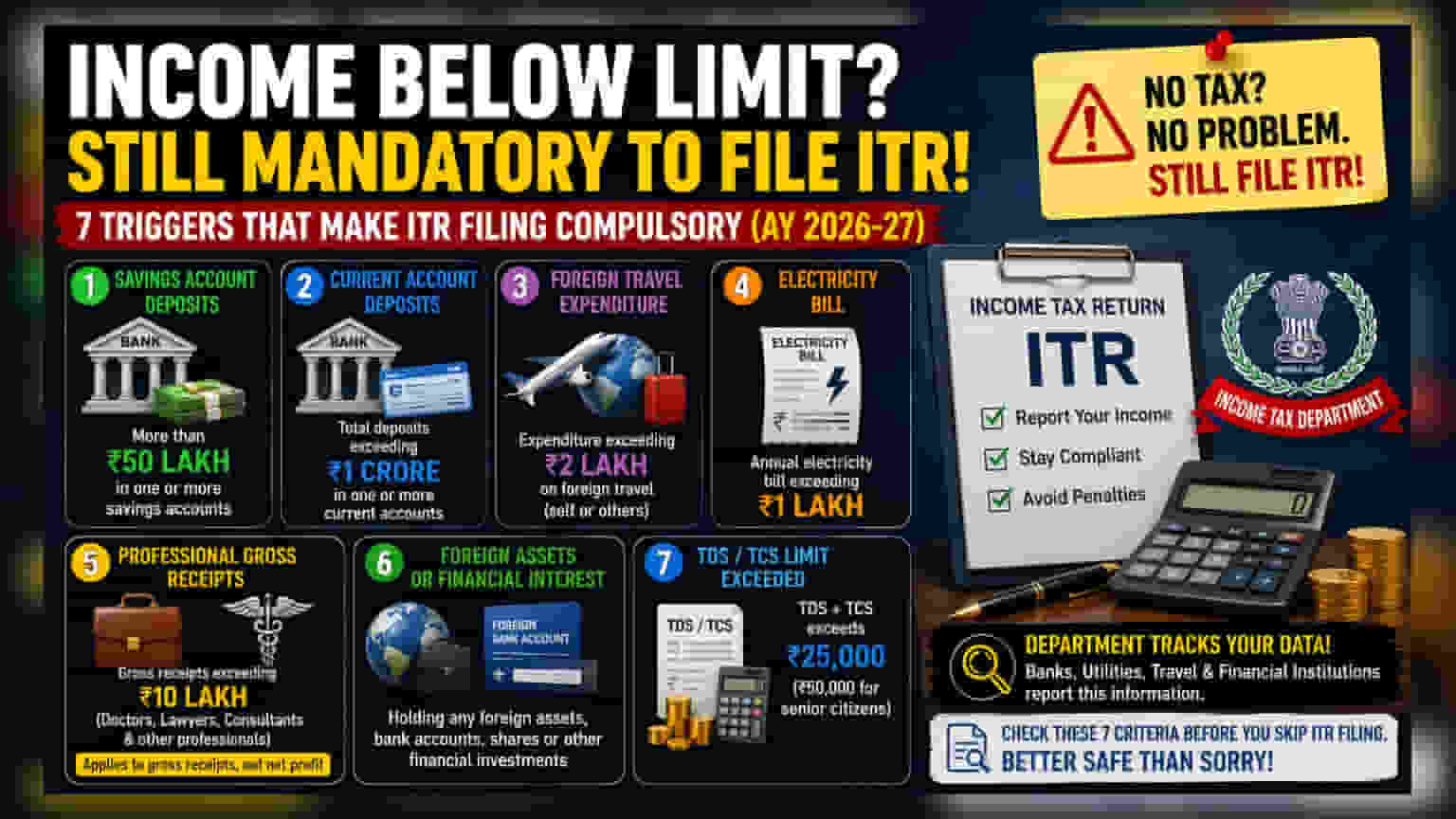
Filing an Income Tax Return is compulsory for some taxpayers even if their income is below the tax exemption limit for Assessment Year 2026-27. The Income Tax Department monitors specific high-value financial activities, such as large bank deposits, foreign travel, and significant electricity bills. Being aware of these seven rules is essential to avoid potential tax notices and penalties.
What Happened
For the Assessment Year (AY) 2026-27, many taxpayers might assume they do not need to file an Income Tax Return (ITR) if their total income is below the government's basic exemption limit. However, the Income Tax Department tracks several financial activities that make filing mandatory, regardless of whether you owe any tax. These rules are designed to increase transparency and ensure that individuals with significant financial footprints remain within the tax system.
High-Value Bank Transactions
One of the primary triggers for mandatory filing relates to bank usage. If you have deposited more than ₹50 lakh in one or more savings accounts within a single financial year, you are required to file an ITR. Similarly, if your total deposits in one or more current accounts exceed ₹1 crore in a financial year, filing is compulsory. These limits help the authorities track substantial movement of money that might not be captured solely through income tax data.
Lifestyle And Professional Spending
Certain lifestyle choices also bring a taxpayer under the mandatory filing radar. If you have incurred an expenditure exceeding ₹2 lakh on foreign travel for yourself or for any other person, you must file an ITR. Additionally, the government monitors high utility consumption; an annual electricity bill exceeding ₹1 lakh is another trigger that makes filing mandatory, regardless of your income level.
For self-employed professionals, the rule is tied to gross receipts. If a doctor, lawyer, consultant, or other professional earns gross receipts exceeding ₹10 lakh in a financial year, they must file an ITR. It is important to note that this threshold applies to total receipts, not the net profit earned.
Taxes And Foreign Holdings
Having financial interests outside India creates an automatic requirement to file an ITR. This includes holding foreign assets, such as shares, bank accounts, or other financial investments abroad. This rule ensures that individuals with global financial ties report their activity to domestic tax authorities.
Furthermore, the amount of tax already paid through deductions is a factor. If the aggregate Tax Deducted at Source (TDS) and Tax Collected at Source (TCS) during the year exceeds ₹25,000, filing is required. For senior citizens, this limit is higher at ₹50,000. This often applies to individuals who earn interest on fixed deposits or have professional income where tax is deducted at the source.
What Investors Should Track
Before deciding that you are exempt from filing for AY 2026-27, it is useful to cross-check your financial data against these seven criteria. The Income Tax Department receives information from various financial institutions, making it easier to identify individuals who meet these conditions but fail to file. Keeping records of bank statements, electricity bills, and foreign travel expenses can help in assessing whether you meet these mandatory filing thresholds.