

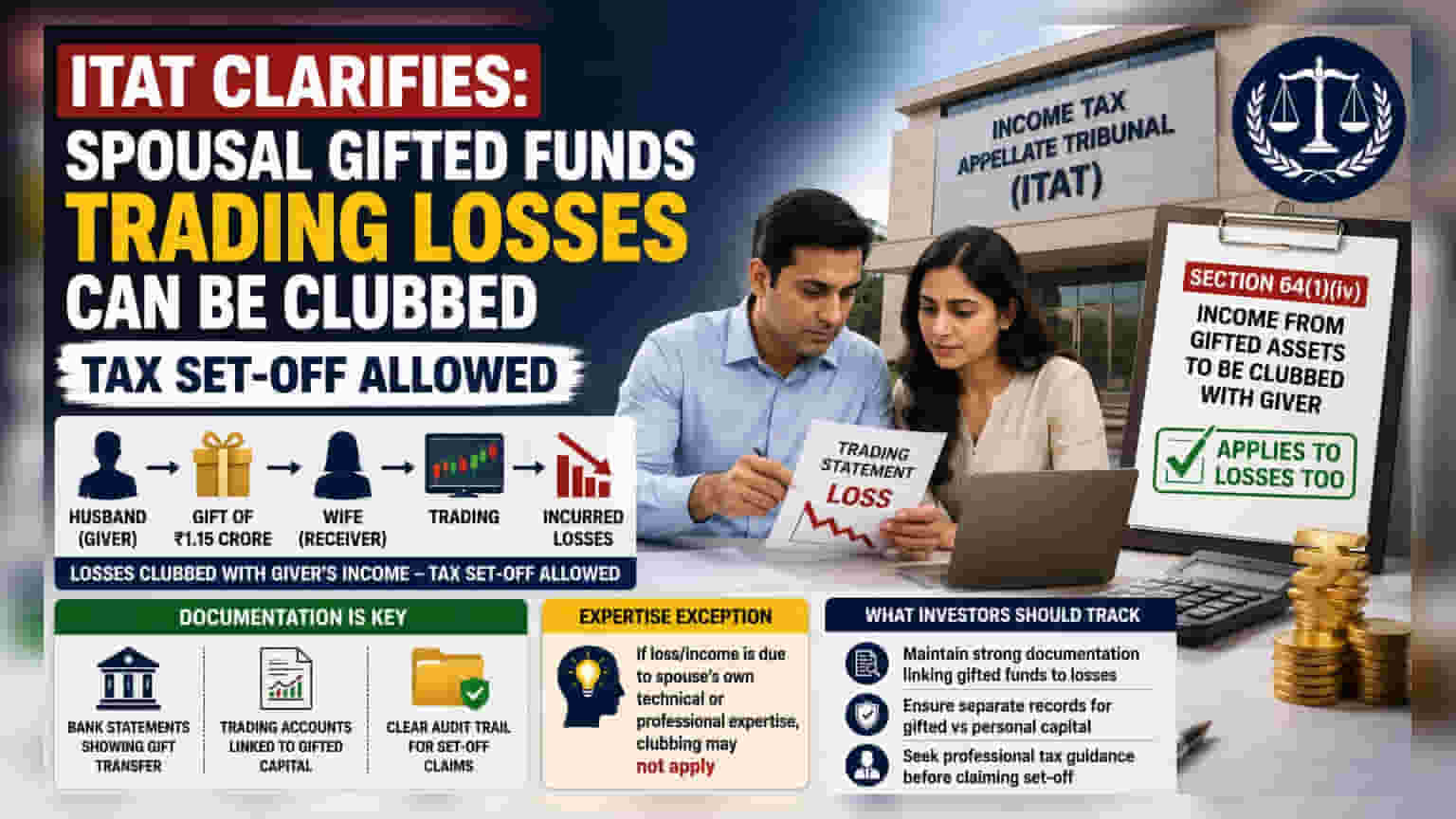
The Income Tax Appellate Tribunal (ITAT) has ruled that trading losses incurred by a spouse using gifted funds can be clubbed with the transferor's income. This decision allows taxpayers to offset their gains against these losses, provided they maintain clear documentation linking the losses directly to the gifted capital.
What Happened
The Income Tax Appellate Tribunal (ITAT) has clarified how tax laws apply to trading losses when funds are gifted between spouses. In a recent ruling, the Tribunal established that if a person gifts money to their spouse and that money is used for trading, any losses incurred can be 'clubbed'—or combined—with the transferor's own income. This is based on the principle of Section 64(1)(iv) of the Income-tax Act, 1961, which historically required income generated from gifted assets to be added to the giver's tax return. The ITAT has now confirmed that this logic applies to losses as well, allowing for tax set-offs.
The Case Context
The ruling stems from a case involving a taxpayer, Vipin Yadav, who had gifted approximately ₹1.15 crore to his wife. She utilized these funds for equity and Futures & Options (F&O) trading, which eventually resulted in significant financial losses. When the taxpayer attempted to offset his own trading income with these losses, the tax department initially rejected the claim, arguing that the trading decisions were made independently by his wife. The ITAT, however, ruled in favor of the taxpayer, emphasizing that if the capital for trading originated from a gift, the resulting financial outcome—whether profit or loss—is essentially tied to the giver.
The Importance Of Documentation
This ruling is not a blanket permission to claim any spousal trading loss. The ITAT stressed that taxpayers must provide clear and verifiable proof of the link between the gifted funds and the specific losses. If a taxpayer intends to claim this set-off, they must maintain rigorous financial records. This includes bank statements clearly showing the transfer of funds marked as a 'gift' and trading accounts that distinguish between the capital gifted by the spouse and any personal funds the spouse might have used. Without a clear audit trail, the tax department may continue to reject such claims.
The 'Expertise' Exception
Investors should be aware of a critical nuance in this ruling. The ITAT noted that this clubbing rule may not apply if the loss or income is solely the result of the transferee spouse’s own technical or professional expertise. For instance, if the spouse is a professional trader whose own skills and strategy drive the trading performance, the tax authorities may view the loss as belonging to the spouse rather than the person who gifted the money. This exception serves as a reminder that the tax treatment depends on whether the money itself drove the loss, or the personal skill of the trader.
What Investors Should Track
Taxpayers planning to utilize this provision should ensure they have professional tax guidance. The key monitorable for any such claim is the strength of the documentation trail. It is essential to demonstrate that the losses are directly attributable to the gifted capital. As tax regulations regarding income clubbing can be complex, maintaining separate records for gifted capital versus personal capital remains the most practical way to support any future claims during an assessment.