

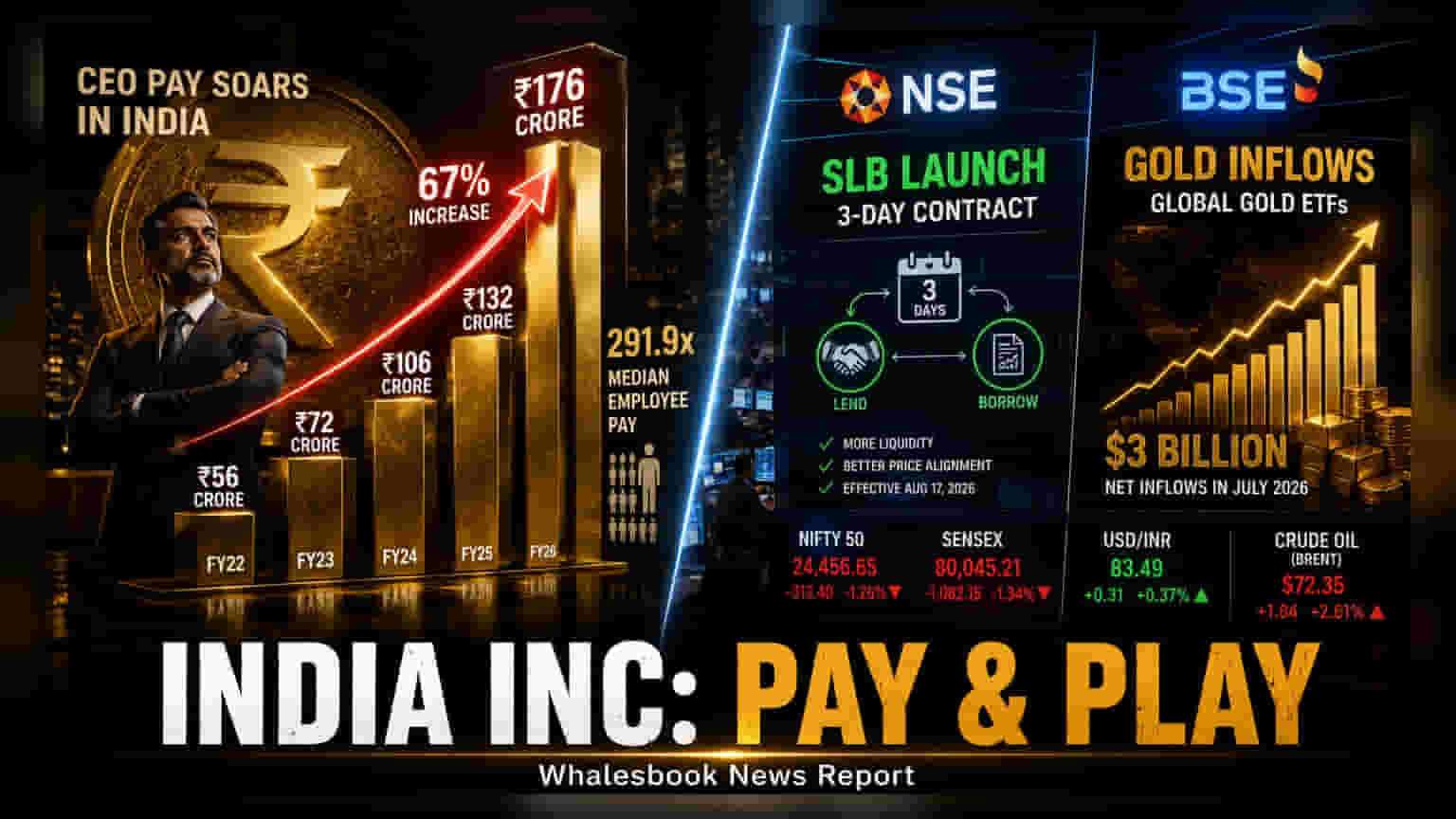
Executive compensation at top Indian firms rose in FY26, with HCLTech's CEO C Vijayakumar earning approximately ₹176 crore. Meanwhile, NSE and BSE have introduced three-day Securities Lending and Borrowing contracts to improve market liquidity. Investors are also tracking steady progress in Kharif sowing, which hit 1,016.57 lakh hectares, and continued global inflows into gold ETFs.
Executive pay packages at India’s major listed companies saw a notable increase in the 2026 fiscal year. Among the most prominent figures, HCLTech CEO C Vijayakumar reported remuneration of approximately ₹176 crore, marking a 67% increase compared to the previous year. Much of this compensation was driven by long-term incentives and the exercise of stock units. This trend of high executive pay is drawing attention to corporate governance, with recent data showing that the CEO’s remuneration at HCLTech is roughly 291.9 times the median pay of the company's employees. Investors often scrutinize such ratios to gauge the balance between leadership incentives and equitable pay practices across the organization.
In a significant move for market participants, the National Stock Exchange (NSE) and the Bombay Stock Exchange (BSE) launched new three-day Securities Lending and Borrowing (SLB) contracts starting August 17, 2026. This system allows traders to borrow or lend shares for a short, fixed period of three days to help settle trades or manage market positions. The goal of this initiative is to improve short-term liquidity and ensure better price alignment across the exchanges. However, investors should note that these specific three-day contracts currently do not offer options for repayment, recall, or rollover. This means the structure is more rigid compared to longer-tenure contracts, which may limit flexibility for some institutional traders.
Beyond corporate and market developments, the broader agricultural and investment landscape remains active. India’s Kharif sowing has reached 1,016.57 lakh hectares as of August 14, 2026. While this is slightly behind the previous year’s figures, it is nearing normal levels despite the uneven monsoon rainfall seen in August. The performance of these crops is crucial, as it impacts domestic food supply and inflation levels, which are key monitorables for the Reserve Bank of India and the broader economy.
Meanwhile, global interest in gold remains resilient. After two months of outflows, global gold exchange-traded funds (ETFs) recorded net inflows of $3 billion during July 2026. This steady interest suggests that even as gold prices fluctuate from their record highs, global investors are continuing to view the metal as a significant part of their portfolio. The trend indicates that market participants are maintaining a focus on safe-haven assets amidst global macroeconomic uncertainty. Moving forward, investors will likely focus on whether the new SLB contracts effectively bridge the liquidity gap in the closing auction session and how the final Kharif crop harvest influences retail food prices in the coming quarters.