

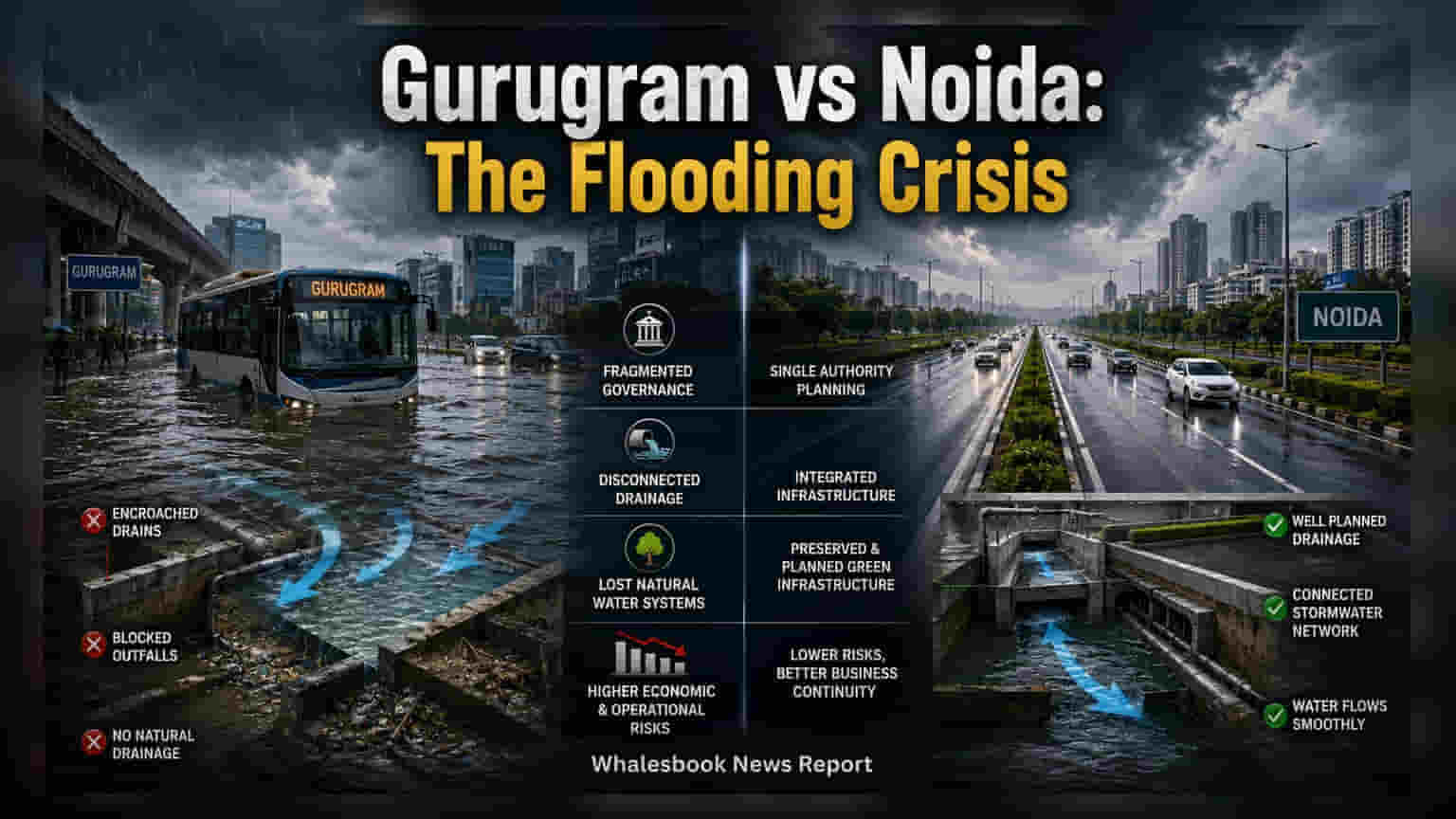
Severe waterlogging in Gurugram highlights deep-rooted urban planning flaws, contrasting sharply with Noida’s centralized development. This persistent issue creates operational risks for businesses and impacts long-term property value. Understanding this structural divide is essential for anyone evaluating real estate or commercial opportunities in the National Capital Region.
The recurring flooding in Gurugram during the 2026 monsoon has once again focused attention on the stark divide in infrastructure development within the National Capital Region (NCR). While neighboring Noida remains relatively resilient, Gurugram has faced significant paralysis, with widespread work-from-home advisories and school closures becoming a standard response to heavy rain. For investors and businesses, this is not just a seasonal weather inconvenience; it is a structural issue with long-term economic implications.
The fundamental divergence between these two cities lies in their planning models. Noida was built under a single, centralized authority that prioritized core infrastructure—such as trunk roads, sewage networks, and primary drainage—well before significant private construction began. This top-down, integrated approach ensured that the drainage capacity grew in tandem with the city’s population and surface area. In contrast, Gurugram developed through an organic, fragmented model. Private developers often built isolated high-end commercial and residential hubs without connecting them to a unified, city-wide drainage backbone. Over time, this has left the city with a disconnected network of drains that struggle to manage runoff during intense downpours.
Environmental degradation has further compounded these structural failures. Gurugram was historically supported by the Aravalli foothills, which featured a natural, gravity-fed system of ponds and seasonal channels that allowed for effective groundwater recharge and water management. Rapid, often unchecked urbanization has seen much of this landscape covered in concrete. The loss of these natural sinks, combined with the encroachment of drainage channels, means that rainwater has nowhere to go but into urban depressions, leading to the severe waterlogging seen in recent days.
For investors, particularly those looking at real estate or corporate infrastructure, these factors introduce significant risk. Properties located in flood-prone areas face the constant threat of damage and potential devaluation. Beyond the physical asset, there is a clear operational risk. Businesses operating in these zones experience productivity losses, increased costs due to infrastructure repairs, and the challenge of managing employee attendance during extreme weather events. While these risks may not always be captured in immediate price-to-earnings ratios of companies, they represent a long-term liability for property owners and tenants alike.
Looking ahead, the primary monitorable for investors and stakeholders is the governance response. Responsibility for Gurugram’s infrastructure is currently split among multiple bodies, including the Gurugram Metropolitan Development Authority, the Municipal Corporation of Gurugram, and the Public Works Department. Market watchers will likely track whether the government moves toward a more centralized, empowered authority similar to the Noida model, or if it continues to rely on piecemeal fixes. Until a cohesive, city-wide drainage master plan is executed, the vulnerability to monsoon cycles will likely remain a persistent factor in the region's economic and real estate landscape.