 Whalesbook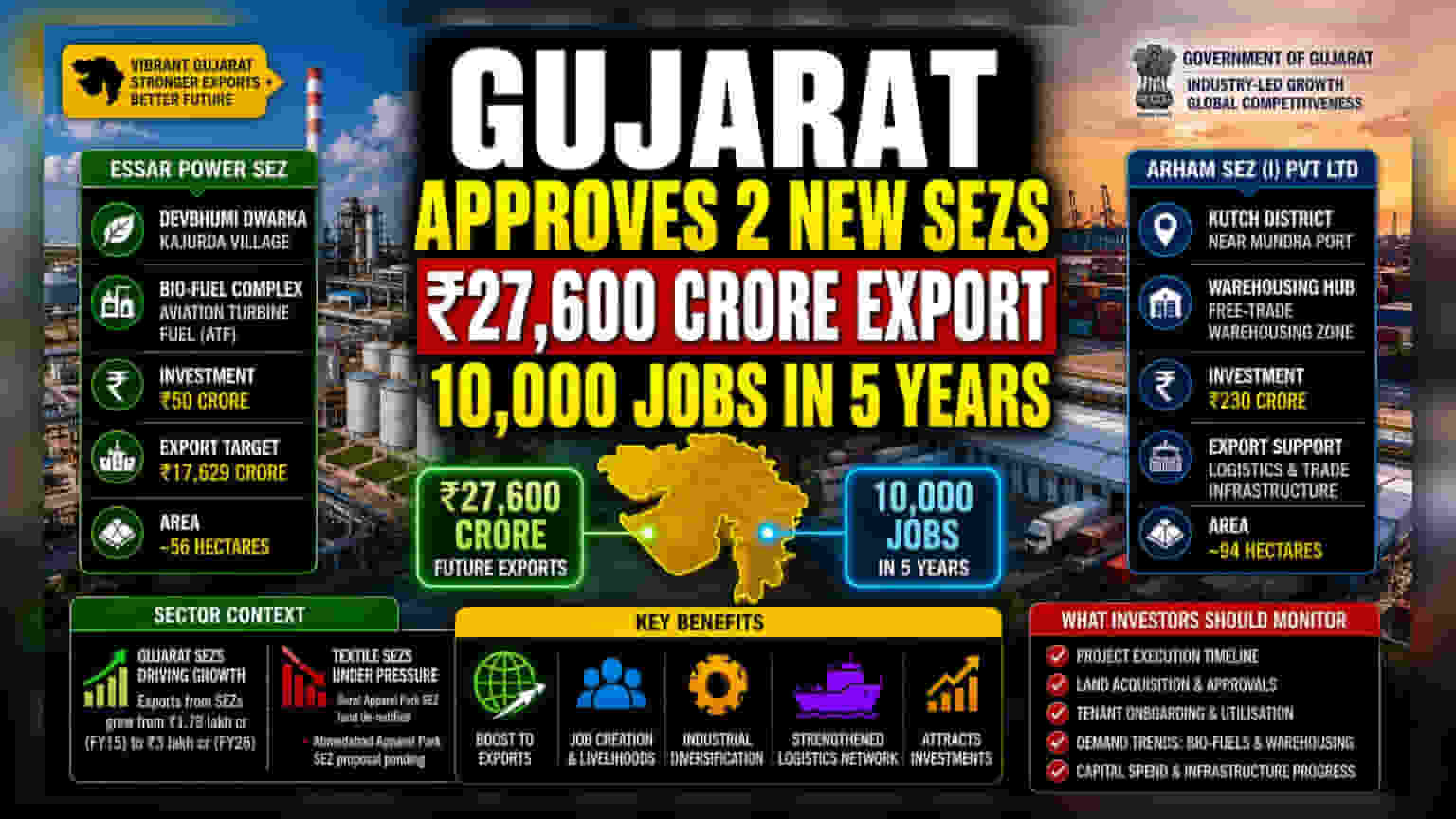


The Gujarat government has approved two new Special Economic Zones (SEZs) led by Essar Power and Arham SEZ, aiming for ₹27,600 crore in exports. While the move signals growth in bio-fuel and warehousing, investors should monitor execution risks and contrast this with the ongoing slowdown in textile-focused SEZs in the region.
What Happened
The Gujarat government has granted in-principle approval for two new Special Economic Zones (SEZs) in the state. Essar Power and Arham SEZ (I) Pvt Ltd are the primary developers for these projects, which are located in the Devbhumi Dwarka and Kutch districts. The state government expects these zones to contribute significantly to the export economy, with a target of ₹27,600 crore in future exports and the creation of nearly 10,000 jobs over the next five years.
Strategic Moves in Bio-Fuels and Logistics
Essar Power is setting up a multi-sector SEZ in the Devbhumi Dwarka district, specifically at Kajurda village. The project, which spans about 56 hectares, is centered on a bio-fuel complex intended to produce alternatives like Aviation Turbine Fuel (ATF). The company has committed an initial capital spending of ₹50 crore for this project, targeting a substantial export figure of ₹17,629 crore.
Separately, Arham SEZ (I) Pvt Ltd is developing a warehousing hub near Mundra port in the Kutch district. This 94-hectare project aims to establish a Free-Trade Warehousing Zone, with an investment plan of approximately ₹230 crore. This development aligns with Gujarat's broader effort to improve logistics and trade infrastructure, capitalizing on the state's proximity to major maritime gateways.
The Export Targets and Execution Reality
For investors, these projects represent a mix of industrial potential and execution risk. While the projected export figures are high, the initial capital investments mentioned are relatively small compared to these targets. This suggests that the real value will depend on how efficiently the companies can scale their operations and attract tenants or manufacturing units to these zones. Success here is not guaranteed; it will depend on the companies’ ability to secure necessary approvals, build infrastructure on time, and ensure consistent demand for their specific offerings, particularly in the competitive bio-fuel sector.
Sector Context and Current Challenges
Gujarat remains a dominant force in India's export landscape, with 24 operational SEZs currently accounting for over one-fifth of the nation's total SEZ exports. While the overall trend has been positive, with exports from these zones rising from ₹1.79 lakh crore in FY15 to ₹3 lakh crore in FY26, the sector is not uniform.
Investors should be aware that not all parts of the SEZ sector are performing well. Textile-focused SEZs, for instance, have struggled recently. Projects like the Surat Apparel Park SEZ have seen land de-notification, and similar proposals for the Ahmedabad Apparel Park SEZ remain pending. This highlights the vulnerability of certain sectors to weak global demand and pressure on profit margins. The contrast between the optimism for new bio-fuel or semiconductor zones and the stagnation in textile zones serves as a reminder that sector-specific trends often dictate the success of industrial infrastructure projects.
What Investors Should Monitor
The key monitorables for these new projects will be the actual timeline for construction and the ability of the developers to attract businesses to these zones. Investors tracking companies with exposure to industrial land or infrastructure in Gujarat should watch for updates on land acquisition progress, project commissioning dates, and any further updates on capital spending. Additionally, keeping an eye on broader demand trends for bio-fuels and warehousing will be crucial to assessing whether these new SEZs can achieve their stated export targets in the coming years.